Email:
 Phone:
 WhatsApp:

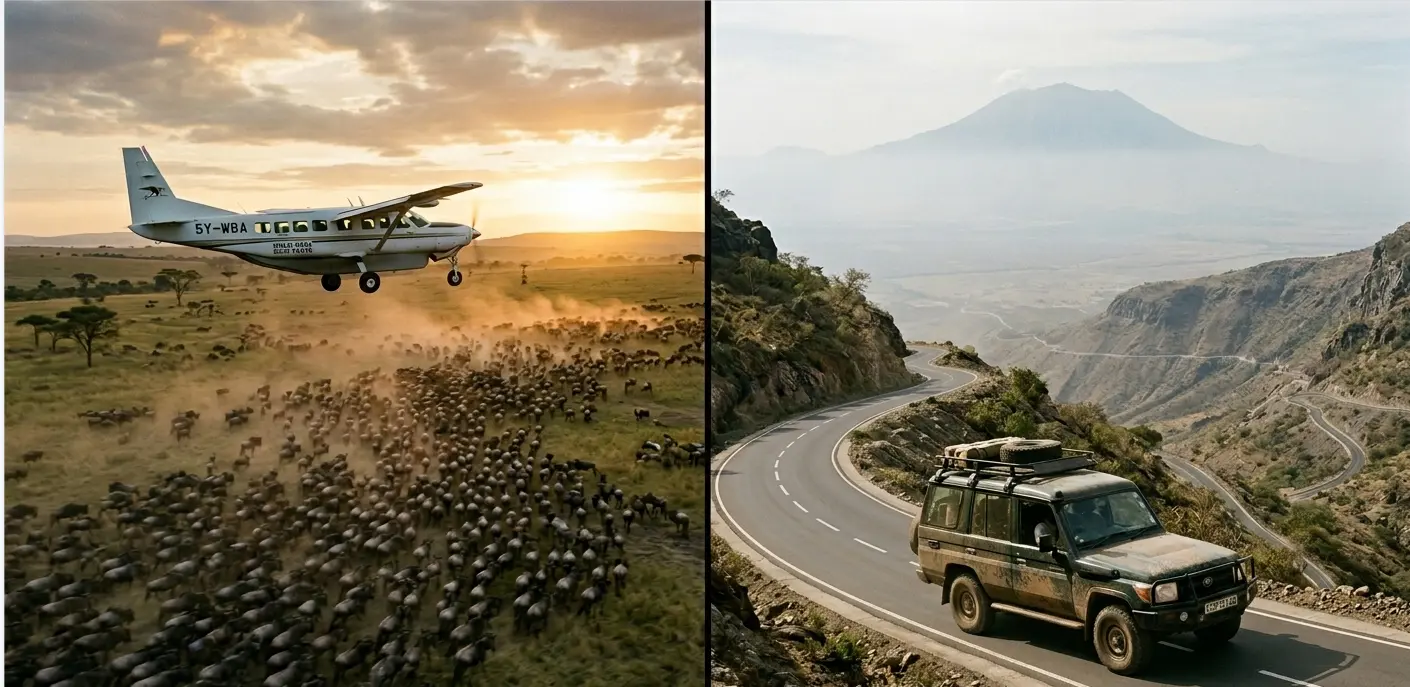
Whether it is better to fly or drive to Masai Mara in 2026 depends on one calculation: how much is an hour of game drive time worth to you compared to the cost difference between a ticket and a tank of fuel.
Flying is better than driving to Masai Mara in 2026 for time-conscious travelers—a 45-minute flight from Wilson Airport delivers 8 hours of game drive time versus 4 to 6 hours lost on the road. Driving suits scenic, budget-focused trips with flexible schedules.
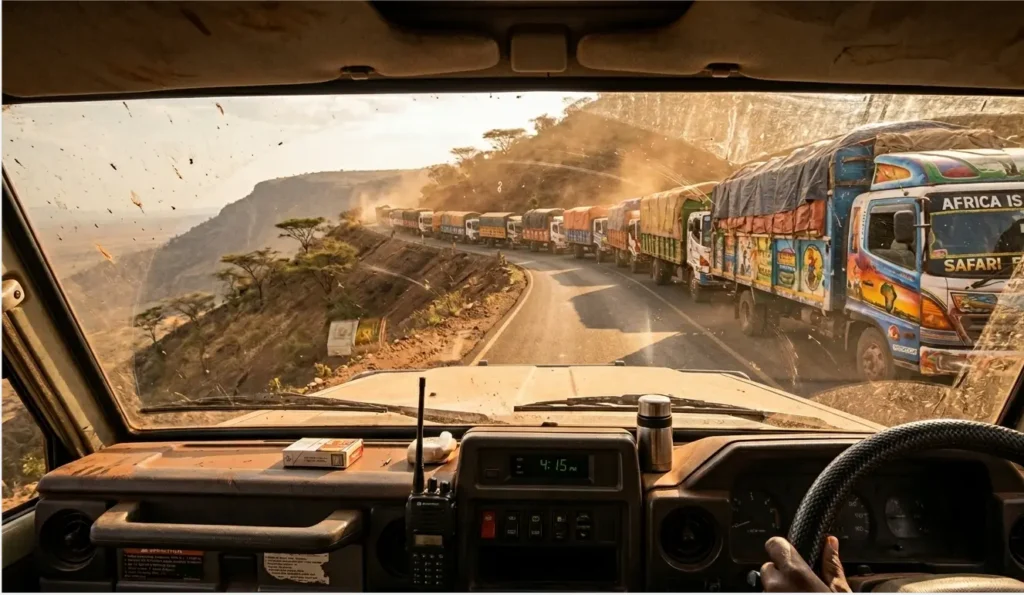
Evans, a Mara-based safari guide and Hilmuks ground partner with 1,300+ documented wildlife sightings, observed that clients who fly almost always witness the golden hour predator window that road clients miss. While generic booking platforms claim the drive from Nairobi is a predictable 5 hours, the 2026 reality on the ground is that a single truck stall on the narrow Mai Mahiu escarpment road creates multi-hour snarl-ups that can cost you your entire first evening game drive.
QUICK COMPARISON TABLE
|
Factor |
Flying |
Driving |
|
Journey time |
45 minutes |
5 to 8 hours |
|
Cost one-way |
$200 to $400 |
$80 to $150 fuel and vehicle |
|
Game drive hours gained |
6 to 8 hours |
Depends on departure time |
|
Luggage limit |
15kg soft bag only |
No limit |
|
Scenery |
Aerial Mara view before landing |
Rift Valley escarpment and Narok plains |
|
Best for |
Time-conscious, fixed itineraries |
Budget-focused, flexible schedules |
|
Hilmuks verdict |
Recommended for 2-day safaris |
Viable for 3+ day trips or groups |

Quick Navigation-Jump to Your Section
The 2026 Reality — Why the Drive Time Question Is No Longer Simple
The decision of whether to fly or drive to Masai Mara became significantly more complex in 2026 than any pre-2025 comparison guide acknowledges. While legacy travel forums still claim the drive from Nairobi is a predictable 4 to 5-hour journey on “excellent tar,” our ground team’s daily logs tell a different story. The reality is that drive time has become a high-stakes gamble due to increasing cargo traffic and frequent mechanical failures on the steep grades of the Rift Valley.
In 2026, the same journey now carries a real worst-case scenario of 8 to 13 hours during heavy rain or escarpment stalls. A single stalled truck on the narrow Mai Mahiu escarpment road can paralyze traffic for half a day, effectively eating your entire first game drive before you even reach the gate. This unpredictability is the primary reason we now actively discuss the flight option with clients who previously assumed driving was the obvious budget choice.
Driven by these road delays, many travelers look for a railway alternative, but attempting an SGR from Nairobi to Masai Mara booking instead leaves you completely stranded at a remote Rift Valley terminal.
🛡️ OPERATOR INSIGHT: The most dangerous mistake travelers make in 2026 is trusting outdated “4-hour drive” estimates from 2023. To protect your first day’s itinerary from unpredictable delays, see our Nairobi to Masai Mara drive time and route guide for the latest ground updates on the Mai Mahiu road 2026 and alternative bypass options.
A guaranteed 45-minute flight versus an unpredictable 5 to 13-hour drive is no longer a marginal difference; it is a full day’s variance that changes your entire cost calculation. While the road remains paved, the “time-cost” of being stuck behind a slow-moving convoy on the Mai Mahiu escarpment can be higher than the price of a plane ticket. We consider the drive a viable option only for those with flexible schedules or stays exceeding three days.
With the true time range established, the next question is what that time difference actually costs you—not in fuel or ticket price, but in the one currency a safari cannot replace: wildlife hours.
The 12-Hour Permit Math — When Driving Costs More Than Flying
The financial case for flying rather than driving to Masai Mara becomes most compelling when the 12-hour permit window is factored into the calculation. Most travelers assume that a park “day” lasts 24 hours, but Narok County government regulations dictate a strict gate-to-6:00 PM rule. This means your permit expires at sunset regardless of whether you entered the park at 8:00 AM or 4:00 PM.
If you choose the road and suffer a delay on the Mai Mahiu escarpment, you risk paying a full high-season fee for just a few minutes of wildlife viewing. Our ground team has seen this scenario play out repeatedly: clients arriving at Sekenani Gate at 4:30 PM, having paid $200 per person, only to have 90 minutes before they must exit the reserve.
The Game Drive Value Comparison
|
Scenario A: Driving (Late Arrival) |
Scenario B: Flying (Morning Arrival) |
|
Park Fee: $200 |
Park Fee: $200 |
|
Gate Arrival: 4:00 PM |
Gate Arrival: 11:00 AM |
|
Hours in Park: 2 Hours |
Hours in Park: 7 Hours |
|
Effective Cost/Hour: $100+ |
Effective Cost/Hour: $57 – $86 |
For solo travelers or couples on a 3-day itinerary, flying produces significantly better value per dollar when this permit math is factored in. The Wilson Airport flight might cost more upfront, but it secures an extra 5 to 6 hours of “safari ROI” that a road traveler structurally cannot access.
To simplify these calculations, our Masai Mara fly-in safari packages are structured to align arrival times with these permit windows, ensuring every dollar spent on park fees translates into active wildlife viewing.
🛡️ OPERATOR INSIGHT: The 12-hour permit math is the single calculation most road-focused guides avoid publishing because it makes the flight look like the sensible choice for short stays. We strongly recommend checking the Masai Mara park fees 2026 before deciding, as a late arrival on a 3-day trip effectively voids 33% of your total safari value on day one.
The permit math makes the financial case clearly. But the decision is not only financial—there is a wildlife experience argument for flying that has nothing to do with cost.
The Wildlife ROI — What Flying Clients See That Road Clients Miss
For wildlife photographers and first-time safari visitors, the question of whether to fly or drive to Masai Mara has a clear answer based on what each arrival window makes possible. While driving is a journey of endurance, flying is a tactical advantage that begins the moment you cross the reserve’s border from the air.
Evans notes that flying clients have a wildlife advantage that begins before the wheels touch the airstrip. The aerial approach over the reserve acts as a high-altitude scouting mission, revealing wildebeest concentrations, river crossing activity, and large predator kills that are visible from the cockpit. This bird’s-eye view allows a guide to plan the first game drive with surgical precision, heading straight to the action while road travelers are still navigating the dusty approach to the gates.
The Predator Return & Golden Hour Window
More importantly, clients who fly and reach the park by mid-morning consistently witness the “predator return window.” This is the brief, high-action period when nocturnal hunters like leopards and lions carry their kills back to thickets or drainage lines before the midday heat sets in. Road clients, arriving in the late afternoon at best, structurally miss this window and often arrive just as the big cats settle into an impenetrable sleep that lasts until dusk.
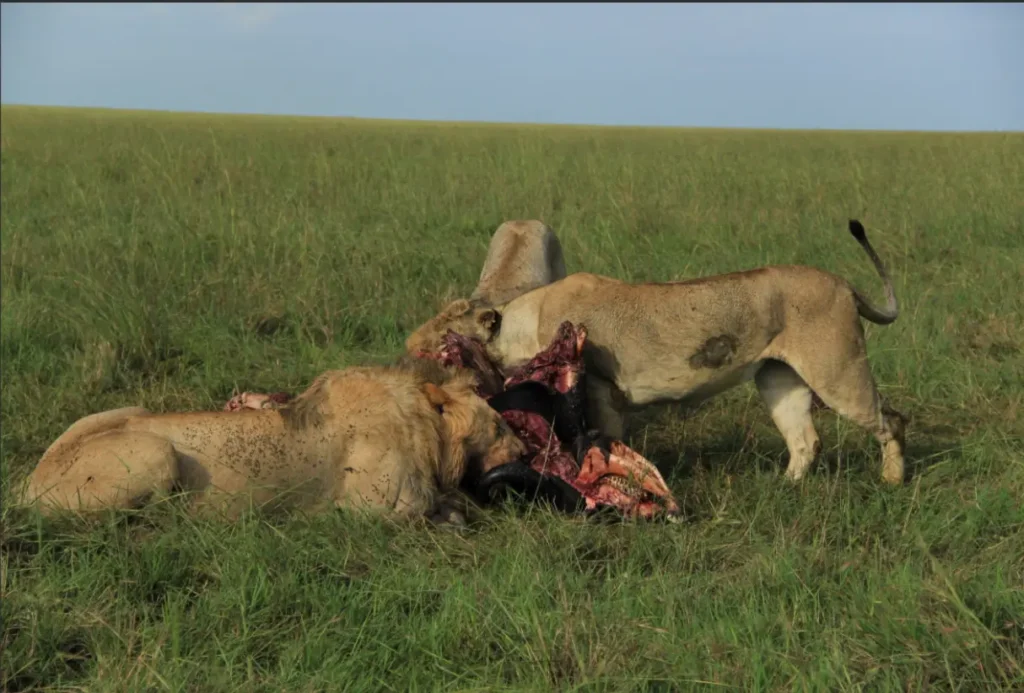
🛡️ OPERATOR INSIGHT: For serious photographers, the 10:30 AM arrival window provided by flights from Wilson Airport is non-negotiable. If you are on a short 3-Day Masai Mara Safari from Nairobi, missing the predator return on your first day can be the difference between a mid-action leopard sighting and a distant, sleeping pride.
Arriving early also ensures your first afternoon game drive catches the full “golden light” window. Predators become active again before the sun sets, but you need to be deep in the bush to catch the start of this activity. Road travelers arriving at 4:00 PM are often too fatigued from the Mai Mahiu escarpment transit to maximize these critical final hours of light.
The wildlife argument is compelling for experience-focused travelers. Now let us look at the practical logistics that most fly-versus-drive guides forget to mention—luggage, airstrips, and the operator services that make flying genuinely seamless.
The Practical Logistics — Luggage, Airstrips, and the Hilmuks Office Hack
The practical barriers to flying rather than driving to Masai Mara are real but solvable with advance planning. The primary deterrent for most travelers is the strict aircraft weight limit, which can feel restrictive compared to the unlimited trunk space of a safari Land Cruiser. Flights departing from Wilson Airport Nairobi to Masai Mara typically utilize small aircraft like Cessna Caravans, which enforce a mandatory 15kg soft-bag limit per passenger.
This means hard-sided suitcases, rigid frames, and oversized gear are structurally impossible to load into the small belly pods of these planes. For many, the thought of leaving behind city clothes or business laptops is what makes them choose the road.
While weight is non-negotiable on a Nairobi to Masai Mara helicopter, the rigid cargo constraints of standard aircraft are slightly more flexible when you control the entire cabin.
Larger groups often eliminate this trade-off by upgrading to Masai Mara private charter flights 2026, where empty seats serve as additional cabin space for hard-shell cases and heavy gear. However, this “barrier” is exactly where localized operator knowledge changes the decision.

🛡️ OPERATOR INSIGHT: Hilmuks Safaris maintains a secure luggage storage facility at our Nairobi office for both our flying and road-using clients. You can pack your essential 15kg soft safari bag for the bush and leave your heavy suitcases or laptop bags with us at no additional charge. This is a specialized service designed to make your flying safari seamless, allowing you to bypass the luggage stress that stops most people from flying.
Getting the Wilson Airport execution right determines whether your 45-minute flight actually delivers the full first-day game drive. Our complete 2026 operational checklist covers every non-negotiable detail: Nairobi to Masai Mara Flights 2026: Wilson Airport Guide.
Navigating Wilson Airport and Airstrip Arrivals
Flying to Masai Mara from Wilson Airport is a professional, streamlined experience, but it requires arriving at the domestic terminal at least 45 to 60 minutes before departure. Major carriers like Safarilink and AirKenya operate multiple scheduled flights daily, landing at various bush airstrips across the reserve.
It is crucial to know that your choice of lodge or camp determines which specific airstrip you must fly into—be it Ol Kiombo, Keekorok, Mara North, or Musiara. Your safari package typically includes a ground transfer from the airstrip to your camp, so ensure your operator has coordinated your flight arrival with the correct landing zone.
With luggage logistics solved, the decision comes down to one final question—is the road genuinely worth choosing for some travelers? The honest answer is yes, and the reasons are specific.
When to Choose the Road — The Scenery and Budget Case
The honest answer to whether you should fly or drive to Masai Mara is not always flying—the road has genuine advantages that the flight cannot replicate. While we often recommend flying for short itineraries, the overland journey offers a geographic context and a sense of scale that aerial arrivals miss. For many, the drive itself is the first chapter of the safari experience, providing a transition from the urban bustle of Nairobi to the wild plains of the Rift Valley.
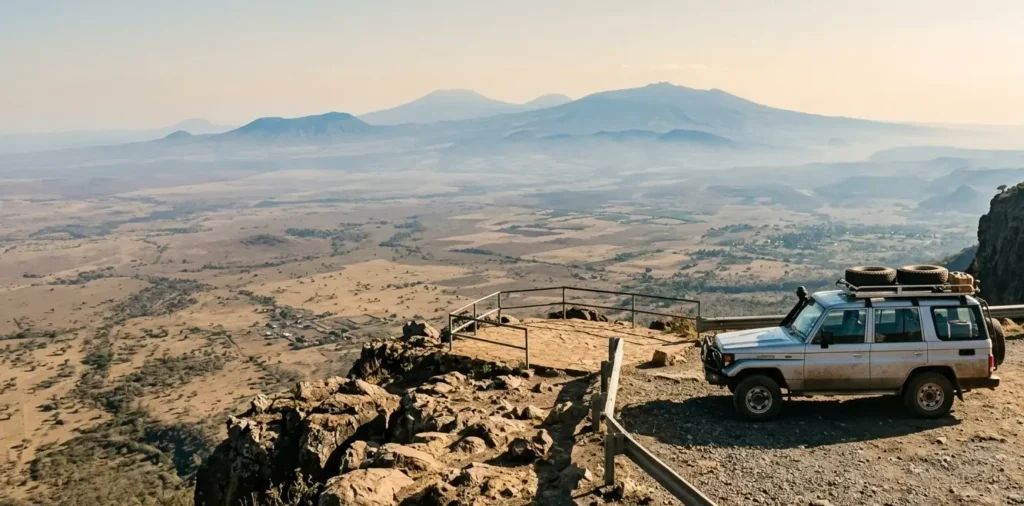
Evans considers the Mai Mahiu escarpment descent one of the most dramatic landscapes in Kenya, offering a sheer drop from the highland plateau to the valley floor with views of Mount Longonot. This route allows you to witness the changing vegetation and the vastness of the Narok plains before you even reach the reserve gates. For first-time visitors who are not under a strict time crunch, these vistas are a memorable introduction to the East African landscape.
The Budget and Flexibility Argument
For groups of four or more travelers, the road becomes financially compelling as the cost of fuel and vehicle hire is split, often equaling the price of just one flight ticket. Driving also eliminates the stress of the 15kg luggage limit, making it the practical choice for families with young children or professional photographers carrying extensive gear. Furthermore, a private vehicle grants you the freedom to stop at viewpoints or local markets in Narok, turning the transit into a curated road trip.
Splitting these vehicle expenses among multiple passengers drastically lowers your individual transit footprint. To see how these shared road dynamics compare against full lodge packages, evaluate our baseline Masai Mara safari cost matrices.
🛡️ OPERATOR INSIGHT: If you are planning to drive, timing is everything to avoid the escarpment snarl-ups we discussed. Our guide confirms that a 5:00 AM departure using the Nairobi to Masai Mara Ngong-Suswa bypass makes the journey genuinely reliable, often allowing for a 10:30 AM gate arrival that rivals the flight’s schedule.
Despite these perks, we do not recommend flying for repeat visitors who already know the reserve or those for whom the per-person flight cost multiplies into an impractical sum for a large group. However, if you are on your second or third visit, the scenic drive adds value by connecting the dots of the ecosystem that you’ve previously only seen from a landing strip.
With both cases made honestly, the final verdict depends on which traveler profile matches yours.
The Hilmuks Verdict — Which One Is Right for Your Safari?
The clearest answer to whether to fly or drive to Masai Mara depends on three variables: trip length, group size, and how much of your safari budget you are willing to spend on transit. There is no “best way” that applies to every traveler, but there is always a logically superior choice based on your specific 2026 itinerary constraints. We believe in being brutally honest about these trade-offs so you don’t spend your dream vacation looking at a truck bumper on the escarpment.
The Decision Matrix
I recommend using the following criteria to make your final Masai Mara travel decision 2026:
You should FLY if:
- Your safari is 3 days or fewer—the strict 12-hour permit math means every arriving hour is worth roughly $30-$50 in “sighting value.”
- You have a fixed international return flight—road unpredictability makes missing a connection a real and expensive risk.
- You are a solo traveler or couple where the per-person flight cost isn’t being multiplied by a large family budget.
- This is your first Mara visit and you want to prioritize the predator window over the road journey.
You should DRIVE if:
- Your safari is 3 days or more—the “permit loss” of a late first-day arrival is diluted over a longer stay.
- You are a group of four or more—splitting fuel and vehicle costs makes the road significantly cheaper than four flight tickets.
- You have non-negotiable heavy gear or hard-sided luggage that cannot be stored at our Nairobi office.
- You are a repeat visitor who values the “slow travel” experience of the Rift Valley and Narok plains.
The Hilmuks Default Recommendation
For most international visitors on a tight schedule, flying is the only operationally sensible choice in 2026. Between the Mai Mahiu traffic snarl-ups and the wildlife window advantage our guides consistently observe, the extra cost of the flight is an investment in the quality of your sightings. Our ground team consistently observes that clients who fly report higher satisfaction because they arrive with energy rather than road fatigue and permit anxiety.
🛡️ OPERATOR INSIGHT: If you have decided to fly, our 3-Day Masai Mara flying package is designed to solve every logistical hurdle mentioned in this guide. We provide seamless ground transfers from the airstrip, secure luggage storage at our Nairobi office for your city bags, and our experienced guides’ real-time ground intelligence to ensure you hit the predator tracks the moment you land.
Conclusion
The fly or drive decision for Masai Mara in 2026 is ultimately a permit math question disguised as a budget question. Flying costs more upfront but delivers more game drive hours for the same permit price. Driving costs less but only produces equal or better value when departure timing is controlled and the escarpment cooperates. For a 2-3-day safari, fly. For a 3-5-day trip with a flexible start time and a group of four, drive. The bush does not care how you arrived — it cares how many hours you have before the 6:00 PM close.
FAQ — Expert Answers on Flying vs Driving to Masai Mara
Is it better to fly or drive to Masai Mara
Flying is better than driving to Masai Mara in 2026 for most first-time visitors on short itineraries. A 45-minute flight from Wilson Airport delivers 6 to 8 additional game drive hours compared to road travel, and the Masai Mara’s strict 12-hour permit window means a late road arrival can cost the equivalent of the flight price in wasted permit time. Driving is better for groups, longer stays, and travelers who value the Rift Valley scenery as part of the experience.
How much does it cost to fly from Nairobi to Masai Mara?
Scheduled flights from Wilson Airport to Masai Mara airstrips with Safarilink or AirKenya typically cost between $200 and $400 per person one-way in 2026 depending on the season and booking timing. Charter flights cost significantly more. The Masai Mara high-season park entry fee of $200 per person applies regardless of whether you fly or drive.
How long does it take to fly to Masai Mara from Nairobi?
The flight from Wilson Airport to Masai Mara airstrips takes approximately 45 minutes. Including check-in, boarding, and the airstrip-to-lodge transfer, door-to-door time is typically 2 to 2.5 hours from central Nairobi. By comparison, driving from Nairobi to Sekenani Gate takes 5 to 8 hours depending on road conditions and departure time.
What is the luggage limit for flights to Masai Mara?
Flights to Masai Mara operate on small aircraft with a strict 15kg soft-bag limit per passenger. Hard-sided suitcases are not permitted on board. Hilmuks clients who fly can store excess luggage at our Nairobi office at no charge, allowing you to travel to the reserve with a compliant soft safari bag while your city luggage remains secure.
Is it safe to drive from Nairobi to Masai Mara?
Driving from Nairobi to Masai Mara is generally safe in 2026. The main risks are road fatigue on the Mai Mahiu escarpment, unpredictable delays caused by the traffic snarlups on the Escarpment, and the time pressure of arriving late relative to the Masai Mara’s 12-hour permit window. Using the Ngong-Suswa bypass for early morning departures significantly reduces road risk and time variability.
Which airstrip should I fly into for Masai Mara?
The airstrip you use depends on your lodge or camp location. The main Masai Mara airstrips include Ol Kiombo, Keekorok, Mara North, and Musiara. Your safari operator or lodge will specify which airstrip serves your accommodation — confirm this before booking your flight as routes and availability differ between airstrips.
Can you fly from Masai Mara to Serengeti directly?
Yes — scheduled charter connections exist between Masai Mara airstrips and Serengeti airstrips in Tanzania, making a Kenya-Tanzania combined safari itinerary possible without returning to Nairobi. These routes are operated by charter companies rather than scheduled carriers and must be arranged in advance through your safari operator. Pricing varies significantly by season and group size.