Email:
 Phone:
 WhatsApp:

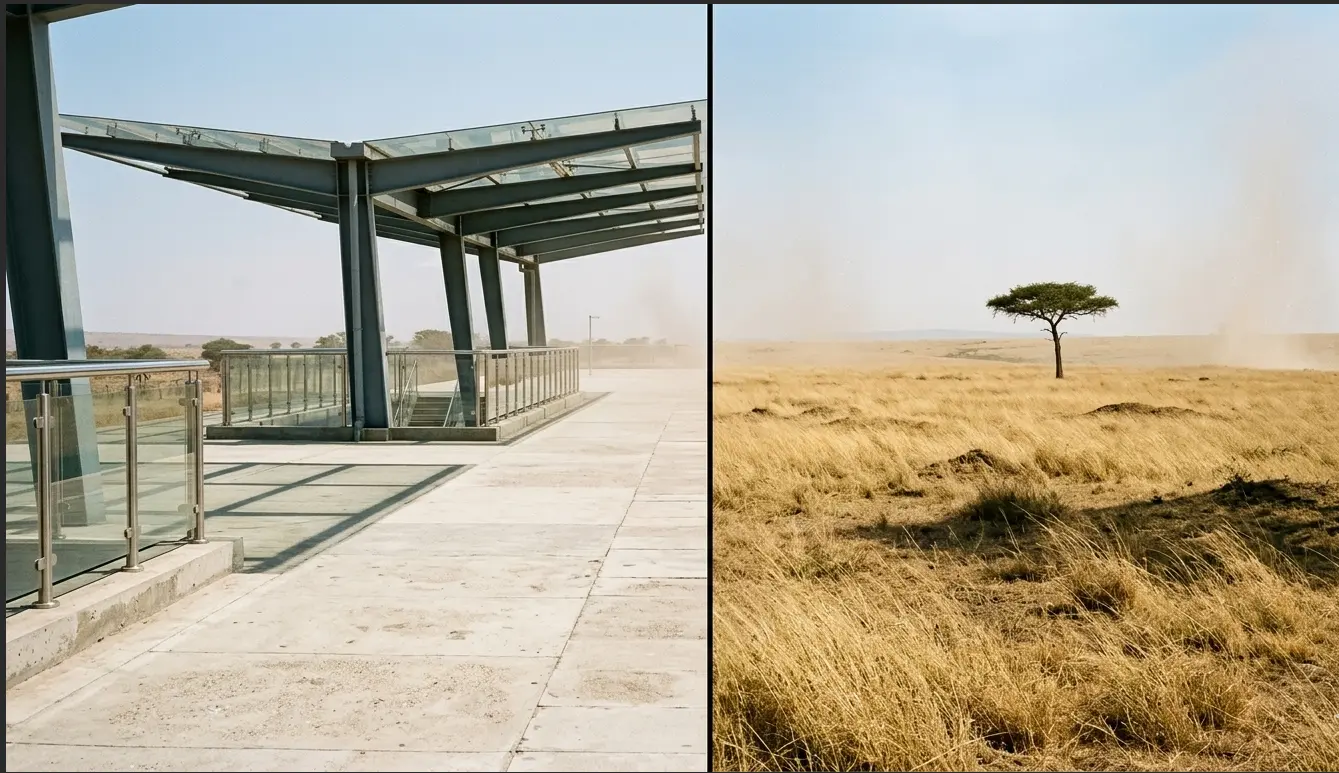
The SGR from Nairobi to Masai Mara does not exist—and that single fact has stranded real travelers at a station 180km from the nearest park gate with no way forward except an emergency phone call to an operator and an unexpected private vehicle cost.
No—you cannot take the SGR from Nairobi to Masai Mara. The train terminates at Suswa station, approximately 180km from the nearest Masai Mara gate. There is no public transport, no taxi rank, and no Uber coverage at Suswa. A private vehicle transfer is the only option from Suswa to the reserve.
Evans Kimojino, a Mara-based safari guide and Hilmuks ground partner with 1,300+ documented wildlife sightings, confirms this is the most common transport planning mistake he encounters among travelers researching the Mara independently. The question “can I take the train to the Mara?” arrives in our enquiries regularly—and the honest answer requires more than a one-sentence no. When travelers use automated tools for an SGR from Nairobi to Masai Mara online booking, they see “Narok County” on the destination confirmation and assume the logistics are solved.
This article exists because the Kenya Railways SGR Madaraka Express runs from Mombasa through Nairobi to Suswa. Suswa is located in Narok County, and Narok County is the same administrative region where the Masai Mara National Reserve sits. A traveller looking at a map or asking an unverified source on the train can easily connect those dots and reach a costly conclusion: that the Suswa terminal puts them close to the wildlife. Below, we break down the exact geographical scale of this mistake, what happens when independent travelers act on it, and the only three practical transit methods you should actually use to reach the gates safely.
QUICK REFERENCE TABLE
|
Question |
The Answer |
|
Does the SGR go to Masai Mara? |
No — it terminates at Suswa |
|
How far is Suswa from Masai Mara gate? |
Approximately 180km |
|
Is there public transport from Suswa to Masai Mara? |
No — zero public transport |
|
Is there Uber at Suswa? |
No — poor network, no Uber vehicles |
|
Is there a taxi rank at Suswa? |
No |
|
Can I take SGR from Mombasa to Masai Mara? |
No direct route exists |
|
Best alternative to SGR? |
Drive directly from Nairobi or fly from Wilson Airport |
Quick Navigation-Jump to Your Section
The Suswa Station Reality — Why the SGR Route Stops 180km Short of the Mara
The Standard Gauge Railway Madaraka Express runs from Mombasa through Nairobi and extends westward into the Great Rift Valley, terminating at Suswa station. Because Suswa is geographically located within Narok County—the very same administrative county that contains the Masai Mara National Reserve—independent travelers often jump to a logical but highly incorrect conclusion. They assume that booking the SGR from Nairobi to Masai Mara is a connected, continuous transit route.
In reality, the physical rail line stops dead at Suswa, leaving a massive 180-kilometer geographical gap between the train platform and the nearest reserve gates like Sekenani or Talek. This distance spans rugged rural stretches, heavy terrain, and the busy transit hub of Narok town, turning an assumed quick transfer into a grueling, multi-hour overland journey. Attempting to navigate the SGR from Nairobi to Masai Mara timetable to save time backfires completely because the rail line does not factor in the massive geographical scale of southwestern Kenya.
The Madaraka Express commuter service to the Suswa extension operates on a highly restrictive, limited weekly calendar rather than a standard daily commuter rotation. To confirm the active operational days for your specific travel window, you should verify the live departures on the official Kenya Railways Corporation passenger portal at metickets.krc.co.ke. Relying on fixed, third-party blogs for the precise SGR from Nairobi to Masai Mara schedule is a significant risk, as Kenya Railways updates these timetables periodically based on seasonal demand and track maintenance.
🛡️ OPERATOR INSIGHT: If you are trying to piece together a rail-based itinerary across the southwestern circuit, you must look closely at where the physical tracks actually lead. The rail line layout forks sharply north of the Mara plains, which is why we highly recommend reading our comprehensive Nairobi to Nakuru by SGR train guide to understand the real network split before spending money on non-refundable tickets.
Our field teams stationed on the ground confirm that Suswa station lacks basic public transit infrastructure, featuring no operational taxi ranks, no car rental desks, and absolutely zero ride-sharing coverage due to poor cellular network signals in the valley. A traveler arriving at the terminal without a pre-arranged private 4×4 safari vehicle waiting for them on the platform will find themselves completely stranded in a remote rural area. No reliable matatu or public bus service services the route between the Suswa station platform and the remote safari gates.
This logistical breakdown is caused by a classic “map scale trap,” where a compressed digital map makes two points in the same county look deceptively close together. While Suswa sits directly on the eastern border of Narok County, the wildlife reserve occupies the far southwestern corner, separated by miles of unpaved wilderness roads that degrade rapidly during wet seasons. Now that you understand the physical layout of the railway terminus, let’s look at the actual mathematics of ticket pricing versus unexpected wilderness rescue fees.
The Real Cost — SGR Ticket Price vs the Private 4×4 Rescue Mathematics
At first glance, attempting to route your journey via the SGR from Nairobi to Masai Mara looks like an incredible budget hack. The individual standard commuter seat fare from Nairobi to Suswa listed on the official Kenya Railways ticketing platform is undeniably cheap. For independent, budget-conscious travelers mapping out their itineraries for 2026, this massive price difference makes the rail option appear far superior to paying upfront for a private 4×4 safari cruiser to drive all the way from the capital.
However, looking strictly at the upfront passenger ticket fare creates a massive financial illusion. If you buy tickets online and take the train to Suswa, you cannot simply hail a budget taxi at the terminal to complete your journey to the reserve gates. Instead, an established safari operator must dispatch an empty 4×4 cruiser from their garage in Nairobi down to the Rift Valley floor solely to rescue you. Because Suswa sits roughly 80km down the highway from Nairobi according to the Kenya National Highways Authority classification records, you are forced to pay for a specialized vehicle to drive out to the station empty, wait for your arrival, and then embark on the grueling 180km overland transit to the park gates.
When you calculate the true financial data, the real SGR from Nairobi to Masai Mara price becomes painfully clear. The total mathematics look like this: the initial train ticket cost, plus the heavy premium of hiring an empty rescue vehicle from Nairobi, plus the fuel required to cover the Suswa-Narok-Sekenani link. According to official Narok County Government operational rules, wildlife reserve entry permits run on a strict, non-negotiable clock that expires at 6:00 PM daily. Because you must sit at a remote station with zero traveler facilities waiting for your private transfer vehicle to arrive, you waste critical morning hours that eat directly into your evening game drive window.
🛡️ OPERATOR INSIGHT: At Hilmuks Safaris, when a client asks us about using the train option to cut costs, our logistical calculation is immediate: the combined cost of the train fare, the empty vehicle dispatch premium, and the lost hours against the park gate permit clock always exceeds the cost of a direct Nairobi departure. Trying to stitch together this rail connection is not cheaper; it is significantly more expensive in total and produces a highly stressful transit experience.
Now that we have exposed the flawed financial math of this transit route, let’s look at a real-world scenario where this exact mistake completely upended a group itinerary.
The Real Cost — A Hilmuks Client Case Study
Evans describes the most costly real-world example of the Suswa mistake our team has managed directly on the ground. A client traveling from Diani on the Kenyan coast was booked on a classic budget group safari departing from our main Hilmuks Nairobi office. While riding the standard Madaraka Express train from Mombasa to Nairobi, he struck up a casual conversation with a fellow passenger about using the SGR from Nairobi to Masai Mara. The passenger mentioned that the westward line extensions ran all the way into Suswa, which is located deep within Maasai territory.
The client reasoned that Maasai land and the core reserve boundaries were effectively the same geographic place. Acting without consulting our office, he decided to completely bypass his Nairobi meeting point and alight early at the Suswa terminal. He assumed he could use standard regional transit options to hop straight into camp, cutting off the traditional road transfer entirely.
The frantic distress call came through to our office after the client had already stepped off onto the platform and found himself completely isolated. Because we were operating on a fixed itinerary with a full vehicle of other safari-goers, our group cruiser had to depart from the city on time without him. Our driver had to immediately pull an additional 4×4 cruiser from our city garage and dispatch it as an emergency rescue vehicle to Suswa. The client reached the park gates long after the sun went down, losing his entire first day of wildlife viewing due to a simple misunderstanding about how an SGR from Nairobi to Masai Mara online booking actually works.
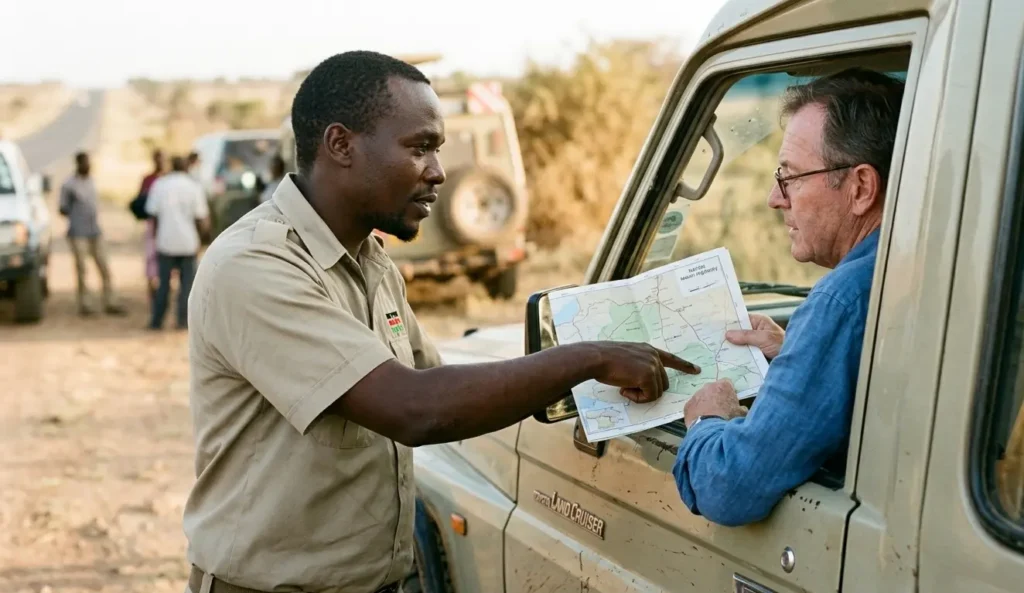
This error was not born out of carelessness, but rather from an incorrect inference based on partial geographic facts. While Suswa is historically a Maasai territory, the actual reserve boundary sits massive miles away over rough terrain.
If You Are Already at Suswa — What to Do Right Now
If you are reading this guide directly from your phone while standing on the platform at Suswa station with no onward transport arranged, you must secure an official rescue vehicle immediately. Do not wander outside the main station perimeter expecting to find a local transport office, as there are no registered matatus or local taxis servicing the reserve route from this point.
You will need to call a registered safari provider in Nairobi to dispatch an empty 4×4 cruiser to your exact location. Be prepared to clear a premium private transfer rate, as a specialized vehicle must drive empty out of the capital to collect you and complete the long journey through Narok. You can reach out directly to the emergency contacts listed on our main platform, and our dispatch desk will coordinate the fastest available field driver to come out and salvage your itinerary.
Having looked at how an unverified rail transfer can completely fracture a travel itinerary, let’s explore how coastal travelers face unique logistical confusion when mapping out their routes from Mombasa.
Coastal Travellers — The Mombasa Route Confusion
Travellers planning a bush-and-beach holiday from the Kenya coast—including Mombasa, Diani, or Malindi—frequently fall into a parallel version of the Suswa transit misunderstanding. When mapping out their cross-country connections, many beach-goers search for a direct 2026 rail corridor linking the coast directly to the southwestern plains. Our safari logistics team frequently intercepts enquiries asking if the high-speed SGR from Mombasa to Masai Mara can bypass the capital completely.
The structural reality of the Kenya Railways network makes this completely impossible. Our ground team confirms that there is absolutely no direct SGR from Mombasa to Masai Mara, as the standard Madaraka Express coastal line terminates strictly at the Syokimau Nairobi Terminus. To head toward the western circuit via rail, a train would have to switch onto the entirely separate, westward Suswa commuter branch, which only leaves the capital on a highly restrictive weekly schedule.
[Mombasa Terminus] ---> SGR Coastal Line ---> [Nairobi Terminus] (End of Coast Line)
                                                      |
                                           Must switch to separate line
                                                      |
                                                      v
                                            [Suswa Station] (Stops 180km short of Mara)
The correct, operator-approved sequence for a coastal traveler always requires treating Nairobi as the primary, mandatory hub. You must first take the Madaraka Express from Mombasa to Nairobi, and then transition to either a direct highway drive in a 4×4 safari cruiser or book a scheduled flight out of Wilson Airport. Attempting to use the westward rail extension from the capital provides zero competitive advantage for a coastal traveler, as it adds a complex rail transfer point while still dropping you 180km short of the reserve gates.
🛡️ OPERATOR INSIGHT:: Be highly cautious of online itineraries marketed broadly as “SGR Safari Packages” departing from the coast. These commercial tour packages are legitimate, but they do not use a hidden rail link to enter Masai Mara territory; they simply use the train to cover the Mombasa-to-Nairobi highway section before converting to a standard road vehicle or a domestic flight. Misinterpreting these package titles as a continuous train journey will leave you stranded at an intermediate rail platform with your bags, far away from your booked lodge.
Now that we have untangled the structural layout of the coastal railway network and its endpoints, let’s analyze the only three proven, reliable transit methods you should use to safely reach the reserve.
The Honest Alternatives — Three Proven Ways to Get from Nairobi to Masai Mara
Because relying on the SGR from Nairobi to Masai Mara leads travelers into an expensive logistical dead-end, you need a straightforward, operational alternative to reach the reserve safely. Our ground teams use three main highway and air corridors every single week to transport guests seamlessly from the capital straight to the plains. By abandoning the train route, you eliminate mid-journey vehicle transfers and ensure your transit aligns perfectly with official gate protocols.
Alternative 1: Drive Directly from Nairobi (The Logistics Standard)
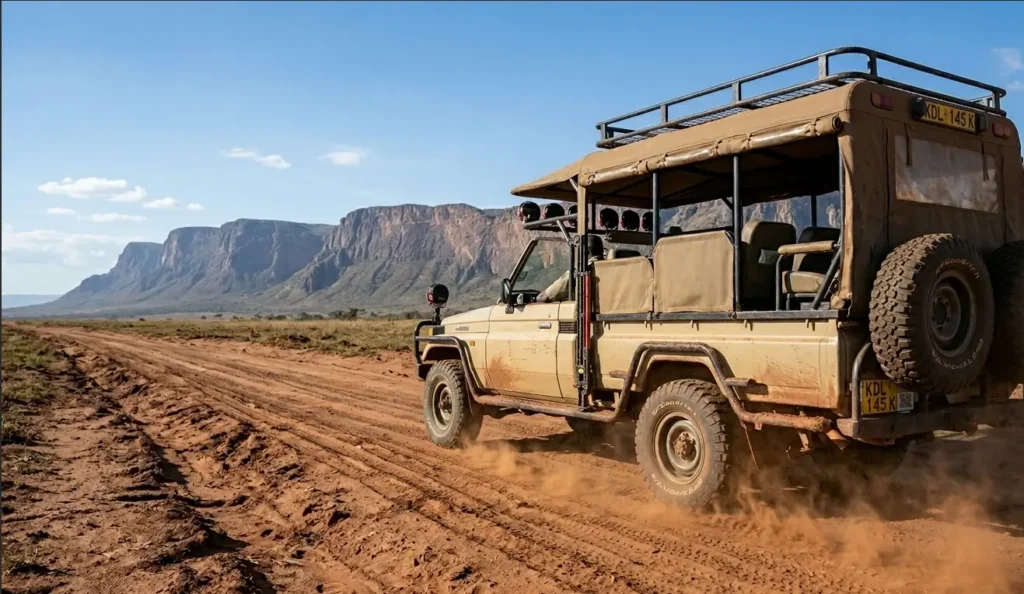
The most practical, reliable, and cost-effective approach for families or small groups is a direct overland drive from the capital in a specialized safari vehicle. A typical itinerary begins with a 6:00 AM hotel departure to beat the city traffic, bringing you to the main reserve gates in approximately 5 to 8 hours depending on weather and regional road conditions. The defining operational advantage here is that the vehicle leaving your hotel is the exact same custom 4×4 cruiser that will conduct your daily game drives inside the reserve. Your entry ticket clock—which is strictly monitored by the Narok County Government at all physical checkpoints—starts running only when you cross into the reserve, rather than ticking away while you sit stranded at a rural rail platform.
Alternative 2: Fly from Wilson Airport (The Premium Time-Saver)
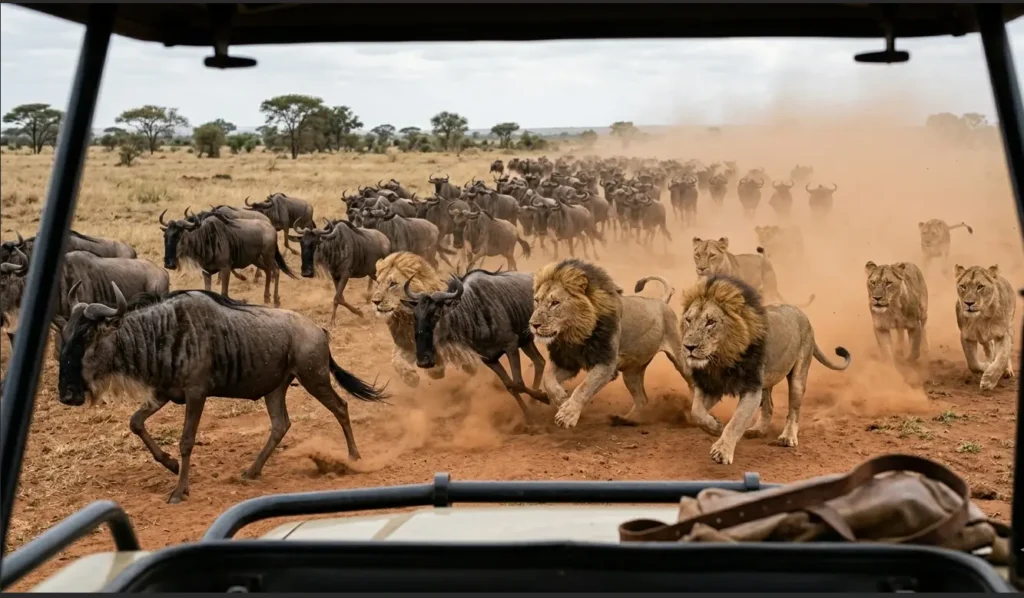
For independent travelers on a tight schedule, those with strict luggage limits, or anyone arriving during the peak Great Migration season, a domestic flight is the ultimate logistical bypass. Scheduled flights depart from Wilson Airport daily and land on the dirt airstrips inside the reserve in just 45 minutes flat. This air bridge saves you up to 7 hours of transit on your arrival day, converting grueling highway miles into immediate, premium wildlife viewing opportunities within your initial 24-hour park permit window.
Alternative 3: Drive via Alternative Bypass Corridors
While the standard Nairobi–Narok tarmac highway remains the default overland option, our professional drivers routinely analyze regional traffic patterns to utilize lesser-known bypasses. Transitioning through the scenic Kijabe escarpment route or taking the lower Ngong–Suswa bypass can save significant time when heavy commercial freight clogs the primary highway. These alternative route choices and seasonal road conditions are analyzed completely in our fly or drive to Masai Mara full comparison.
🛡️ OPERATOR INSIGHT: If you want to avoid common tarmac delays and map out an efficient overland itinerary, see our comprehensive Nairobi to Masai Mara drive time guide to learn more on how to beat the city traffic and choose the absolute best departure windows for your group. For travelers who prefer an airborne arrival that skips the highway network altogether, see our Nairobi to Masai Mara flights guide to quickly secure regional airstrip schedules and provider terminal details.
Our firm operational stance for 2026 remains unchanged: a direct highway drive with a trusted local operator represents the absolute best balance of cost and reliability for the majority of travelers. For those looking to avoid unpaved roads entirely, a domestic flight out of Wilson Airport is the only true logistical shortcut. Trying to utilize the SGR from Nairobi to Masai Mara price model to cut costs will always result in a net financial loss and a broken itinerary.
Conclusion — SGR from Nairobi to Masai Mara
The SGR from Nairobi to Masai Mara does not exist — and the Suswa extension, however convenient it looks on a map, is 180km from the nearest gate with nothing waiting at the other end. The real cost of the Suswa mistake is not just the rescue vehicle fee — it is the lost game drive hours and the disrupted group itinerary that follows. At Hilmuks Safaris, we put it simply: drive from Nairobi with an operator who knows the route, or fly from Wilson. The train is not a Mara option in any practical scenario.
FAQ — Expert Answers on the SGR from Nairobi to Masai Mara
Can you take the SGR from Nairobi to Masai Mara?
No. There is no SGR route from Nairobi to Masai Mara in 2026. The Madaraka Express passenger service extends from Mombasa through Nairobi to Suswa, but Suswa is approximately 180km from the nearest Masai Mara gate. There is no public transport connecting Suswa to the Masai Mara — only a pre-arranged private vehicle can complete the journey from the station to the reserve.
What is the SGR ticket price from Nairobi to Suswa?
SGR ticket prices from Nairobi to Suswa are available on the official Kenya Railways booking platform at metickets.krc.co.ke. We advise checking directly there for current fares as prices are updated periodically. Note that the train ticket price does not include the cost of a private vehicle transfer from Suswa to the Masai Mara — which is required and adds significant cost to the total journey.
What is the SGR timetable from Nairobi to Masai Mara?
There is no SGR timetable from Nairobi to Masai Mara because this route does not exist. The Madaraka Express runs a limited weekly schedule from Nairobi to Suswa on specific days. For current departure times check metickets.krc.co.ke. Arriving at Suswa on the train leaves you 180km from the Masai Mara gate with no onward public transport — the timetable is therefore only relevant to travellers who have a pre-arranged private vehicle waiting at Suswa.
How far is Suswa from Masai Mara?
Suswa station is approximately 180km from the nearest Masai Mara National Reserve gate. The drive from Suswa through Narok town to Sekenani or Talek gate takes approximately 3 to 4 hours in a suitable 4×4 vehicle. There is no public transport covering this route — a private vehicle is required.
Is there public transport from Suswa to Masai Mara?
No. Our ground team confirms there is no public transport connecting Suswa station to the Masai Mara National Reserve. There is no taxi rank at Suswa, no Uber coverage due to poor mobile network and absence of Uber vehicles in the area, and no regular matatu service on the Suswa to Narok to Mara route. A pre-arranged private vehicle from an operator is the only practical onward transport option from Suswa.
Can you take the SGR from Mombasa to Masai Mara?
No. The Madaraka Express from Mombasa terminates at Nairobi — not at the Masai Mara. From Nairobi, travellers must then either drive to the Masai Mara by road or fly from Wilson Airport. Some operators market “SGR safari packages” from Mombasa that use the train to reach Nairobi as part of the travel experience — but these are Nairobi-to-Mara packages by road or air, not train-to-Mara packages.
What is the best way to get from Nairobi to Masai Mara?
The two most reliable options are a direct road drive from Nairobi to the Masai Mara gate with a professional safari operator — typically 5 to 8 hours depending on route and conditions — or a flight from Wilson Airport to a Mara airstrip in approximately 45 minutes. The road drive is the most cost-effective for groups. The flight is the best time-saving option for clients who cannot afford to lose a half-day to road travel, particularly during peak migration season.