Email:
 Phone:
 WhatsApp:

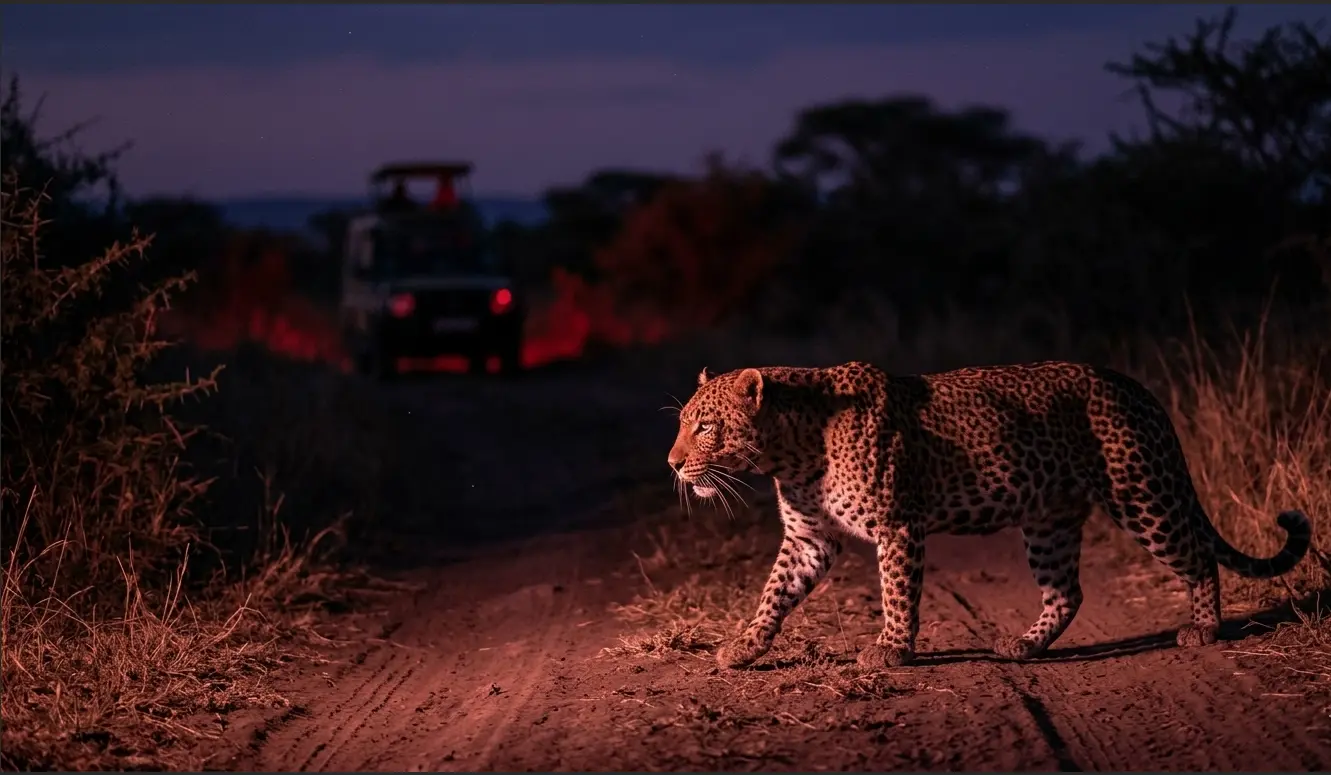
A night game drive Masai Mara experience exists—but only in the private conservancies surrounding the national reserve, and only when booked through the specific lodge you are staying at. If your camp is inside the main reserve, night drives are not available to you at any price.
Night game drives are completely prohibited inside the Masai Mara National Reserve in 2026. All reserve gates close at 6:00 PM and no vehicles may remain on the tracks after dark. Night game drives are fully legal and available in the surrounding private conservancies — but only through your lodge.
Evans Kimojino, a Mara-based safari guide and Hilmuks ground partner with 1,300+ documented wildlife sightings, has conducted night game drives across multiple private conservancies in the Mara ecosystem. His direct observations on the red light protocol, the nocturnal species most consistently located, and the cold reality of the open plains after dark form the verified foundation of this guide.
Most safari planning starts with accommodation—then clients discover after booking that their reserve lodge cannot offer an evening safari or any form of night safari kenya tracking. Understanding the jurisdictional split before you book changes your accommodation decision entirely. This guide covers what the rules actually are, how night drives are accessed, what you will see, and what you need to bring.
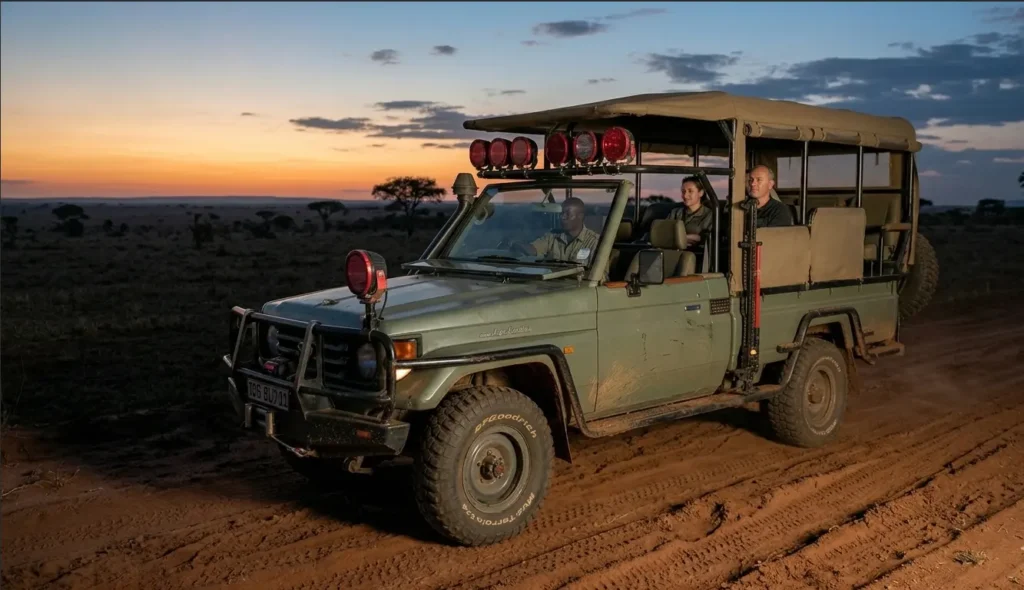
Because these night drives happen exclusively in conservancies, they operate under separate fee structures from the National Reserve—for the reserve’s 12-hour park fee mechanics, see our Masai Mara park fees and 12-hour rule guide.
Night Game Drive Masai Mara 2026 — Quick Reference
|
Operational Variable |
Ground Reality |
|
Legal location |
Private conservancies only — completely prohibited in the National Reserve |
|
Reserve gate time |
6:00 PM — all vehicles must be out or parked |
|
Booking method |
Through your conservancy lodge only |
|
Self-drive |
Completely prohibited — authorised guide mandatory |
|
Spotlight standard |
Red-filtered only — white light prohibited |
|
Primary nocturnal targets |
Leopards, hyena clans, bush babies, genets, civets, serval cats, bat-eared foxes |
|
Pricing |
Variable by conservancy and lodge — confirm at booking |
|
Temperature |
Drops to 12°C or below by 9PM — technical layers plus Masai Shuka required |
|
Photography gear |
High ISO body, f/2.8 or faster lens, spare batteries essential |
Quick Navigation-Jump to Your Section
The Reserve Ban vs Conservancy Rules — The Jurisdictional Hard Line
Night game drives are completely prohibited inside the Masai Mara National Reserve under Narok County Government regulations. All visitor vehicles must be off the tracks and out of the reserve through the gates by exactly 6:00 PM. Ranger patrols enforce this dusk curfew strictly, deploying vehicle checkpoints at key junctions to hand out steep fines to any stranded operators.
The National Reserve operates as a public protected area where daylight hours are tightly regulated for revenue management and wildlife resting cycles. After 6:00 PM, nocturnal wildlife activity is shielded from standard tourist vehicles to prevent headlight glare from disrupting predator hunting patterns. This makes it logistically impossible to experience a night game drive Masai Mara safari within the public reserve boundaries.
The private conservancies surrounding the reserve—such as Mara North, Olare Motorogi, and Naboisho—operate under separate community-led frameworks that legally permit authorized lodge vehicles to track wildlife after dark. These private properties usually allow evening tracking until 10:00 PM, offering an exclusive alternative to a standard game drive masai mara. To plan your bookings correctly, you must decide on your location before paying any park fees.
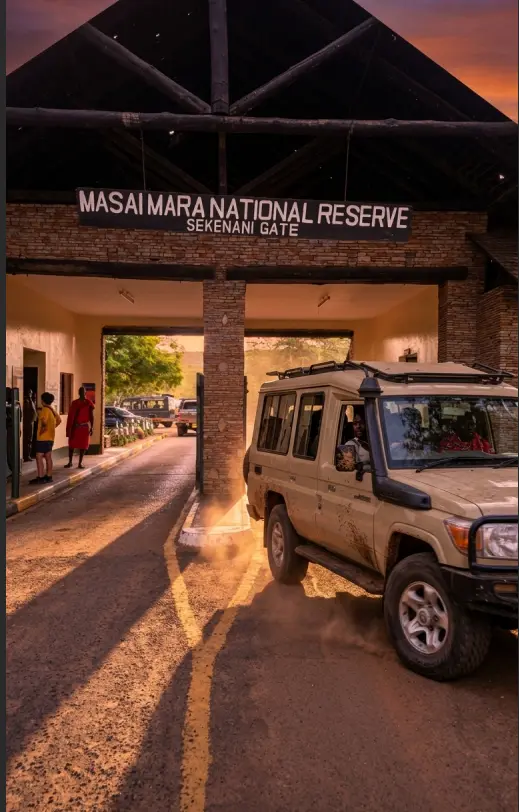
🛡️ OPERATOR INSIGHT: The most common night drive disappointment we see is a client booking a National Reserve lodge for the river crossing access, then arriving and discovering night drives are completely unavailable. A split-stay itinerary—two nights in the reserve for crossings and three nights in a conservancy for night drives—resolves this without compromise. If you are still weighing your accommodation options, read our detailed Masai Mara National Reserve vs Conservancy guide to find the perfect geographic fit for your safari goals.
Now that you know where the legal boundaries are drawn on the savannah, let’s look at the specialized tools required to spot predators in the dark…
The Red Light Protocol — Why Ethical Night Tracking Uses No White Light
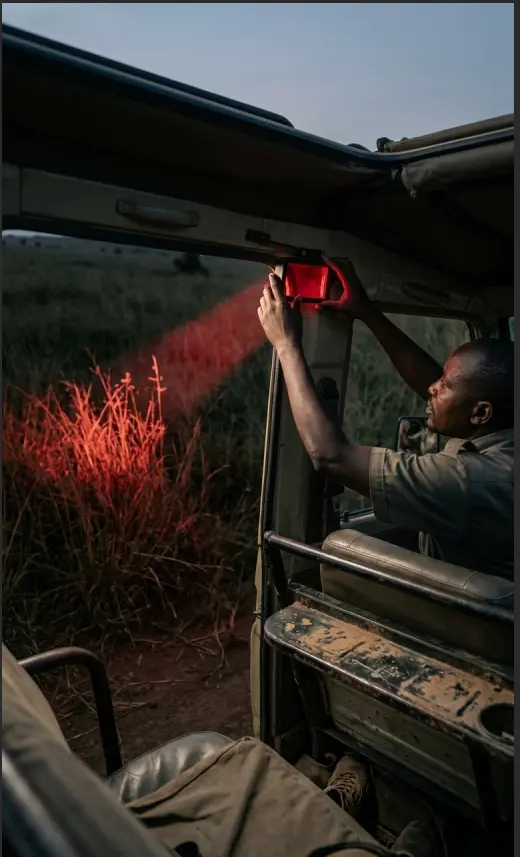
Our ground partner Evans confirms that all legitimate night game drive Masai Mara operations use red-filtered spotlights specifically because they do not alter the peace of the animals being observed. Standard white spotlight beams temporarily blind nocturnal predators whose eyes are biologically optimized for low-light ambient conditions. This blinding glare alters their hunting behavior, causes prey animals to panic, and completely disrupts natural predatory sequences that may have been building for hours.
Red light, which sits at the far end of the visible spectrum, does not trigger the same intense photoreceptor response in nocturnal mammal eyes. According to the Kenya Wildlife Service (KWS) wildlife viewing standards, artificial light sources must never be used to stress or disorient animals in their natural habitats. By adhering to this ethical restriction, top-tier guides ensure that predators continue their natural behaviors entirely unbothered by your presence.
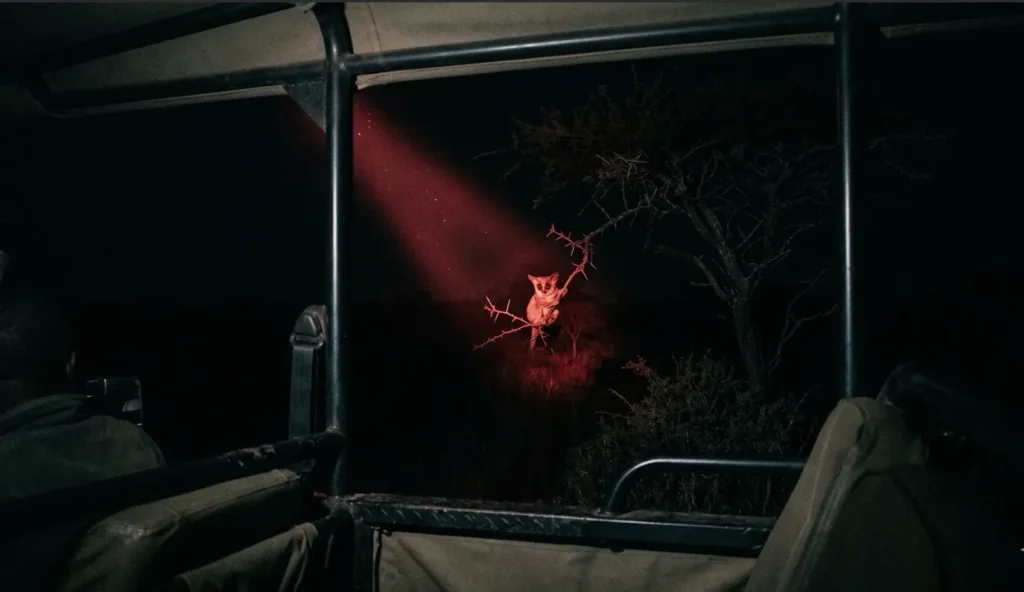
The practical mechanics of a night safari Kenya rely heavily on a dedicated two-man crew. The spotlight is operated by a trained spotter seated beside the driver, whose sole role is to scan the bush lines to call out reflective eye-shine in the darkness. This anatomical reflection—the tapetum lucidum inside the eyes of nocturnal animals Masai Mara hosts—appears vividly even under a red beam and serves as the primary method for tracking wildlife at a distance.
Under the cover of darkness, the savannah reveals its true operating system. The massive herds of grazers that dominate your daylight tracking retreat into highly defensive, compact formations. Meanwhile, the apex hunters emerge from the thickets to claim the tracks, making the inversion of wildlife roles the defining highlight of the evening.
Now that you understand the mechanics of ethical tracking, let’s look at the strict logistics and booking rules required to secure your seat in the vehicle…
Booking a Night Game Drive — Logistics, Self-Drive Ban and Lodge Access
Night game drives in Masai Mara conservancies are organized and booked exclusively through the specific safari lodge where you are staying. The camp property coordinates the designated vehicle, the authorized tracker, and the exact navigation routes within their conservation boundaries. You cannot legally arrange an independent evening excursion with an outside operator or a day-trip driver from outside your specific location; the entire experience is an internal, lodge-managed activity strictly tied to your guest accommodation.
Confirm Availability Before Booking Your Lodge
Not every luxury tented camp or eco-lodge automatically offers after-dark tracking services to its guests. Some smaller mobile bush properties do not maintain specialized spotlights or certified spotters on their operational staff rosters. Before finalizing your room deposits, explicitly ask management if evening tracking is bundled into their all-inclusive rates or treated as an optional paid excursion. Our ground team verifies these specific property assets as a mandatory standard for any itinerary consultation we handle.
The Absolute Self-Drive Ban
Independent travelers cannot conduct a night game drive Masai Mara expedition under any circumstances. Narok County ranger units and conservancy wardens enforce a complete ban on unguided self-drive vehicles operating on any wilderness track after 6:00 PM to protect vulnerable habitats and prevent vehicle stranding. Safe navigation through trackless, unlit sectors depends entirely on the terrain knowledge and emergency radio protocols of a professionally certified local guide.
🛡️ OPERATOR INSIGHT: Attempting to drive a rental vehicle inside any protected ecosystem after dark can result in heavy vehicle impoundment fees and immediate eviction by local authorities. If you are navigating the region independently during daylight hours, you must clear the tracks before sunset; see our comprehensive Masai Mara self drive rules guide to plan your routes safely and avoid steep penalties at the ranger gates.
Understanding the Financial Structures
The final Masai Mara night safari cost is never uniform across the region because pricing structures differ significantly between corporate conservancies and boutique lodges. Certain high-end luxury brands embed unlimited evening tracking directly into their base tariff packages. Other mid-range properties manage it as a premium supplementary activity and levy a per-person fee on your final checkout bill. Our concierge team insists on reviewing the fine print during your planning phase to ensure your itinerary budget remains transparent.
Now that the booking rules and logistics are completely cleared up, let’s explore the unique nocturnal creatures you will actually encounter on the plains…
What You Actually See — Nocturnal Target Species on a Mara Night Drive
Our field spotters confirm the key nocturnal animals Masai Mara private conservancies preserve for night-time viewing: apex predators on active patrol and unique tree-dwellers. A standard daytime safari highlights herds grazing or resting, but entering the plains after dusk completely shifts the narrative. The red spotlight allows you to witness complex predatory interactions without disturbing the local wildlife dynamics.
Leopards in Stalking Mode
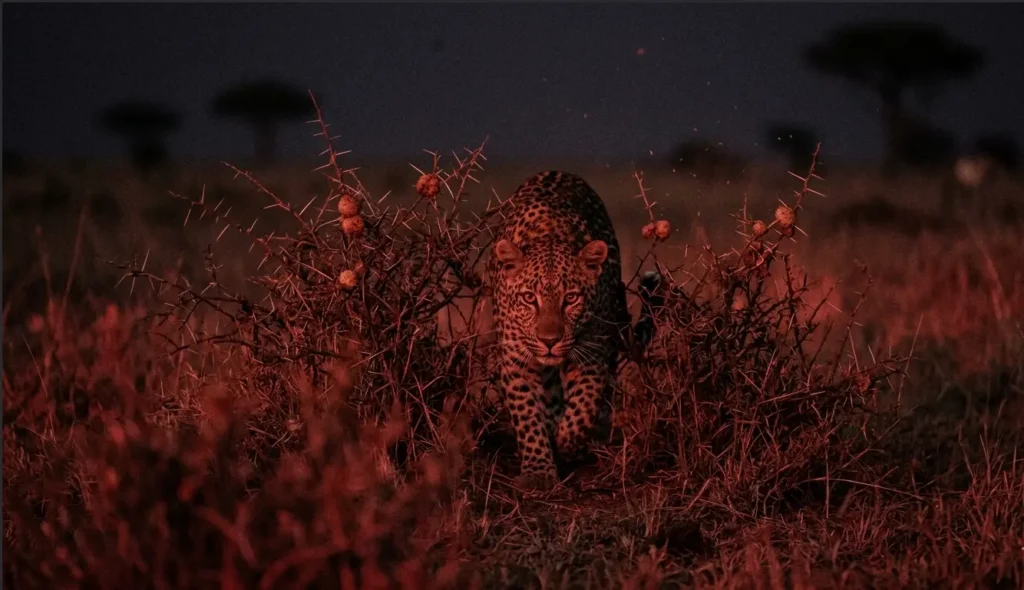
Daytime leopard sightings on a traditional Masai Mara game drive usually feature a cat draped over a high tree branch, resting away from the oppressive equatorial sun. After dark, these camouflaged felines descend to become active, highly dangerous ground hunters. They rely on the cover of low whistling thorn bushes to stalk impalas and gazelles at close range, moving with a silent focus that daytime travelers never get to experience.
Coordinated Hyena Clans
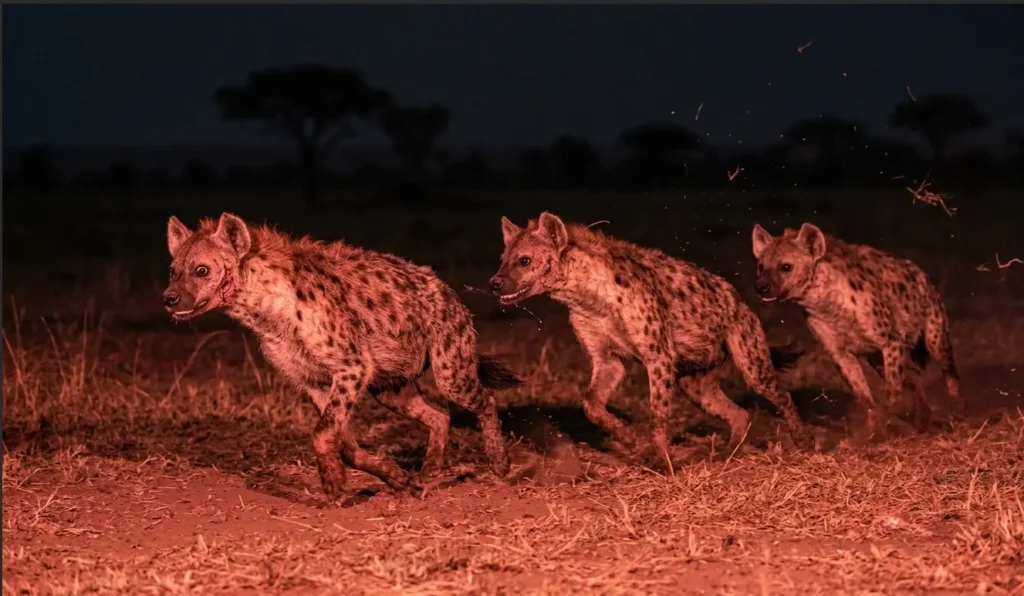
Spotted hyenas are highly intelligent, apex nocturnal hunters despite their common reputational myth as lazy scavengers. Once darkness falls, localized clans execute structured pursuit tactics, working as coordinated teams to cut off and tire out targeted wildebeests or zebras. Watching a large hyena pack communicate through a series of tactical low groans while closing in on a target under red light is an intense wildlife encounter.
Bush Babies and Rare Nocturnal Hunters
Bush babies—tiny tree-dwelling primates with massive, light-sensitive eyes—frequently appear in the acacia canopies as distinct amber reflections under the tracking spotlight. Other highly elusive species that emerge at night include predatory African civets, large-spotted genets, serval cats, and insect-hunting bat-eared foxes. Most of these smaller carnivores avoid large vehicles entirely during the day, making a night game drive Masai Mara excursion the only practical way to spot them.
The Ecosystem Inversion: Day vs. Night
|
Feature |
Daytime Game Drive |
Night Game Drive |
|
Dominant Profile |
Large grazing herds (Wildebeest, Zebra, Topi) |
Active apex carnivores (Leopards, Hyena packs) |
|
Predator Behavior |
Sleeping in thick shade or tall grass |
Active patrolling, scent marking, and hunting |
|
Prey Strategy |
Dispersed grazing across open savannah |
Compact herd formations on high, open ground |
|
Elusive Species |
Mostly hidden in deep riverine thickets |
Foraging openly (Genets, Civets, Bush babies) |
Now that you know what moves across the dark savannah corridors, let’s look at the financial and practical reality to see if this experience is truly worth your time…
Is a Masai Mara Night Game Drive Worth It? The 2026 Honest Operator Verdict
For travelers driven by a deep interest in raw predator behavior, a night game drive Masai Mara session delivers encounters that daylight tracking structurally cannot replicate. Large carnivores are biologically programmed to rest during the heat of the day and expend their hunting energy under the cover of darkness. If witnessing a leopard stalk or a serval leap is your primary Kenya safari objective, this focused evening tracking is entirely worth the premium.
However, for enthusiast wildlife photographers, the operational reality requires a serious reality check. Capturing sharp images from an open-sided vehicle under red-filtered light involves intense technical challenges due to low contrast, vehicle engine vibrations, and moving subjects. To walk away with publishable frames from a night safari kenya tracking session, your gear bag must include a high-ISO camera body and lenses sporting a maximum aperture of $f/2.8$ or faster.
For the general holiday visitor, the primary limitation of an evening drive is the highly restricted field of view. You lose the sweeping, wide-angle savannah panoramas of a standard daytime masai mara game drive, seeing only what the spotter’s beam manages to illuminate. The pace is deliberately slow, highly concentrated, and demands immense patience as the crew listens for nocturnal alarm calls in the dark.
From our seat as ground operators, an evening excursion should always be treated as a fascinating addition to your trip, never as a standalone replacement for daylight tracking. Combining both options gives you a complete, unbroken view of the ecosystem across its two completely different operating states. If your itinerary constraints force you to choose only one premium tracking window, we openly recommend prioritizing the 6:00 AM morning golden hour instead, which captures rising predator activity at a fraction of the logistical complexity.
Now that we have balanced the wildlife viewing pros and cons, let’s address the sharp drop in temperatures on the plains and how to dress for it…
The Cold Reality — What to Wear on a Masai Mara Night Game Drive
The Masai Mara sits at a high altitude of approximately 1,500 meters above sea level, creating a massive thermal contrast between day and night. While daytime temperatures regularly reach a warm 28 to 32 degrees Celsius, the lack of cloud cover triggers a rapid drop after sunset, plunging the plains down to 12 degrees Celsius or lower by 9:00 PM. When you add the sharp wind chill of an open-sided 4×4 cruiser moving across the plains, the midnight air feels down-right freezing.
🛡️ OPERATOR INSIGHT: Do not make the rookie mistake of relying on your standard daytime safari clothing during an evening drive. The lightweight shorts and linen shirts that kept you perfectly comfortable at noon will leave you shivering uncontrollably by 8:00 PM. Our ground experts use a strict three-layer clothing protocol for all late-night clients: a high-wicking technical thermal base layer, a heavy mid-layer fleece, and a windproof outer shell jacket. To make sure you do not pack the wrong materials for the rest of your trip, check out our comprehensive Masai Mara packing list guide before finalizing your luggage bags.
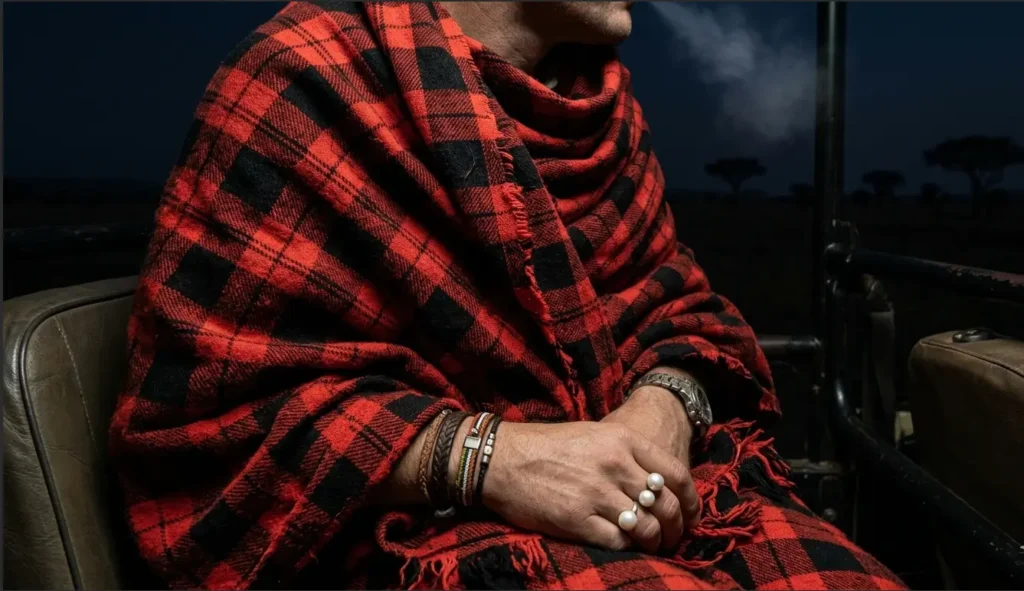
A traditional Masai Shuka—the durable, tightly-woven wool-blend blanket instantly recognized by its iconic red and black geometric patterns—is your absolute best weapon against the elements during a night game drive Masai Mara excursion. Unlike flimsy commercial travel throws, these locally made blankets are thick enough to block incoming drafts when wrapped tightly across your lap and chest. Our custom vehicles carry a clean batch of these traditional wraps for guests, but you can easily purchase your own at the local markets in Narok or Nairobi before crossing into the region.
The severe temperature drop does more than test your comfort; it directly impacts your camera gear. The cold environment causes lithium-ion batteries to drain rapidly, meaning you should store your spares inside an interior jacket pocket close to your natural body heat until the exact moment of use. Furthermore, moving your camera bodies between a heated safari lodge room and the freezing night air can instantly fog up your glass elements, so allow your lenses to acclimatize slowly before firing your first shots.
Conclusion on Night Game Drive Masai Mara
A night game drive Masai Mara in 2026 requires one non-negotiable planning decision: your lodge must be in a private conservancy, not the National Reserve. Everything else — the red light, the guide, the target species, the Shuka — follows from that single accommodation choice. Evans, whose night drive observations have shown clients leopards actively hunting and hyena clans coordinating in the dark, makes the case simply: the Mara after dark is a different ecosystem from the one the day shows you. Dress for the cold. Book the conservancy. The night is worth it.
FAQs — Expert Answers on Night Game Drives in Masai Mara 2026
Can you do a night game drive inside the Masai Mara National Reserve?
No. Night game drives are completely prohibited inside the Masai Mara National Reserve. All reserve gates enforce a 6:00 PM closure — no vehicles may remain on the tracks after this time. To access a night game drive legally, you must book accommodation inside a private conservancy surrounding the reserve, where night drives are available through your lodge.
Why do safari guides use red lights instead of white lights on night drives?
Red-filtered spotlights are used because red wavelengths do not disrupt the natural night vision of nocturnal predators. Standard white spotlight beams temporarily blind leopards, hyenas, and other nocturnal species whose eyes are optimised for low-light conditions — altering their hunting behaviour and causing prey animals to panic. Red light allows intimate observation without disturbing natural animal behaviour.
Can I drive my own vehicle on a night game drive in Masai Mara?
No. Self-drive vehicles are prohibited from operating after dark throughout the Mara ecosystem — including inside private conservancies. All night game drives must be conducted in an authorised vehicle with a professionally certified local guide. This rule covers safety, navigation in no-signal terrain, and conservation management requirements that cannot be met by self-drive operators.
What animals can you see on a Masai Mara night safari?
Night game drives in Masai Mara conservancies primarily target leopards in active hunting mode, spotted hyena clans on coordinated hunts, and bush babies in acacia trees. Other species regularly encountered include genets, civets, serval cats, and bat-eared foxes — all of which are virtually impossible to observe on daytime drives. Lions are also more active at night but are less reliably located than leopards and hyenas.
How cold does the Masai Mara get during night game drives?
Temperatures in the Masai Mara drop rapidly after sunset due to the reserve’s 1,500-metre elevation, regularly falling to 12 degrees Celsius or below by 9PM. Wind chill from open-sided vehicles moving at speed intensifies this significantly. Bring thermal base layers, a fleece mid-layer, a windproof outer shell, and a Masai Shuka blanket — the Shuka is the most effective single item for blocking the evening wind in an open vehicle.
Is a Masai Mara night game drive worth the extra cost?
For clients specifically interested in predator behaviour — leopard hunting sequences and hyena clan coordination — a night drive is worth it because these behaviours are not consistently observable during daylight hours. For wildlife photographers, the right low-light camera equipment is essential for the experience to deliver usable images. For general safari visitors, the night drive is best experienced as an addition to daylight game drives rather than a replacement — the restricted field of view and slower pace are different from the open panoramic scale of a daytime drive.
How do I book a night game drive in Masai Mara?
Night game drives in Masai Mara conservancies are booked through the specific lodge you are staying at — not arranged independently. Confirm that your chosen lodge offers night drives before finalising your accommodation booking, as not every conservancy lodge has this programme. Some lodges include night drives in an all-inclusive daily rate; others charge a supplementary per-person activity fee. Hilmuks Safaris confirms night drive availability as part of every conservancy itinerary consultation.