Email:
 Phone:
 WhatsApp:

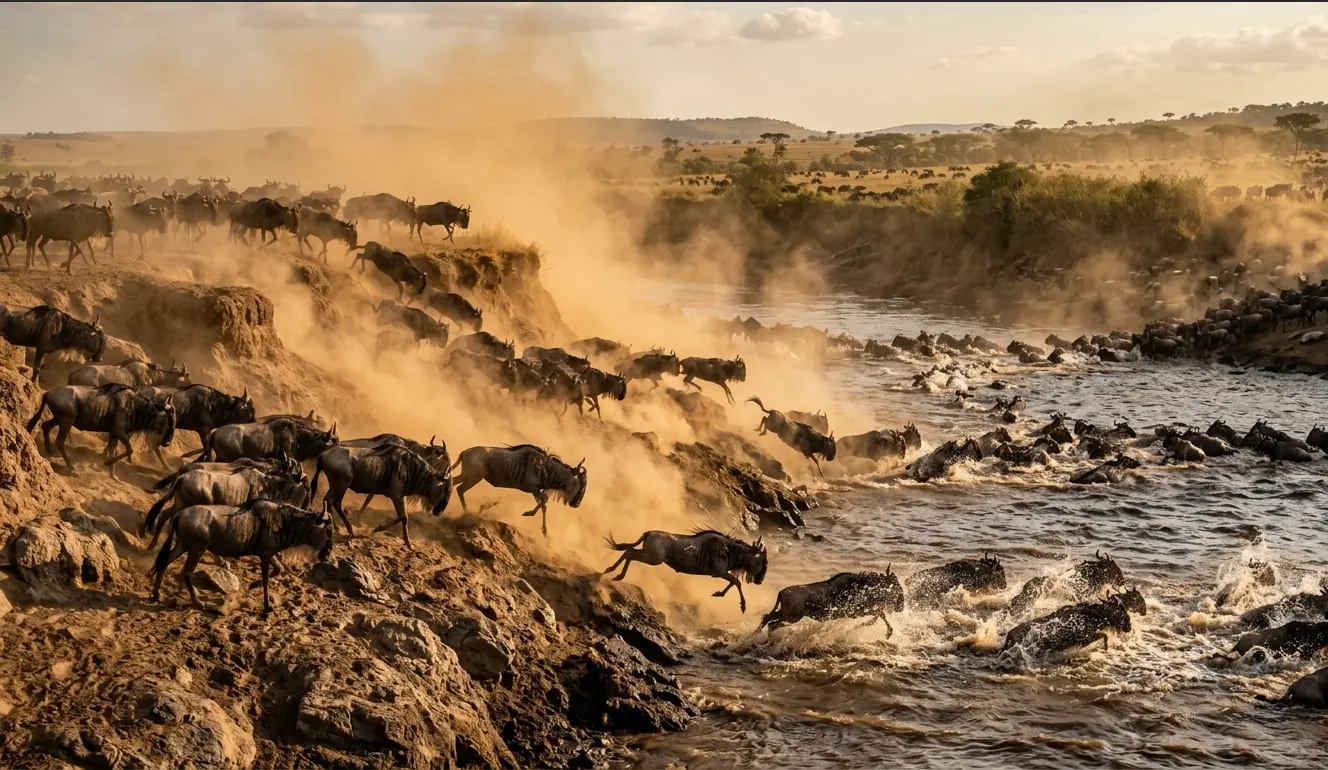
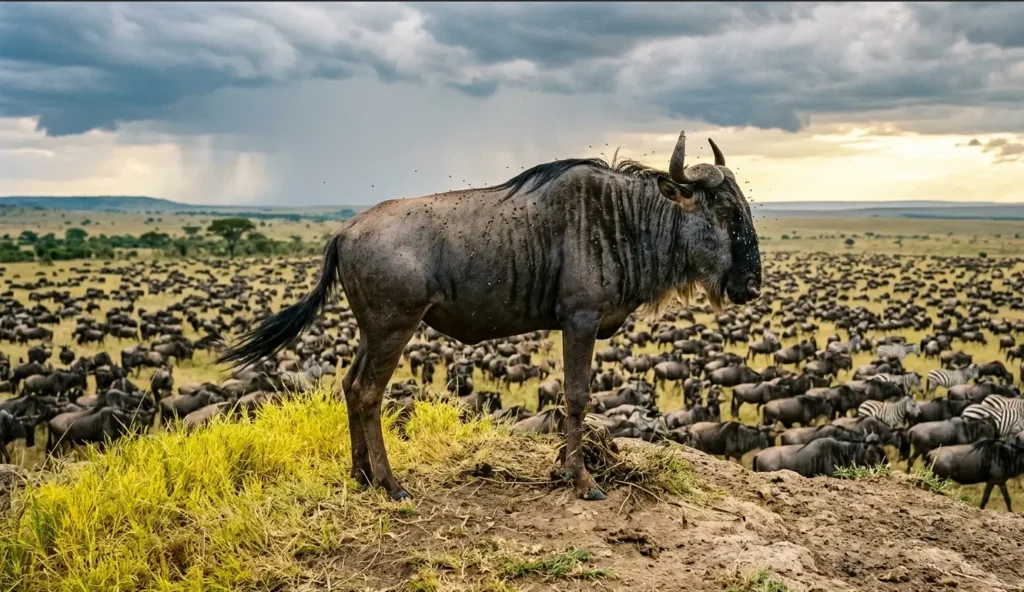
The Great Migration Masai Mara in 2026 is the largest movement of land animals on Earth — 1.5 million wildebeest, hundreds of thousands of zebras and gazelles, crossing from Tanzania’s Serengeti into Kenya’s Masai Mara between July and October in a circular annual journey driven entirely by rainfall.
Wildebeest cross three rivers entering Kenya during the Great Migration in 2026: the Sand River first, then the Talek, then the Mara River. Only the Mara River delivers the dramatic leaps and crocodile encounters. The Sand River and Talek are shallow — action here is minimal.
Evans Kimojino, a Mara-based safari guide and Hilmuks ground partner with 1,300+ documented wildlife sightings, has stood at the Mara River during peak August crossings more times than most visitors will see in a lifetime of safaris. His ground intelligence — from which river actually delivers the drama to what the 200+ car crowd reality looks like — shapes every section of this guide.
Every safari booking site will tell you the migration runs July to October and the crossings are spectacular. None of them will tell you that the Talek River crossings are anti-climactic, that August at the main crossing smells of death, that 200 vehicles can converge on one riverbank, or that your $200 park permit expires at 6:00 PM whether you saw a crossing or not. This guide covers all of that.
QUICK REFERENCE TABLE
|
Factor |
What Guides Say |
What Actually Happens |
|
Best months |
July–October |
July–October, but no guarantee of daily crossings |
|
River for drama |
“The Mara crossings” |
Mara River only — Sand and Talek are shallow |
|
Vehicle density |
“Comfortable viewing” |
200+ vehicles at popular crossing points in August |
|
Park fee validity |
“24 hours” on old guides |
6AM to 6PM only — expires daily |
|
Conservancy crossings |
Implied by brochures |
Crossings happen in the Reserve — conservancy clients must travel in |
|
Close Camps/lodges |
All within the Reserve/Conservancy |
Ashnil Mara Camp, Entim Main Camp, Mara Ngenche Safari Camp, Naibor Camp, Matira Bush Camp, Malaika Camp. |
|
Waiting time |
Not mentioned |
Wildebeest can stand at the bank for up to 5 hours to 1 day without crossing |
|
River/Air smell |
Never mentioned |
Death smell from carcasses affects lunch positioning |
Quick Navigation-Jump to Your Section
What the Great Migration Actually Is: Scale, Route, and 2026 Forecast
The Great Migration Masai Mara 2026 is a continuous, clockwise survival journey covering approximately 3,000km through the Serengeti-Mara ecosystem. Driven by the search for nitrogen-rich short grass triggered by rainfall, over 1.5 million wildebeest, 400,000 zebras, and 200,000 gazelles move in a massive, relentless loop.
In 2026, the annual cycle remains dictated by these rain patterns:
- January – March: Calving season in the southern Serengeti (Tanzania).
- April – June: The herds move northwest through the central Serengeti.
- July – October: The “Kenya Window,” where the mass enters the Masai Mara.
- November – December: The return journey south as the short rains begin in Tanzania.
🛡️ OPERATOR INSIGHT: While many generic guides suggest the herds arrive on a fixed date, the 2026 Masai Mara migration forecast depends entirely on the Kenya Meteorological Department seasonal rainfall data. If the Serengeti experiences early dry spells, the herds push into Kenya sooner, but if the grass remains lush in the south, the “Main Crossing” may delay until late August. See our 3-Day Masai Mara Safari from Nairobi to learn more about how we timing-match our departures with real-time herd sightings.
The wildebeest migration operator guide to entry follows a strict three-river sequence. The herds first hit the Sand River at the Tanzania border (low drama, shallow water), occasionally cross the Talek, and finally congregate for the high-stakes plunges at the Mara River.
Our ground team monitors these movements daily via radio frequencies to ensure clients don’t spend eight hours waiting at an empty riverbank. We’ve observed that in recent years, the herds are increasingly using “satellite” crossing points rather than just the traditional main stages to avoid the 200-car “circus” congestion.
Now that the scale and timing are clear, we need to address the one question every visitor asks: which river is actually worth your time, and where does the real drama happen?
The River Crossing Reality: Which River Actually Delivers the Drama
To witness the Great Migration Masai Mara 2026, you must understand that not all rivers are created equal. Most generic guides bundle every water crossing into one category, but Evans explains a specific three-river sequence that dictates the level of “action” you will see.
The journey starts at the Sand River along the Kenya-Tanzania border; while you will see thousands of animals here, the water is shallow, meaning no jumping and zero crocodile ambushes. Similarly, our field intelligence confirms the Talek River is merely a transit point with low water volume and no dramatic spectacle. The true theater is the Mara River, where crocodiles lurk in deep pools and the herds are forced into high-stakes plunges.
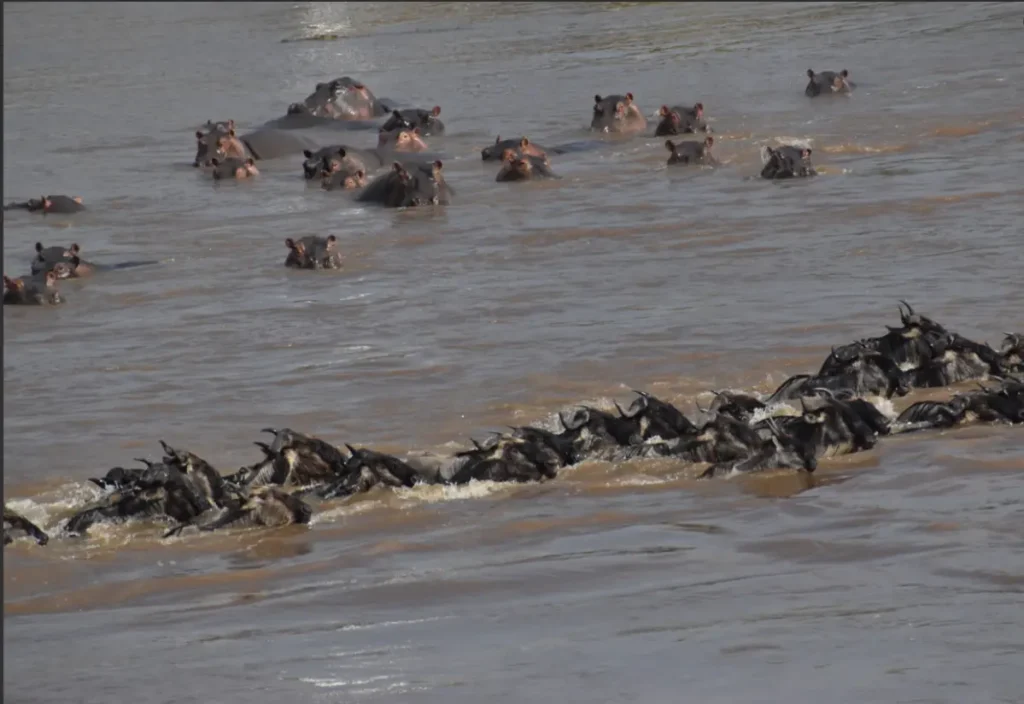
🛡️ OPERATOR INSIGHT: Many travelers are misled into thinking the Talek River offers crossing drama. It does not. If your goal is to see the iconic “big jump,” you must prioritize Masai Mara river crossing locations along the main Mara River vein where water levels and steep cliffs create the chaotic stampedes searchers crave.
Water Levels and Probability Reading
The intensity of a crossing is a direct result of rainfall and water depth. High water levels after recent rains transform the river into a high-energy stage for jumping and stampeding, while dry conditions offer a much quieter experience.
Our wildebeest migration operator guide to success relies on reading three specific signals before we commit to a spot:
- Proximity: How close the lead “scouts” are to the water’s edge.
- Agitation: High-energy movement and pushing within the herd.
- The “Stand-Off”: If the herd is merely standing still, they may wait for five hours without a single animal touching the water.
Mastering these nuances requires an expert eye for the wildebeest migration river crossing protocols that separate a thirsty herd from one ready to plunge.
💡 PRO TIP: Space at the riverbank is never guaranteed, and during peak August mornings, more than 200 vehicles can converge on a single site. To secure a front-row seat for photography, see our guide on the best time to visit Masai Mara National Reserve to understand how seasonal crowds affect vehicle positioning at the river.
The “No-Crossing” Reality
Sometimes, despite the agitation, the wildebeest simply refuse to cross. This is not a failure of the guide; it is the unpredictable nature of the wild. When the probability drops, our protocol is to pivot to other game drives and stay tuned to the radio network, returning only when the lead animals commit to the water.
Knowing which river to watch is the first step, but your choice of accommodation determines whether you spend your morning at the riverbank or stuck in a two-hour commute from the gate.
Masai Mara National Reserve vs Conservancy 2026: The Choice That Determines Your Experience
When planning for the Great Migration Masai Mara 2026, the most critical fact omitted by glossy brochures is that all major river crossings happen inside the National Reserve. If you stay in a private conservancy, you must physically drive into the Reserve to witness the drama, which incurs an additional daily entry fee on top of your lodge rate.
The National Reserve is the “heart of the action” where herds concentrate, but it is also the site of the 200-car “circus” phenomenon at crossing points. Conversely, private conservancies offer a sanctuary of exclusivity where vehicle numbers are strictly limited to three or five per sighting.
Navigating these two distinct management zones requires a precise Masai Mara National Reserve vs Conservancy ground comparison to avoid paying double fees for the same river crossing day.
The Comparison: Spectacle vs. Exclusivity
Choosing the National Reserve gives you a front-row seat to the Great Migration Masai Mara 2026 crossings and high wildlife density. However, it operates under strict rules: off-road driving is prohibited, and you must be out of the gates or at your lodge by 6:00 PM.
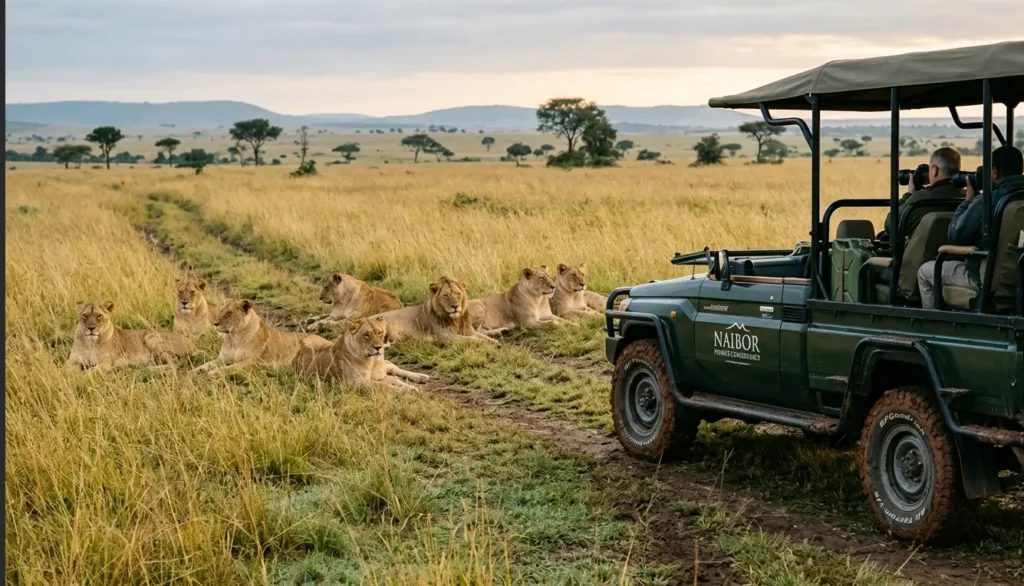
Private conservancies like Mara North or Olare Motorogi allow for activities strictly forbidden in the Reserve. Here, you can enjoy night game drives, walking safaris with armed rangers, and the ability to drive off-road to follow a leopard into the thick bush.
The 2026 Split-Stay Strategy
For the ultimate experience, we recommend a “Split-Stay” approach: two nights in the National Reserve to focus on the river crossings, followed by three nights in a conservancy for intimacy. This ensures you witness the “Great Show” without sacrificing the quiet, luxury moments that define a high-end safari.
| Factor | National Reserve | Private Conservancy |
| River Crossing Access | Direct — Crossings happen here | Must travel to Reserve — extra fee |
| Vehicle Density | 200+ at major crossings | 3–5 maximum |
| Night Game Drives | Prohibited | Permitted |
| Off-Road Driving | Prohibited | Permitted |
| Park Fee | $200 (Peak Season) | Included in rate (+ Reserve fee for crossings) |
With the location decision clear, the next section covers some close camps and lodges to the crossings drama.
Choosing Your Migration Camp: The Proximity Principle
The single most important factor in your Great Migration Masai Mara 2026 experience is river proximity. A camp located two hours from the crossings forces you into a four-hour daily commute, which eats directly into your 12-hour permit window and your prime game-viewing time.
Many lodges market themselves as “migration camps” or “river view” properties, but this can be misleading. While some are within 15 minutes of the main banks, others require a long drive through the dense 2026 traffic that plagues peak season. Before booking, you must verify the specific drive time to the nearest main Mara River crossing point, as sector access can change based on river bridge congestion.
🛡️ OPERATOR INSIGHT: The Mara Triangle crossings (managed by the Mara Conservancy) are distinct from the Main Reserve crossings. Accessing the Triangle often requires crossing the Mara River bridge, a notorious bottleneck in 2026. If your priority is the high-drama plunges, see our Masai Mara fly-in packages and airstrip proximity guide to ensure your airstrip-to-lodge transfer doesn’t leave you stranded on the wrong side of a traffic jam.
Front-Row Seats: Operator-Verified “Inside” Camps
Staying at a camp deep inside the Reserve—specifically near the confluence of the Mara and Talek Rivers—is a tactical necessity for serious wildlife enthusiasts. These “inside” camps exempt you from the 6:00 PM gate-exit rush that affects those staying in distant conservancies or outside the park.
The following camps are verified for their elite proximity to major Masai Mara migration 2026 dates and fees action:
- Entim Mara Camp: Situated directly on the Mara River; you can often watch wildebeest gather on the banks while eating breakfast.
- Ashnil Mara Camp: Located at the confluence of the Mara and Olkeju Rivers, sitting right in the primary path of the herds.
- Mara Ngenche Safari Camp: An intimate, unfenced camp overlooking the Mara/Talek confluence with minutes-away access to iconic crossing points.
- Malaika Camp: A favorite of Evans, this camp allows photographers to monitor river activity directly from their tents.
- Naibor Camp & Matira Bush Camp: Hidden in riverine woodland, these offer “bush-style” authenticity right in the center of the predator-prey zone.
The “Early-Start” Advantage
Staying close to the water allows our drivers to reach crossing points by 6:30 AM. While other vehicles are still queuing at the Sekenani or Talek gates, our clients are already positioned for the best angles. This 45-minute headstart is often the difference between a clear view of a “leap” and being stuck behind a wall of twenty other Land Cruisers.
⚠️ 2026 ROAD ALERT: The black cotton soil tracks between the Talek area and the main Mara crossings can become a “silt trap” after heavy rains. If you are staying at Matira or Naibor, ensure your operator uses a high-clearance 4×4, as the 2026 water levels have softened the riverbank approaches significantly.
The Honest Truth: Crowds, the “Death Smell,” and the 5-Hour Wait
Radical transparency is the hallmark of a true wildebeest migration operator guide. While glossy brochures promise a private viewing of nature’s greatest show, the 2026 reality at the riverbank is often a high-pressure “circus” where over 200 vehicles can converge on a single crossing point. If your goal is pristine, vehicle-free photography, you must arrive before 7:00 AM or work with a guide who understands the satellite crossing points away from the main stages.
Beyond the crowds, there is the sensory reality that no travel agent mentions: the smell. Many wildebeest die during the crossing from stampede pressure, crocodile attacks, or exhaustion, leading to carcasses accumulating along the banks. Our lead guide observes that this distinct “death smell” can make picnic lunches near the river difficult for sensitive travelers.
To escape the ground-level congestion and the sensory intensity of the riverbanks, a Masai Mara Balloon Safari 2026 offers a silent, elevated perspective of the herds’ formation without the 200-car “circus” below.
🛡️ OPERATOR INSIGHT: The smell of the migration isn’t just a nuisance; it brings a significant increase in fly density near the riverbanks. To manage this, our guides are trained to identify wind direction and position vehicles upwind for meals. If you are sensitive to strong odors or insects, see our 2-day Lake Nakuru and Naivasha safari for a cleaner, fresher lakeside experience as a secondary option.
The Predator Circle and Aerial Restrictions
The high mortality rate at the river creates a massive “predator circle.” Lions, leopards, and hyenas linger in the tall grass specifically to capitalize on the exhausted survivors, while crocodiles lurk in the deep pools. This results in the highest-density predator sightings of 2026, but it is important to remember that these sightings are driven by the brutal reality of the migration.
💡 PRO TIP: Do not bring a drone. The Narok County Government strictly prohibits the use of drones or unauthorized helicopters within the Reserve to protect the herds from harassment. Violating these 2026 park rules can result in immediate confiscation of equipment and heavy fines, which are enforced by rangers at every major crossing point.
The migration is a mixture of awe-inspiring scale and the grit of nature—it is beautiful, but it is also dusty, loud, and occasionally quite smelly.
Ground reality cleared — the final financial trap to understand before booking is the park fee timing rule that catches more migration visitors than any other single factor.
The $200 Trap: The 12-Hour Rule and How to Use It
The most expensive mistake you can make during the Great Migration Masai Mara 2026 is following outdated advice regarding ticket validity. While many safari guides still claim tickets last for 24 hours, Narok County Government regulations strictly enforce a 12-hour calendar day rule. Your permit is valid only from 6:00 AM to 6:00 PM on the day of entry; it does not roll over to the next morning.
This creates a massive financial disparity for the unaware traveler. A visitor entering the gate at 3:00 PM pays the full $200 for just three hours of game viewing, whereas entering at sunrise gives you twelve full hours for the same price. To avoid this, we implement the Hilmuks 6 AM Protocol, ensuring our vehicles are at the gate before opening to capture the golden hour predator activity before the crossing crowds build.
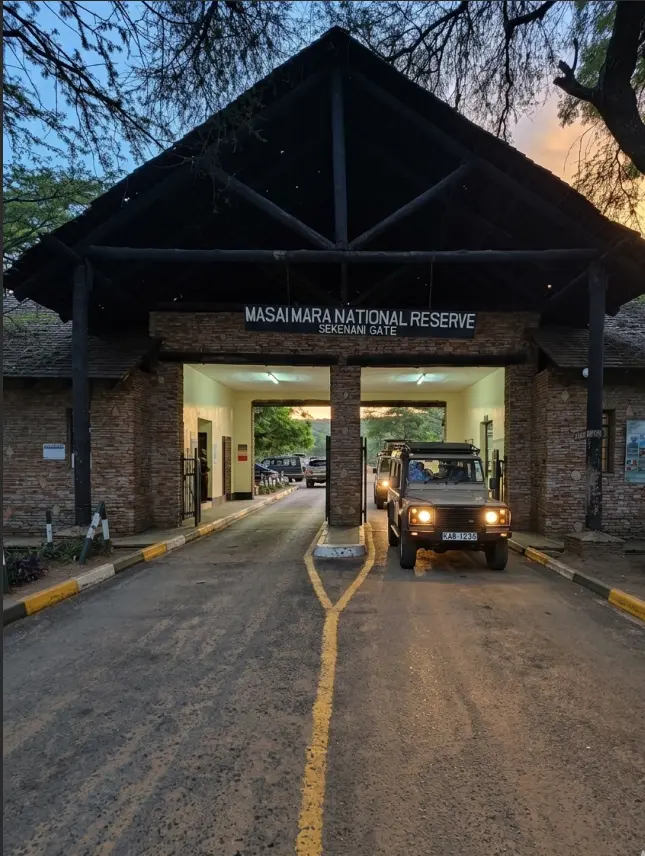
🛡️ OPERATOR INSIGHT: Rangers at the exit gates are increasingly strict about the 6:00 PM cutoff. If you are caught inside the reserve after your permit window has closed without a valid receipt for the next day, you will be charged an additional $200 on the spot. For the most current rates and payment methods, see our step-by-step Masai Mara payment guide to ensure your paperwork is watertight before you reach the gate.
Maximizing the 2026 Permit Window
Understanding the Masai Mara migration 2026 dates and fees requires a tactical approach to your itinerary. Our operational standard is to position clients near the exit gates well before the permit expires to avoid financial exposure. This is particularly crucial if you are staying in a camp outside the reserve but want to witness a crossing that is several miles from the gate.
💡 PRO TIP: If you are planning a multi-park trip, do not confuse the Mara rules with the KWS system used in places like Lake Nakuru, which operates on a 24-hour cycle. To see how these systems differ and save your budget, check our guide on Masai Mara 12-hour permit mechanics which breaks down the specific “gate hacks” our drivers use to keep your costs down.
|
Entry Time |
Cost |
Utility per Hour |
|
6:00 AM |
$200 |
$16.60 / hour |
|
10:00 AM |
$200 |
$25.00 / hour |
|
3:00 PM |
$200 |
$66.60 / hour |
With your permit timing managed and the “12-hour trap” avoided, the final practical question is how to get to the Mara without losing half your first day in transit.
Getting to the Mara for Migration Season: Transport Options
Getting to the Great Migration Masai Mara 2026 effectively is a choice between budget-friendly endurance and time-sensitive efficiency. During the peak July-August window, the road from Nairobi to Sekenani Gate can become a logistical bottleneck due to heavy safari traffic and seasonal road maintenance. A road transfer typically takes between 5 to 8 hours, making an early morning departure from Nairobi non-negotiable if you hope to reach the reserve before the primary afternoon crossing window.
Conversely, the fly-in option from Wilson Airport puts you on a Mara airstrip in just 45 minutes. This is the gold standard for the wildebeest migration operator guide, as it eliminates road fatigue and ensures you are at the riverbanks by mid-morning. Since the 12-hour permit clock starts the moment you enter the reserve, arriving via flight by 10:00 AM versus a 3:00 PM road arrival can be the difference between seeing a crossing or missing it entirely on your first day.
🛡️ OPERATOR INSIGHT: While helicopter transfers to high-end lodges are a popular 2026 luxury, remember that drones and helicopter-based aerial photography are strictly prohibited inside the Reserve without explicit, pre-authorized permits from Narok County. To decide which transport mode fits your schedule and budget, see our fly or drive to Masai Mara full comparison to weigh the costs of time versus money.
Navigating the Nairobi-Narok Corridor
If you choose to drive, be prepared for the “Maai Mahiu crawl”—a stretch of road known for heavy truck traffic that can add two hours to your journey without warning. Our drivers prioritize a 5:30 AM departure to beat the city gridlock and ensure we reach Narok town for a quick pitstop before the final leg into the Reserve.
💡 PRO TIP: For those opting for the speed of air travel, booking the earliest flight (usually 7:30 AM or 8:00 AM) is essential to maximize your $200 permit value. Check our Nairobi to Masai Mara flights guide for a breakdown of which airstrips are closest to the main crossing points to minimize your ground transfer time once you land.
Now that your transport is sorted and your permits are ready, it’s time to look at the equipment you’ll need to capture the action without the common “safari fails” most visitors regret.
Migration Essentials: Capturing the Action Without the “Safari Fail”
Capturing the Great Migration Masai Mara 2026 requires a specific technical setup that goes beyond standard travel photography. The most common “safari fail” is bringing a high-end camera but lacking the stabilization needed for long-distance river shots; the Mara is notoriously dusty during the July–August dry season, and constant lens changes can introduce silt into your sensor in seconds.
To avoid irreversible sensor damage from the highly abrasive volcanic silt kicked up during these chaotic river crossings, professional shooters utilize our specialized Masai Mara Migration Photography 2026 field protocols.
Your primary lens for the river crossings should be a telephoto with at least 400mm to 600mm reach to capture the “eye-contact” moments during the plunges. While the scale of 1.5 million animals is breathtaking, it is the detail of the struggle in the water that makes for a world-class photograph.
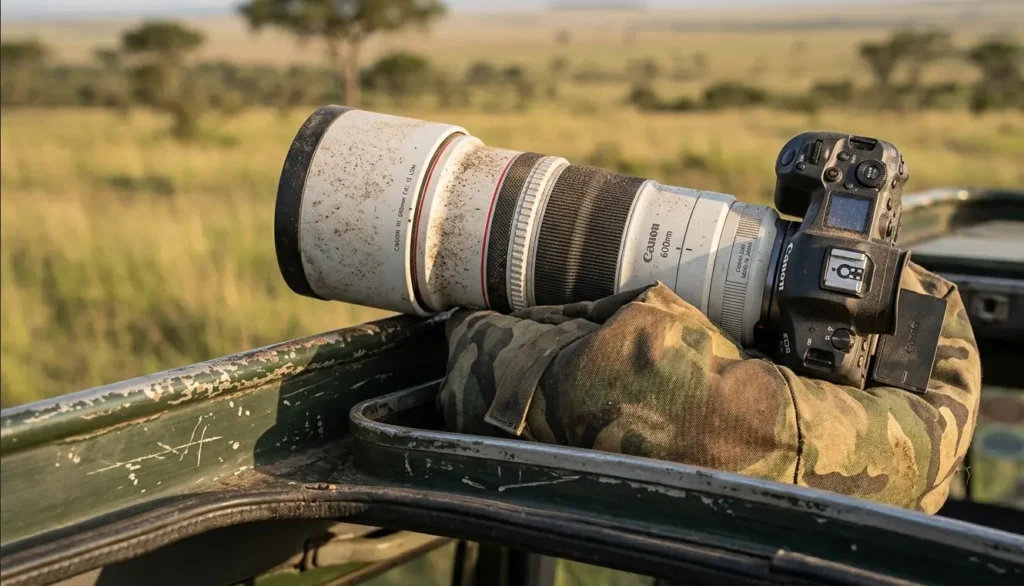
🛡️ OPERATOR INSIGHT: Standard tripods are physically impossible to use inside a crowded safari vehicle. Instead, we recommend a heavy-duty beanbag—which you can fill with rice or beans in Nairobi—to steady your long lens on the vehicle’s roof hatch. This is the 2026 “pro-move” for capturing steady, 4K video of the crossings without the bulk of a tripod.
The “Survival” Tech Checklist
Beyond your camera body and glass, several small items determine your success during a 5-hour wait at the riverbanks. High-quality binoculars (8×42 is the operator’s choice) are essential for scanning the far banks for the “lead animal,” which signals the start of a crossing before the 200-car crowd even notices.
💡 PRO TIP: To ensure you aren’t over-packing or missing critical essentials like the specific “Dust-Proofing” kits we use in the bush, see our Masai Mara packing list for a complete breakdown of clothing, electronics, and medical gear needed for the migration season.
- Extra Batteries: The 2026 heat and constant high-frame-rate shooting will drain batteries twice as fast as usual.
- UV and Polarizing Filters: These are non-negotiable for cutting through the midday river glare and protecting your glass from the “silt-blast” kicked up by the herds.
- Portable Power: A rugged power bank is necessary to keep your communication devices live for real-time radio updates from our guide network.
With your gear packed and your logistics finalized, you are now ready to experience the greatest wildlife show on earth as an insider, not just a tourist.
Ready to book your spot at the riverbank? Contact our operator team today to secure your 2026 migration safari.
Conclusion-the Great Migration Masai Mara 2026
The Great Migration Masai Mara in 2026 is the greatest wildlife spectacle on Earth — and also the most honest test of a safari operator’s ground knowledge. The difference between a $200 permit that expires before you reach the crossing and a full 12-hour day with a front-row position at the Mara River is the difference between a guide who communicates with the network and one who does not. Evans, whose 1,300+ sightings include hundreds of crossing mornings, puts it simply: patience is the one principle the wild will always demand. Plan accordingly.
FAQ — Expert Answers on the Great Migration Masai Mara 2026
When is the best time to see the Great Migration in Masai Mara?
The best time to see the Great Migration in Masai Mara is between July and October in 2026, when the wildebeest herds have crossed from Tanzania’s Serengeti into Kenya. The most dramatic Mara River crossings typically peak in August and September. However, because these are wild animals, exact crossing dates cannot be predicted — arrivals can begin as early as late June and extend into November depending on rainfall patterns.
How much does it cost to see the wildebeest migration in Masai Mara in 2026?
The Masai Mara National Reserve entry fee is $200 per person per day during peak season in 2026. This fee is valid from 6:00 AM to 6:00 PM on the day of entry — it does not roll over to the next day. Additional costs include accommodation, guide fees, transport to the Mara, and any conservancy fees if staying in a private conservancy. For a full cost breakdown, see our Masai Mara migration safari cost guide.
What is the 12-hour rule for Masai Mara park fees?
The 12-hour rule means your Masai Mara park permit is valid for one calendar day only — from 6:00 AM to 6:00 PM. Unlike some national parks where tickets last 24 hours, the Masai Mara National Reserve enforces a strict daily expiry. A visitor who enters at 3:00 PM receives only 3 hours of access for the same $200 fee as a visitor who enters at 6:00 AM and receives 12 hours.
Where do wildebeest cross the Mara River?
Wildebeest cross three rivers entering Kenya during the Great Migration: the Sand River first along the Tanzania border, then the Talek River, then the Mara River. Only the Mara River delivers the dramatic jumping and crocodile encounters that define migration photography. The Sand River and Talek carry shallow water and produce minimal spectacle.
How long do you need in Masai Mara to see a river crossing?
A minimum of three to four days is recommended to have a realistic chance of witnessing a Mara River crossing in 2026. Wildebeest can stand at the riverbank for up to five hours without crossing — or cross multiple times in a single day. Our guide network communicates crossing probability across the reserve in real time. The longer your stay, the higher your probability of witnessing a crossing.
Is it better to stay in the National Reserve or a private conservancy for the migration?
The National Reserve is better for direct river crossing access — crossings happen inside the reserve and conservancy guests must travel in and pay an additional reserve fee to witness them. Private conservancies are better for exclusivity, night game drives, walking safaris, and off-road vehicle access. For stays of five or more days, a split strategy — two nights in the reserve, three in a conservancy — delivers both experiences.
What happens if the wildebeest do not cross while you are waiting?
This is the normal reality of the wild. Wildebeest can gather at the riverbank and wait for hours — sometimes an entire day — before deciding to cross. Our guides read crossing probability from three signals: how close the lead animals are to the bank, whether the herd is actively moving or standing still, and how agitated the animals near the water appear. When probability is low, we leave for other game viewing and return when conditions change. Patience is the essential principle of the migration experience.