Email:
 Phone:
 WhatsApp:

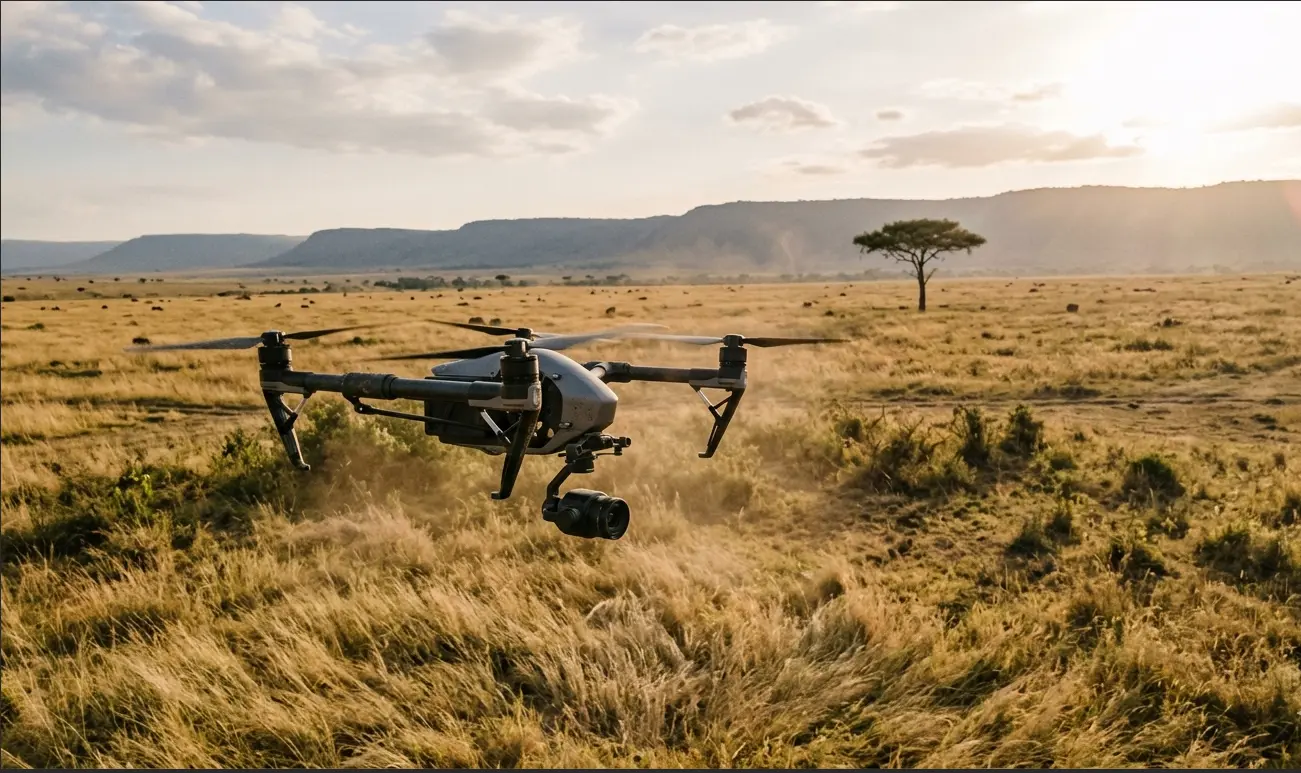
Flying a drone in the Masai Mara in 2026 is not banned—it is regulated. The difference between those two words costs you three separate agency permits, a minimum of USD 300 per day in KCAA fees, and roughly 30 days of administrative lead time before you ever reach the reserve gates.
Flying a drone in Masai Mara National Reserve in 2026 requires three separate permits: a KCAA Remote Pilot License and drone registration, a KWS special filming permission, and a Kenya Film Commission filming license. Without all three, any drone in the reserve is subject to immediate confiscation and heavy fines.
Evans Kimojino, a Mara-based safari guide and Hilmuks ground partner with 1,300+ documented wildlife sightings, has observed drone incidents at reserve gates and guided professional film crews through Kenya’s multi-agency permit process. His confirmed notes on the specific fee structure, gate declaration requirement, and operational rules form the verified foundation of this guide.

Every safari guide says “drones are banned in Masai Mara.” While this is accurate for recreational tourists flying without authorization, it is incomplete. Commercial operators, documentary filmmakers, and professional photographers can obtain authorization through Kenya’s multi-agency permit system.
This guide covers both scenarios—what applies to you depends entirely on your purpose and whether you are prepared to navigate the rigorous administrative process. If you are a photographer looking for ground-level alternatives to aerial shots, see our Masai Mara migration photography gear guide.
QUICK REFERENCE TABLE
|
Operator type |
Status |
Minimum cost |
Lead time required |
|
Tourist with personal drone |
Prohibited without authorisation |
Confiscation if found |
N/A — recreational flight not permitted |
|
Commercial filmmaker with full permits |
Permitted |
USD 300/day KCAA fee + KES 5,000–15,000 KFC + KWS fee |
Minimum 2–4 weeks for all approvals |
|
Wedding/event photographer |
Treated as commercial — permits required |
Same as commercial |
Same as commercial |
|
Research/conservation operator |
Treated as commercial — permits required |
Same as commercial |
Same as commercial |
Quick Navigation-Jump to Your Section
The Short Answer — What Is Permitted and What Is Banned in 2026
Tourists bringing personal drones—such as the DJI Mini, Mavic, or Phantom—to the Masai Mara National Reserve for personal photography cannot legally fly them. This recreational ban is enforced year-round at all entry gates to protect the ecosystem from noise pollution. During the Great Migration (July to October), enforcement is exceptionally strict because the buzz of flying drones in Kenya safaris can trigger mass stampedes at sensitive river crossing points.

Professional filmmakers, documentary crews, and research teams can legally operate, provided they secure official Masai Mara drone permits 2026 before arrival. This pathway requires a “Triple-Lock” authorization from the Kenya Civil Aviation Authority (KCAA), Kenya Wildlife Service (KWS), and the Kenya Film Commission (KFC). Attempting to fly without all three original permits in your possession is a fast track to equipment seizure and heavy fines.
Even if you are a professional photographer wanting footage for “personal use” only, the reserve does not distinguish between a YouTube vlog and a Netflix documentary. Our ground team’s consistent advice is to treat any drone presence as a commercial operation requiring the full Masai Mara drone permits 2026 stack. If you choose to ignore this, the consequences inside the reserve are the same regardless of your intended audience.
🛡️ OPERATOR INSIGHT: If you are caught flying an unauthorized drone, the KWS rangers will not just issue a fine; they are mandated by the Kenya Civil Aviation Act to confiscate the equipment as evidence for court. To avoid this, we recommend leaving the drone at your Nairobi hotel or declaring it at the gate for bonded storage rather than attempting to “smuggle” it in.
The strictness of these rules is rooted in animal welfare, as drones mimic the high-frequency sound of predatory insects or birds of prey. Wildlife—especially wildebeest herds and big cat families with young cubs—react with extreme agitation, often leading to cub separation or behavioral disruption that lasts for hours. Ground research cited by KWS confirms that these stress responses begin at approximately 150 meters, which is why the “distance buffer” is non-negotiable.
Now that we have established what is and isn’t allowed, let’s break down the specific costs you need to budget for the KCAA.
KCAA Drone Permit Price Kenya — The Resident vs. Non-Resident Breakdown
The current fee structure for operating Masai Mara drone permits 2026 is strictly tiered based on residency status. For every drone brought into the reserve, the KCAA daily permit fee is KES 5,000 for East African citizens and Kenyan residents. In contrast, non-residents are required to pay USD 300 per drone, per day, for every park visited.
These daily rates specifically authorize the drone’s presence within the protected airspace of the reserve. Note that these are “addon” costs; you must already possess a valid KCAA Remote Pilot License (RPL) and have your drone registered before these daily permits can even be issued. This distinction is the most common reason professional applications for KCAA drone permit price Kenya are delayed or rejected at the last minute.
|
Requirement |
Authority |
Resident Cost |
Non-Resident Cost |
|
Daily Drone Permit |
KCAA |
KES 5,000 /day |
USD 300 /day |
|
Remote Pilot License (RPL) |
KCAA |
Required |
Required |
|
Drone Registration |
KCAA |
Required (via eCitizen) |
Required (via eCitizen) |
|
Filming License |
Kenya Film Commission |
KES 5,000 – 15,000 |
KES 5,000 – 15,000 |
|
Special Filming Permission |
KWS |
Varies by project |
Varies by project |
The per-day economics often catch international crews off guard. For a non-resident filmmaker flying a single unit for five days, the daily KCAA permit costs alone total USD 1,500. This is before you factor in the separate Kenya Film Commission licenses or the mandatory KWS special interest fees, making a dedicated regulatory budget line essential for any 2026 shoot. These fees are separate from the Masai Mara gate entry fees which must also be paid before entering the reserve.
🛡️ OPERATOR INSIGHT: Do not waste time visiting the KCAA headquarters in Nairobi for manual paperwork. Our team has confirmed that all drone registrations and RPL applications are now processed exclusively through the KCAA eCitizen portal, which is the only recognized submission point for Masai Mara drone permits 2026.
To ensure your shoot stays on schedule, contact the KCAA directly via their official contact page to verify the current processing queue. Once your aviation licenses are secured, the next challenge is navigating the “Three-Agency” approval chain to get the ground permits.
Now that we have cleared the aviation costs, let’s look at the step-by-step process of securing your ground authorization.
The Three-Agency Permit Chain — How to Actually Secure Authorisation
Securing Masai Mara drone permits 2026 is a linear administrative process; you cannot skip steps or run them in parallel without risking a total application stall. To get your drone in the air, you must navigate a “Triple-Lock” system involving the aviation authority, the content regulator, and the land manager. Our ground experience shows that failing to provide proof of the previous permit to the next agency is the primary cause of rejection.
Step 1: KCAA — The Aviation Authority
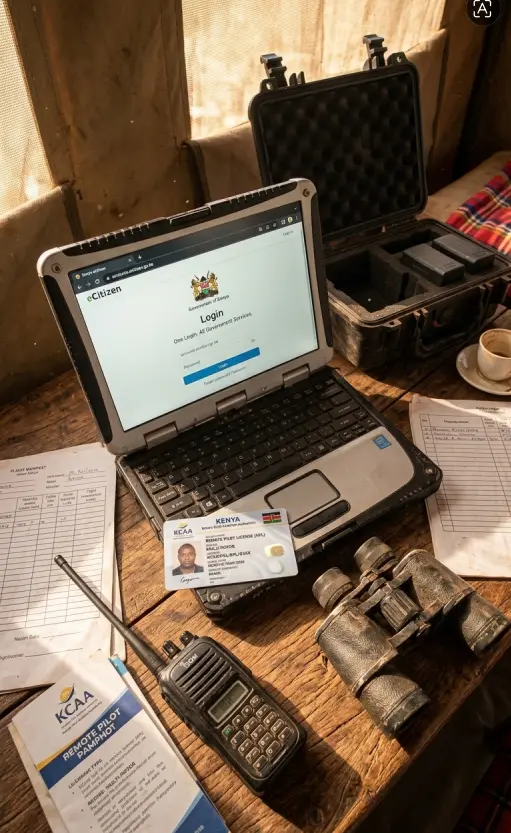
Everything starts with the Kenya Civil Aviation Authority (KCAA). You must register your drone and obtain a Remote Pilot License (RPL) via the KCAA eCitizen portal. This registration is the mandatory foundation for all other Masai Mara filming fees 2026 and permissions; without a KCAA-verified pilot and craft, no other agency will open your file.
Step 2: Kenya Film Commission — The Content Authority
Once your KCAA registration is active, you must apply for a filming license from the Kenya Film Commission (KFC). This applies to all drone footage, whether intended for a global broadcast or a private collection. The KFC is located at Jumuia Place, Block 2, Lenana Road, Nairobi, and licenses typically cost between KES 5,000 and KES 15,000 depending on your project type.
Step 3: KWS — The Land Authority
The final step is submitting a written request to the Kenya Wildlife Service (KWS) for special filming permission. Your application must detail your specific shoot location, date range, and equipment list through the KWS eCitizen portal. KWS will generally only process this once they see your approved KCAA and KFC documents.
🛡️ OPERATOR INSIGHT: Timing is everything in the Mara. We strongly advise allowing a minimum of 2 to 4 weeks for this entire chain to complete. Always plan your shoot dates around when your Masai Mara drone permits 2026 are approved, rather than trying to force the bureaucracy to fit your travel itinerary.
Applying in the correct order—KCAA, then KFC, then KWS—is the only way to avoid having your paperwork held indefinitely. If you are handling the logistics yourself, you can reach the Kenya Film Commission at info@filmingkenya.go.ke or +254 020 2714073 for status updates.
Now that your paperwork is in order, we need to talk about what happens when you physically arrive at the park gates with your gear.
The Gate Declaration — What Happens at the Reserve Entrance with and Without Permits
Evans confirms that anyone entering the Masai Mara National Reserve with a drone in their possession—whether flying it or not—must declare it at the gate. This is a mandatory safety and security requirement enforced at Sekenani, Talek, Oloololo, and Sand River gates. When you arrive, you must declare the device and present your full set of Masai Mara drone permits 2026 for verification.
If you have a valid permit, the process is straightforward: present all three agency permits (KCAA, KWS, and Kenya Film Commission) to the rangers. They will record your details and confirm that your authorization covers the specific dates and locations of your itinerary. Once verified, entry is granted, and you are free to operate within the strict flight rules covered in the next section.
However, if you arrive with a drone but no valid Masai Mara drone permits 2026, rangers will not allow the device to enter the reserve. You will be given two choices: leave the drone with gate staff for safekeeping until your departure or return it to your camp/vehicle outside the reserve. Attempting to conceal a drone is the highest-risk move; if discovered inside, you face immediate drone confiscation Kenya safari penalties, heavy fines, and potential imprisonment.
🛡️ OPERATOR INSIGHT: For travelers handling their own logistics, navigating gate protocols can be tricky depending on which part of the Mara you visit. You can see our Masai Mara National Reserve vs Conservancy guide to understand how enforcement varies between the public reserve and private lands.
Honest Advice for Tourists with Personal Drones
If you planned to bring a DJI Mini or similar consumer drone for holiday snaps, the safest and most stress-free approach is to leave it at your Nairobi hotel. The gate declaration process proves that concealment is a failing strategy, as rangers are specifically trained to identify drone hulls and batteries during routine bag checks.
⚠️ 2026 ALERT: Self-drive visitors are often the most scrutinized at the gates regarding undeclared electronics. To avoid delays or equipment seizures, review the Masai Mara self-drive rules guide before you pack your vehicle for the trip.
Rangers at the Mara are professional but firm; they prioritize the safety of the wildlife over your aerial footage. Now that we’ve covered the gate formalities, let’s dive into the specific operational rules you must follow once you are cleared to fly.
Operational Rules — Altitude, Buffer Distance and No-Fly Zones
Once you have secured your Masai Mara drone permits 2026, you are bound by strict operational parameters designed to protect the integrity of the ecosystem. The maximum allowable altitude for any drone in the reserve is 120 Metres (400 feet) above ground level. This is a drone-specific cap; any guide suggesting a 450-metre limit is mistakenly quoting general aviation rules for planes, which could lead to immediate permit revocation if followed.
Conservation is the priority for anyone flying drones in Kenya safaris, which is why a 150-metre minimum distance must be maintained from all wildlife. This buffer exists because drone frequencies mimic stinging insects, causing documented distress and flight responses in elephants and big cats. Maintaining this distance ensures you capture natural behavior without causing a stampede or separating mothers from their young.
Furthermore, your Masai Mara drone permits 2026 do not grant “fly-anywhere” access, as park headquarters and ranger posts are permanent no-fly zones. KWS management also designates specific sensitive ecological areas as off-limits, which can change depending on seasonal migration patterns or nesting sites. You must confirm these restricted coordinates during your application to avoid straying into prohibited airspace.
🛡️ OPERATOR INSIGHT: Using a drone to “herd” or move wildlife for a better camera angle is a severe violation of KWS filming ethics. Rangers monitor flight paths closely, and using the craft to influence animal movement will result in an immediate stop to your filming and potential blacklisting from the reserve.
Our ground guides note that rangers now use the “Visual Line of Sight” (VLOS) rule aggressively. If a ranger observes a drone being operated beyond the pilot’s direct line of sight without a specific KCAA waiver, they are authorized to ground the flight immediately, even if all other permits are valid.
With the operational boundaries clear, it is time to look at the practical alternatives for those who find the permit process too restrictive.
Alternatives When a Drone Is Not an Option
If the administrative weight of securing Masai Mara drone permits 2026 feels excessive, the hot air balloon safari is your only legal aerial alternative. For approximately USD 500 per person, you get a sunrise flight over the plains where the balloon operator handles all aviation authorizations. Unlike drones, personal camera equipment is fully permitted here, allowing you to capture stunning overhead shots without a single KCAA or KWS filing.
🛡️ OPERATOR INSIGHT: For many, the cost of a balloon flight is actually lower than the cumulative Masai Mara filming fees 2026 and daily drone surcharges. To see if this fits your itinerary, check out our Masai Mara balloon safari guide for a breakdown of what to expect during the flight.
Professional wildlife photographers often find that ground-level shots with a 400mm to 600mm lens are more intimate and artistically significant than aerial views. Because of the Mara’s flat topography, a correctly positioned vehicle at a river crossing allows you to capture raw animal behavior that a drone, restricted to a 150-meter buffer, simply cannot reach. This “eye-level” perspective is often what editors and galleries prefer over the detached look of high-altitude footage.
Our team consistently advises clients that unless you are a major production house, building the permit relationship from scratch for a single visit is a waste of time. It is far more efficient to either book the balloon for a sunrise perspective or hire an established Kenyan production crew that already has a permit standing with Narok County.
Conclusion on Masai Mara Drone Permits 2026
The Masai Mara drone permits 2026 process is real, functional, and strictly designed for commercial operators who can navigate multi-agency Kenyan bureaucracy. With a two-to-four-week lead time and a minimum daily cost of USD 300 in KCAA fees alone, it is a significant undertaking for any production.
For everyone else—which includes the vast majority of safari visitors—the balloon safari delivers a legal aerial perspective at a fraction of the administrative complexity. Our guide, who has observed the consequences of the alternative firsthand, puts it simply: declare your drone at the gate,
Now that we have explored the issue of permits in detail, let’s wrap up with the most frequently asked questions our office receives about drone operations.
Can you fly a drone in Masai Mara National Reserve?
Flying a drone in Masai Mara National Reserve in 2026 requires authorisation from three separate agencies: KCAA for drone registration and a Remote Pilot License, the Kenya Film Commission for a filming license, and KWS for special filming permission within the reserve. Without all three permits in place, any drone in the reserve is subject to confiscation and the operator faces heavy fines or potential imprisonment. Recreational tourist drones without permits cannot fly.
How much does a drone permit cost in Kenya?
KCAA charges KES 5,000 per drone per day per park for East Africa citizens and Kenya residents, and USD 300 per drone per day per park for non-residents in 2026. The Kenya Film Commission filming license costs approximately KES 5,000 to KES 15,000 depending on the project type. KWS special filming permission carries a separate fee — confirm the current amount directly with KWS at kws.ecitizen.go.ke. All three fees apply cumulatively.
What happens if you fly a drone without a permit in Masai Mara?
Unauthorised drone use in the Masai Mara National Reserve in 2026 results in confiscation of the drone equipment by rangers. Heavy fines apply under Kenya’s civil aviation and wildlife legislation, and in serious cases imprisonment is a legal consequence. Attempting to conceal a drone at the reserve entrance and fly it inside the reserve is the highest-risk scenario — rangers are trained to identify drone equipment and the consequences of discovery inside the reserve are more severe than at the gate.
How do I get a KCAA drone permit in Kenya?
Register your drone and apply for a Remote Pilot License through the KCAA eCitizen portal at ecitizen.kcaa.or.ke. This is the first step in the permit chain — no other agency will process your filming application without KCAA registration confirmed. Allow a minimum of two weeks for RPL processing. Contact KCAA for current processing times at kcaa.or.ke/contacts before planning your shoot schedule.
What are the drone operational rules in Masai Mara?
Permitted drones in the Masai Mara National Reserve must not exceed 120 metres (400 feet) above ground level, must maintain a minimum distance of 150 metres from all wildlife, tourists, and camps at all times, and must avoid designated no-fly zones at park headquarters, ranger posts, and sensitive ecological areas specified in your KWS permit. Drones may not be used to direct or influence wildlife movement regardless of the altitude or distance at which they are operating.
Can I bring my drone to Masai Mara for personal photography?
You may bring a drone to Kenya for personal use but you cannot legally fly it inside the Masai Mara National Reserve without the full three-agency permit authorisation — KCAA, KWS, and Kenya Film Commission. The permit process is designed for commercial operators rather than individual tourists and the cost and lead time make it impractical for most personal photography purposes. Leaving your drone at your Nairobi hotel before entering the reserve is the simplest approach for tourist visitors.
Is there a legal way to get aerial footage of the Masai Mara?
Yes — a Masai Mara balloon safari provides legal aerial footage opportunities from approximately USD 500 per person. Personal camera equipment is permitted on balloon flights. The balloon operator holds all aviation authorisations — no individual drone permits are required. For commercial aerial footage specifically, the three-agency permit process described in this guide is the legal pathway, or engaging an established Kenyan production company with existing permit relationships.