Email:
 Phone:
 WhatsApp:

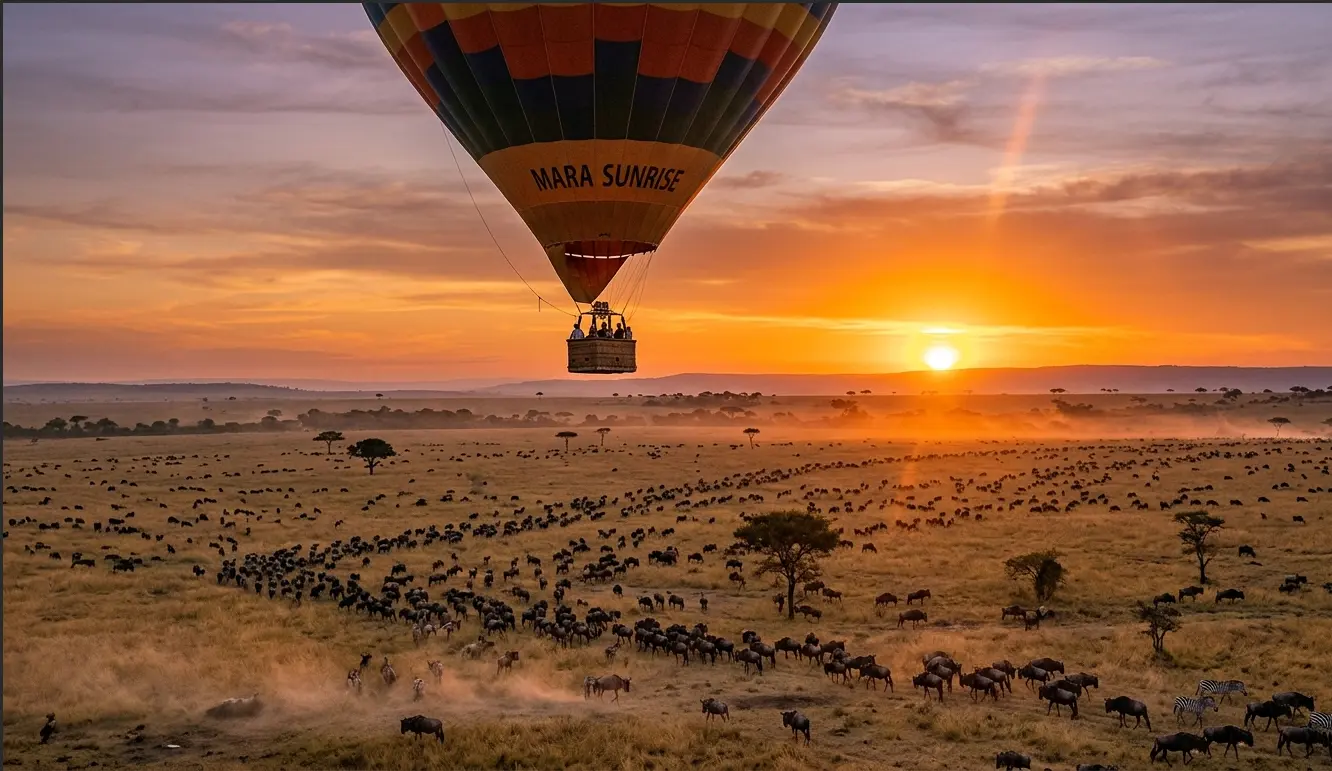
A Masai Mara balloon safari in 2026 is the only way to see the reserve from above—floating silently at altitude as the sun rises over the plains, watching elephants, lions, and wildebeest below without the noise of a vehicle engine or the pressure of another safari car beside you.
A Masai Mara balloon safari in 2026 costs approximately $500 per person for a one-hour flight over the reserve at sunrise. It is worth it during July to October when wildebeest herds are visible below. Outside migration season the experience is beautiful but the wildlife density is lower.
Evans Kimojino, a Mara-based safari guide and Hilmuks ground partner with 1,300+ documented wildlife sightings, has observed balloon clients depart from every launch station in the Mara ecosystem and return with experiences that range from genuinely transformative to mildly disappointing—usually based on three factors: the launch station, the basket position, and the season. His specific observations on all three shape this guide.
Every booking site will show you the price and a photograph of a balloon over a sunset. None of them will tell you which of the five Mara launch stations serves your specific camp, why the centre compartment is quieter for photography, or that the balloon flies silently enough that pilots can drift over a resting leopard without it moving. This guide covers all of that.
QUICK REFERENCE TABLE
|
Factor |
The Reality |
|
Price |
Approximately $500 per person |
|
Duration |
Approximately 1 hour |
|
Passengers |
16 per balloon |
|
Pickup time |
4:00 AM from your camp — no self-transfer required |
|
Noise level |
Quiet and comfortable — not like an aeroplane |
|
Landing |
Smooth — pilots select soft landing spots |
|
Drones |
Completely prohibited |
|
Best Season |
July to October — migration herds visible below |
|
Available |
Both reserve and conservancy camps |
Quick Navigation-Jump to Your Section
1: Is the Masai Mara Balloon Safari Worth $500? The Honest Verdict
When travelers research the masai mara hot air balloon cost, they aren’t just looking for a number; they are asking if the experience justifies the $500 dent in their safari budget. At Hilmuks Safaris, we believe in radical transparency—because the value of a sunrise flight changes significantly depending on which month you choose to visit.
The Price Reality
A Masai Mara hot air balloon safari in 2026 costs approximately $500 per person for a shared 16-passenger flight. According to current Narok County operator standards, this masai mara hot air balloon price typically covers the one-hour flight, the ground transfer from your camp, and a full champagne bush breakfast. However, we advise clients to confirm inclusion at the time of booking, as some budget operators now exclude the breakfast to lower their sticker price.
The Reserve Entry Fee Trap
One detail often glossed over by global booking platforms is that your flight price does not include the Masai Mara National Reserve entry fee. Even if you are staying in a private conservancy, the reserve entry fee is mandatory on the day of your flight because the balloons land within the reserve boundaries.
🛡️ OPERATOR INSIGHT: To avoid being blocked at the gate at 5:00 AM, ensure your park tickets are paid in advance via the official channels. For a step-by-step walkthrough on handling these logistics correctly, see our Masai Mara park fees payment guide.
When the Investment Pays Off
During the Great Migration months of July to October, the balloon flight delivers an aerial perspective that no ground vehicle can replicate. You will witness wildebeest herds stretching to the horizon and river crossings from a vantage point that respects the animals’ space while giving you a “scale” of the Mara ecosystem. At this time of year, a Masai Mara Balloon Safari is arguably the most distinctive wildlife experience in Kenya.
When to Think Twice
Outside of the migration season, while the sunrise over the Mara plains is still a bucket-list visual, the “massed herd” spectacle is absent. We tell our clients honestly: if you are visiting in March, a $500 ground game drive will likely yield more predator encounters and higher wildlife variety than an aerial flight. The flight remains beautiful for the scenery, but the return on investment for wildlife photography is lower in the off-season.
The Champagne Breakfast Tradition
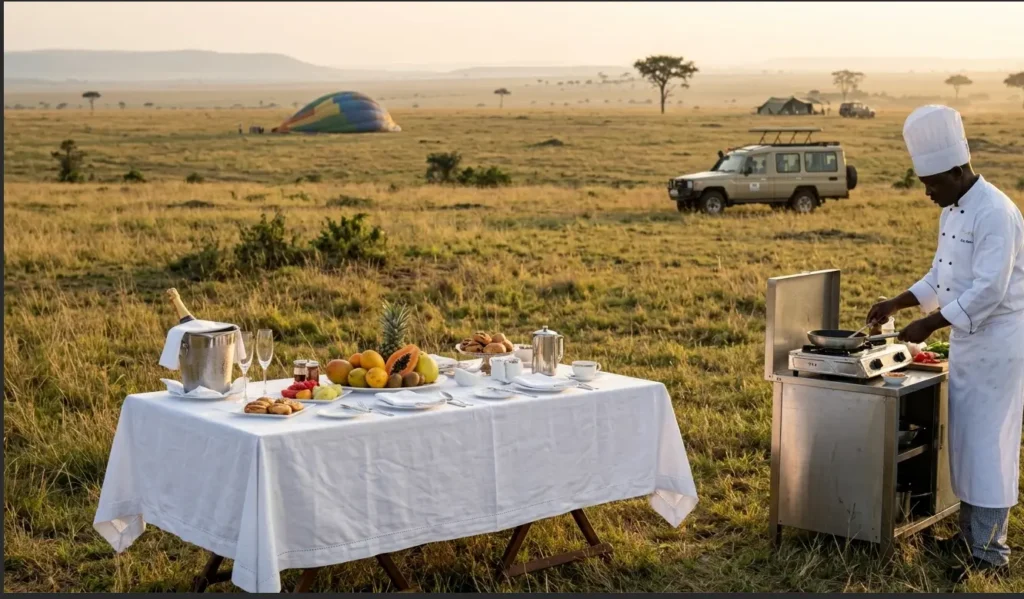
The experience concludes with a full bush breakfast set up exactly where the wind happens to land your basket. You’ll find white linen tables, a cooked-to-order breakfast, and chilled champagne served in the open savannah. This tradition is often the highlight of the morning, providing a quiet moment to digest the scale of the plains before your mid-morning game drive.
🛡️ OPERATOR INSIGHT: At Hilmuks Safaris, we prioritize your experience over a commission. We recommend balloon flights primarily during the migration months; for off-season visits, we present it as a luxury scenic option so you can make an informed choice with your travel budget.
Now that we’ve looked at the financial reality, let’s get into the 4:00 AM logistics and what actually happens once you reach the launch site…
2: What a Masai Mara Balloon Safari Actually Involves — From 4 AM Pickup to Breakfast
The logistics of a Masai Mara Balloon Safari are a well-oiled machine designed to get you into the air precisely as the sun breaks the horizon. Because this is a sunrise-dependent activity, the schedule is non-negotiable and starts while the rest of the Mara is still asleep.
The 4:00 AM Pickup
When you book a flight, the operator handles the logistics entirely; you do not drive yourself to the launch site. A 4×4 transfer vehicle will arrive at your camp or lodge at approximately 4:00 AM to collect you. Our ground team confirms that no camp is too remote for this standard service, whether you are staying deep within the reserve or out in a private conservancy.
Pre-Flight Preparation
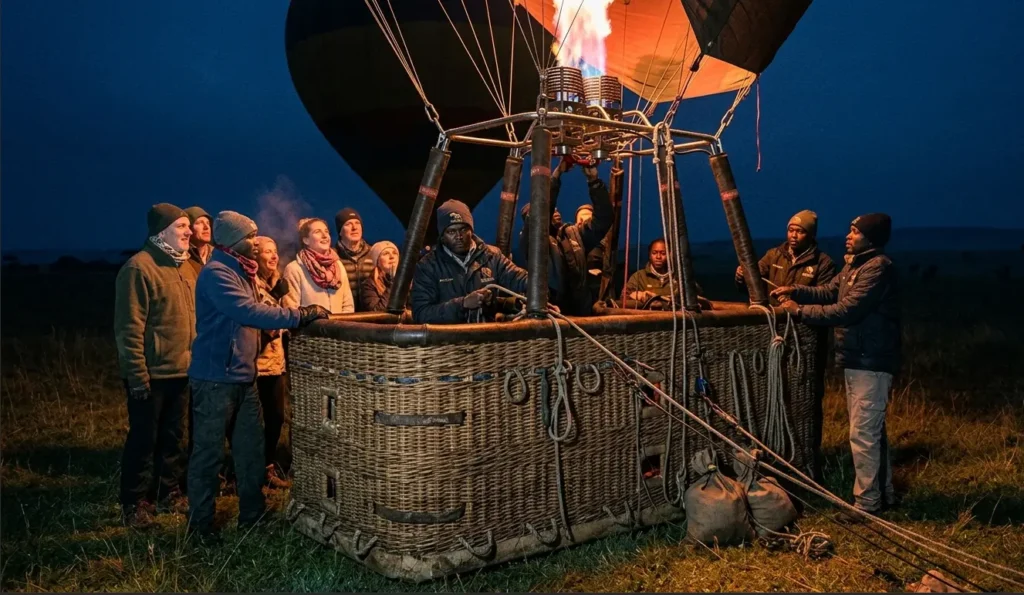
You arrive at the launch site in total darkness, greeted by the roar of ground burners. Watching the massive colorful envelope of the masai mara balloon slowly inflate against the pre-dawn sky is a spectacle in itself. Before boarding, the pilot will brief all 16 passengers on basket protocol, safety positions for landing, and what to expect once airborne.
Altitude, Movement, and the “Silent Drift”
A hot air balloon in Masai Mara operates on a mix of physics and pilot intuition. At high altitudes, you gain a massive perspective of the river systems and the distant Oloololo Escarpment. At lower altitudes, the pilot uses the wind to drift over specific animal groups, providing an intimate view without the vibration of a car engine.
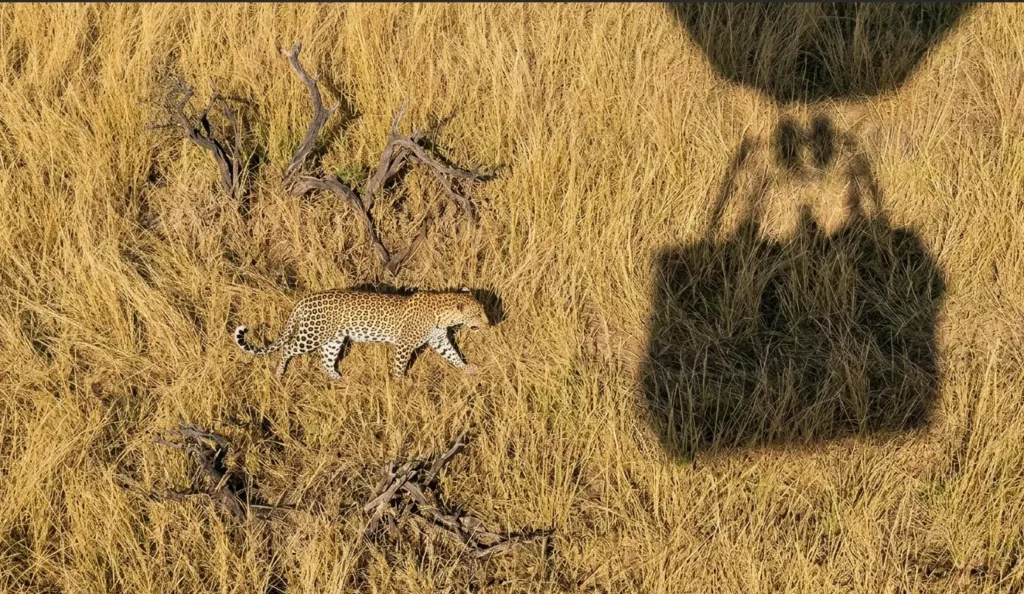
🛡️ OPERATOR INSIGHT: The most striking part of the flight isn’t the height, but the silence. Experienced pilots time their burner firings to gain altitude early, then descend in total silence to drift over predators. This “silent drift” allows you to hover over a leopard or a pride of lions without them even looking up, a level of immersion that ground vehicles simply cannot match.
The Smooth Landing
As the flight ends, the pilot selects a flat, soft landing spot—usually a clear patch of savannah. Contrary to the “rough landing” myths, our ground team confirms that these landings are remarkably smooth. The basket typically settles gently onto the grass rather than jolting, and the chase crew is usually already at the site waiting to assist with your exit.
The Champagne Breakfast
Breakfast isn’t at a fixed restaurant; it’s a pop-up luxury experience wherever you land. The crew sets up white linen tables in the middle of the savannah, serving a full cooked breakfast accompanied by chilled sparkling wine, fresh fruit, and coffee. You’ll spend about an hour eating and sharing stories before the transfer vehicle takes you back to your camp for the mid-morning.
Seasonal Timing for the Flight
While the balloon flies year-round, the “best” experience is tied to the movement of the herds. July to October is the undisputed peak, as the Great Migration delivers thousands of wildebeest and zebras directly into your flight path. To understand why this timing is so critical for photography and sightings, see our Great Migration Masai Mara complete operator’s guide.
- July – October: Peak Migration. Thousands of animals visible from altitude.
- January – February: Excellent predator activity and clearer skies.
- April – May: High risk of weather cancellations due to long rains; generally not recommended for balloon planning.
- June: Pre-migration window with lush green landscapes and good visibility.
Now that you know how the morning unfolds, let’s look at the five specific launch stations and which one serves your camp…
3: The 5 Masai Mara Balloon Launch Stations — Which One Serves Your Camp
Evans has identified five distinct balloon launch stations across the Mara ecosystem. The station that serves you for your Masai Mara Balloon Safari depends entirely on your choice of accommodation. Choosing a lodge without knowing its specific balloon access is a common planning error that results in either missing the flight entirely or enduring an exhausting two-hour pre-dawn transfer.
Station 1: The Talek Hub
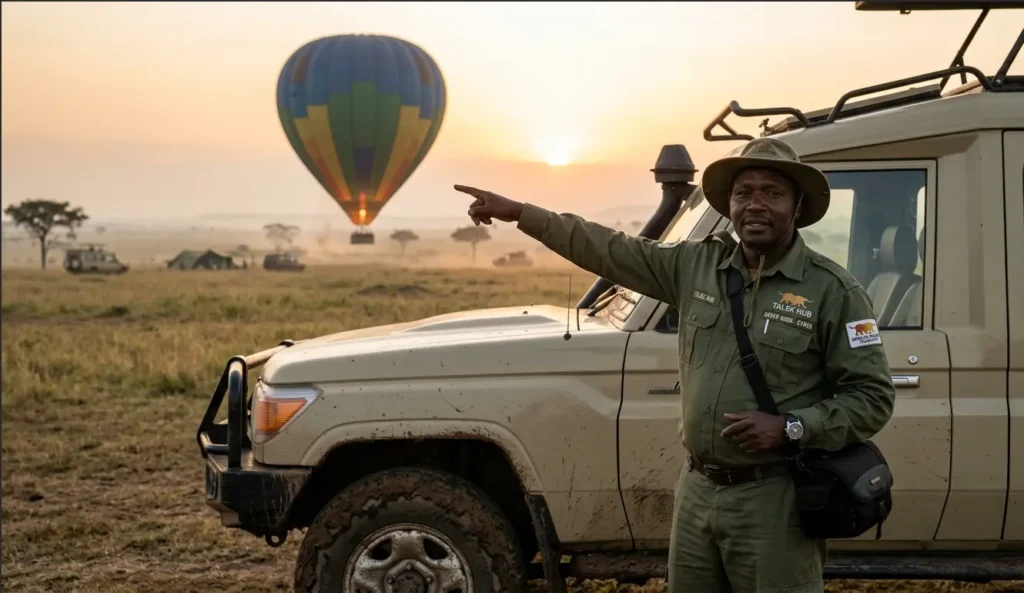
This is the largest and busiest launch station for any hot air balloon masai mara operation. Located on the Talek side of the reserve, approximately four separate balloon companies operate from this hub in 2026, making it the most accessible and reliably bookable option. If you are staying at most reserve camps south and east of the Mara River, this is where your flight will likely begin.
Station 2: The Mara Triangle
This station serves the western sector of the reserve and is widely considered the most scenic for ascent. It offers dramatic, direct views of the Oloololo Escarpment as you rise into the morning air. It primarily serves guests staying at camps located within the Triangle area itself.
Station 3: Mara North
This station serves private conservancy camps, specifically those in the Lemek and Ol Toro areas. It provides local access for guests who want a Masai Mara hot air balloon experience without the long commute to the Talek Hub. For travelers debating between staying here or in the main reserve, see our Masai Mara National Reserve vs Conservancy guide.
Station 4: Mara Serena (Exclusive)
This is an exclusive launch station located within the grounds of the Mara Serena Safari Lodge. Unlike the other hubs, this is not a general-access station; bookings are typically handled through the lodge directly for their resident guests.
Station 5: Little Governor’s
This station serves the northern reserve area, specifically properties in the Governor’s Camp group and nearby luxury lodges. According to our ground observations, this station provides the primary access for guests staying at Kichwa Tembo, Kilima, Enchipai, and Angama Mara.
🛡️ OPERATOR INSIGHT: At Hilmuks Safaris, we confirm the launch station for every client’s accommodation before their safari begins. If balloon access is a priority for your visit, we factor the station’s location into our accommodation recommendation—not just the lodge’s room features—to ensure you don’t spend half your night in a transfer vehicle.
Your camp’s geographic location is the single biggest factor in your balloon logistics. While the Talek Hub offers the most booking flexibility, the exclusive stations like Serena or Little Governor’s offer a more intimate take-off with fewer crowds.
Now that you know where you’ll be taking off, let’s discuss how to capture the perfect shot from the basket…
4: Photography from the Basket — The Centre Position and the Silent Drift
Capturing professional-grade images from a Masai Mara Balloon Safari requires more than just a good camera; it requires understanding the physics of the basket. Because you are shooting from a moving platform that relies on periodic bursts of intense heat, stability is your primary challenge.
The Centre Compartment Advantage
A standard 16-seater Masai Mara hot air balloon basket is divided into compartments arranged around a central pilot section where the burners are mounted. Our ground team has observed a consistent trend: photographers positioned in the centre-adjacent compartments report significantly sharper images than those at the outer edges. This is because the burner is mounted directly above the central axis, meaning the outer edges of the basket experience slightly more “pendulum” vibration during burner firings.
Practical Advice for Sharp Shots
If you are carrying a professional setup, we recommend informing the ground crew or the pilot during boarding that you are a photography-focused client. While they cannot always guarantee a specific spot due to weight distribution requirements, pilots are usually happy to accommodate a request for a centre-adjacent position if space allows. To ensure you have the right glass for these specific aerial angles, see our Masai Mara migration photography gear guide.
The Rotation Protocol
While the wind dictates the direction of the Masai Mara balloon, the pilot controls the orientation of the basket to ensure everyone gets a 360-degree view. They typically rotate the balloon during key moments—like the first break of the sunrise or when passing over a river bend—so that every compartment has an unobstructed line of sight. If you have a specific compositional goal, such as capturing the Oloololo Escarpment in the background of a herd shot, communicate this to the pilot early in the flight.
🛡️ OPERATOR INSIGHT: The “Silent Drift” is an operator secret that separates veteran pilots from the rest. At high altitudes, the burner produces a characteristic roar that can startle animals, but experienced pilots will pre-heat the envelope at a higher elevation and then descend in total silence over a pride of lions. Our team confirms that at low altitude, the balloon can pass within 200 metres of a resting leopard without it flinching, as the only signal of your presence is a silent, moving shadow.
Recommended Camera Settings
- Shutter Speed: Minimum 1/1000s to negate the micro-vibrations from the burner.
- Lenses: A 24-70mm or 70-200mm is far more useful than a 600mm prime; at balloon altitudes, you are capturing “wildlife in a landscape” rather than tight portraits.
- ISO: Don’t be afraid to push to ISO 800 or 1600 during the first 15 minutes of dawn to maintain your shutter speed.
Now that your gear is ready, let’s cover the strict rules and trade-offs that most booking sites conveniently leave out of their brochures…
5: Rules, Restrictions and Honest Trade-Offs — What the Booking Sites Don’t Mention
A Masai Mara Balloon Safari is a strictly regulated aviation activity, not just a tourist excursion. While aggregator sites focus on the beautiful sunsets, there are operational hard lines enforced by the Kenya Civil Aviation Authority (KCAA) and local rangers that can cancel your plans if you aren’t prepared.
The Absolute Ban on Drones
Our ground team confirms that drones are completely prohibited on all flights and throughout the reserve without written Narok County Government authorization. If you attempt to board a hot air balloon in Masai Mara with a drone, it will be confiscated by the ground crew or rangers at the launch site. This rule is strictly enforced to protect wildlife and maintain aviation safety; leave your drone at your camp to avoid permanent loss of equipment.
Pregnancy and Physical Requirements
For safety reasons, all licensed operators prohibit pregnant passengers from flying—this is a non-negotiable aviation rule, not a guideline. Additionally, passengers must be able to stand for the full hour and board the basket unassisted, which involves a step-up of approximately 60 to 80 centimeters. Most operators set a minimum age of 6 or 7 years, though we recommend confirming specific height requirements at the time of booking to ensure children can actually see over the basket rim.
The Weather Cancellation Reality
Because ballooning depends entirely on stable wind and visibility, cancellations can happen even in the “dry” season. If your flight is cancelled due to heavy rain or high-altitude winds, most operators will attempt to reschedule you for the following morning.
🛡️ OPERATOR INSIGHT: To protect your investment, we always advise booking your flight for the first available morning of your stay rather than the last. This creates a “buffer” day, allowing you to reschedule if the weather turns, whereas a last-day cancellation usually results in a refund but a missed experience.
The Honest Trade-Off: Sightings vs. Scale
It is a spiky but necessary truth: a balloon flight is the most expensive activity in the Mara, yet it is rarely the most “wildlife-productive” hour of your trip. A veteran ground guide on a focused game drive will almost always show you more individual species and hunting action than a pilot drifting with the wind. The value of the balloon lies in the total silence, the aerial scale of the landscape, and the champagne breakfast—not in the volume of animal encounters.
6: Conclusion-Masai Mara Balloon Safari
The Masai Mara balloon safari in 2026 is the right activity for the right client at the right time. It is a $500 investment that delivers its full, transformative value during the migration season, while offering a serene, scenic, but quieter experience outside those months.
Our lead guide, who has monitored client feedback from every launch station across multiple seasons, puts it simply: the travelers who remember the flight most vividly are those who witnessed the wildebeest carpet from above. To get the most out of your flight, book between July and October, request a centre-adjacent basket position for the steadiest photos, and ensure your drone stays safely at camp.
7: FAQ — Expert Answers on the Masai Mara Balloon Safari 2026
How much does a balloon safari in Masai Mara cost?
A Masai Mara balloon safari costs approximately $500 per person in 2026 for a shared 16-passenger flight. This typically includes the one-hour flight and a champagne bush breakfast after landing. The Masai Mara National Reserve entry fee is a separate cost payable on the day of your balloon flight — this is not included in the flight price. Confirm exactly what your quoted price includes with the operator at the time of booking.
Is the Masai Mara hot air balloon worth it?
A Masai Mara hot air balloon safari is worth it specifically during July to October when the Great Migration herds are in the reserve — the aerial view of massed wildebeest, river crossings from above, and predator activity on the plains is an experience no ground vehicle can replicate. Outside migration season the flight is a beautiful scenic experience but the defining visual of the massed herds is absent. At approximately $500 per person, the value calculation depends on your season, your photography goals, and whether the aerial perspective is itself what you are paying for.
How long is a Masai Mara balloon safari?
The flight itself lasts approximately one hour. Add 30 minutes for the pre-dawn drive from your camp to the launch site, 20 to 30 minutes for boarding and pre-flight briefing, and 45 to 60 minutes for the champagne breakfast after landing. Total time from camp departure to return is typically 3 to 4 hours. Pickup from your camp is at approximately 4:00 AM.
Can you do a hot air balloon while pregnant?
No — all licensed Masai Mara balloon operators prohibit pregnant passengers from flying. This is an operational safety rule applied by all operators, not a guideline. If you are pregnant, the balloon safari is not available. There are no exceptions to this rule.
Are drones allowed on a Masai Mara balloon safari?
No. Drones are completely prohibited throughout the Masai Mara National Reserve at all times without specific Narok County Government authorisation. This prohibition applies on the balloon flight and on the ground throughout your safari. Bringing an unauthorised drone risks confiscation. Do not attempt to launch a drone from the basket or from any point inside the reserve.
Is the hot air balloon landing rough?
No — Masai Mara balloon landings are smooth. Pilots specifically select soft, flat ground for landing and position the basket’s descent to settle rather than impact. The landing experience is significantly smoother than a light aircraft landing. Our ground team confirms consistent smooth landings across all five launch station areas.
What is the best time of year for a Masai Mara balloon safari?
July to October is the best time for a Masai Mara balloon safari in 2026 because the Great Migration wildebeest herds are in the reserve and visible from altitude. The combination of aerial scale views of the herds, potential river crossing overflights, and peak predator activity makes this window distinctly more spectacular than other months. January and February offer good conditions with active predator sightings. April and May carry the highest weather cancellation risk due to long rains — not recommended for balloon flight planning.