Email:
 Phone:
 WhatsApp:

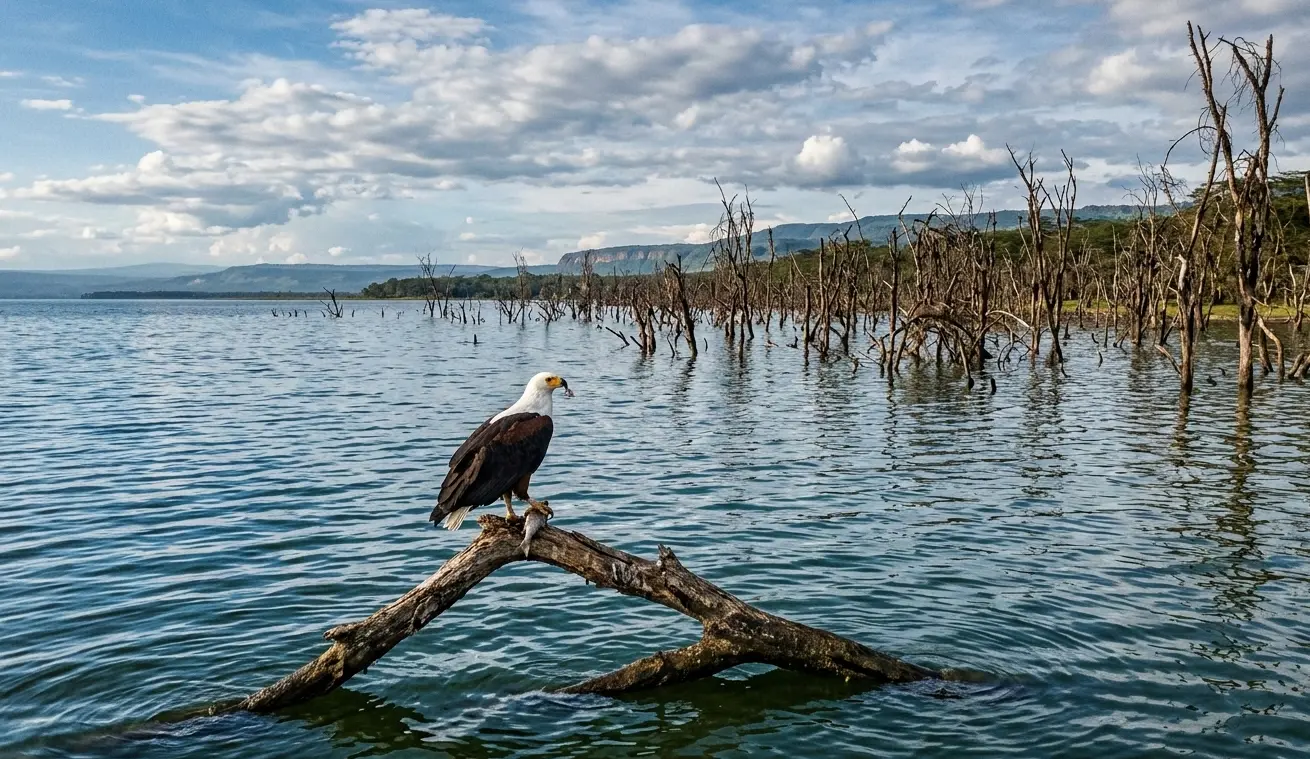
Lake Nakuru Water Levels in 2026 have reached a historic “High-Water Mark,” fundamentally altering the park’s geography. If you are using a guide from 2021 or earlier, your map is officially obsolete. The lake has expanded from its original 43km² to nearly 80km², submerging the old northern tracks and forcing a total shift in wildlife behavior.
What are the Lake Nakuru Water Levels in 2026? Lake Nakuru Water Levels in 2026 are at a record high, with the shoreline expanding by over 40% since 2010. This flooding has submerged the old Main Gate tracks, diluted the lake’s salinity, and shifted wildlife populations toward the higher Naishi and Lanet sectors.
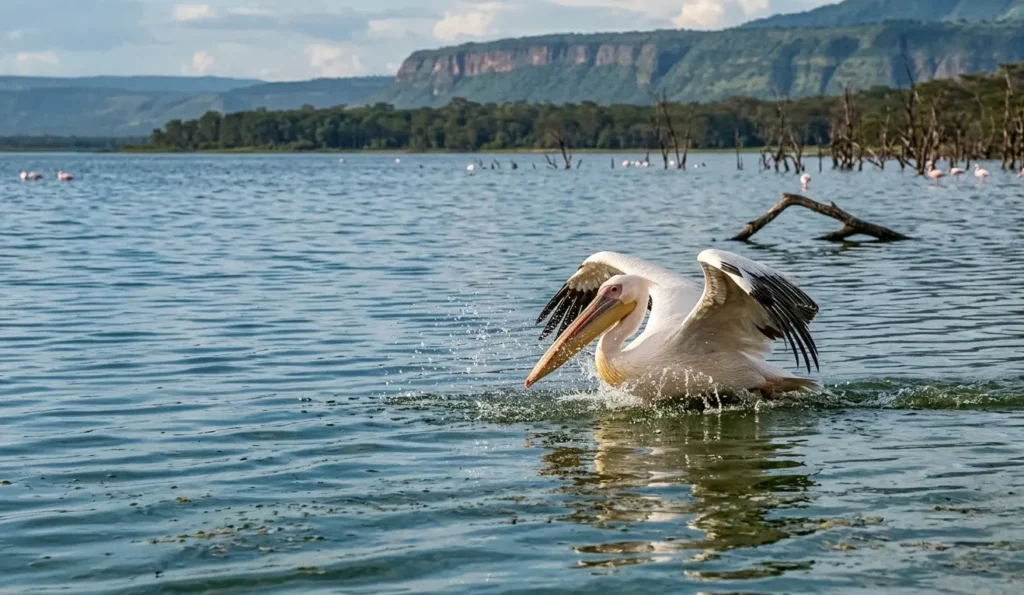
While most generic travel sites still describe Nakuru as a “Soda Lake” filled with millions of flamingos, the ground reality for a 2026 safari is very different. The rising Lake Nakuru water levels have triggered a “Freshwater Pivot,” turning the lake into a hybrid ecosystem where Tilapia now thrive and African Fish Eagles have replaced the pink horizon.
If you are planning a visit, knowing the current Lake Nakuru water levels isn’t just a matter of curiosity—it is a matter of logistical survival. From the submerged “Ghost Forest” to the new “Lion Islands,” here is the 2026 operator’s report on how the water has rewritten the rules of the park.
But that is not all… before you head out, you need to know which gates are actually reachable. If you’re coming from the city, check our Nairobi to Nakuru 2026 Transport Guide to avoid the Rironi construction delays that often keep travellers on the road for hours.
Quick Navigation: Jump to your Section
The 2026 Reality Check: Is Lake Nakuru Still a “Soda Lake”?
If you are following a guidebook printed before 2026, you are likely looking for a “Soda Lake” filled with millions of pink flamingos. The truth on the ground is that the rising Lake Nakuru water levels have triggered a “Freshwater Pivot,” significantly diluting the lake’s once-lethal alkalinity. This shift has fundamentally altered the Lake Nakuru shorelines, allowing freshwater tilapia to thrive where only microscopic algae used to exist.
As an operator who navigates these tracks weekly, I can tell you that the “Pink Lake” is now a “Blue-Green Hybrid.” The dilution means the Spirulina algae—the primary food for lesser flamingos—has drastically declined, causing the famous flocks to migrate toward the saltier shores of Lake Bogoria. While it is technically still classified as alkaline, the influx of rising Rift Valley lakes has introduced an entirely new ecosystem.
🛡️ OPERATOR INSIGHT: Do not let the “missing flamingos” discourage you; the freshwater influx has brought a massive surge in African Fish Eagles and Great White Pelicans. For a transparent look at what to expect regarding bird populations, see our honest flamingo insider guide before you finalize your 2026 itinerary.
This ecological transition is why we no longer see the vast “pink carpets” from a decade ago, but rather a more diverse birding map. The Lake Nakuru water levels have essentially turned the park into a premier destination for raptor sightings and freshwater birdlife.
Now that we’ve debunked the “Soda Lake” myth, let’s look at the “Ghost Forest” and how the expanding shoreline is physically rewriting the park’s map…
The “Ghost Forest” & The 82km² Expansion Forecast
The most striking visual evidence of the current Lake Nakuru water levels is the eerie “Ghost Forest” of submerged Acacia Xanthophlea trees. Recent hydrological data and the Lake Nakuru water levels forecast suggest that the lake is on track to double its historical size, reaching nearly 82km² by the next decade. This massive expansion is part of a larger trend affecting rising Rift Valley lakes, where Lake Nakuru shorelines have moved miles inland, swallowing former grasslands and administrative buildings.
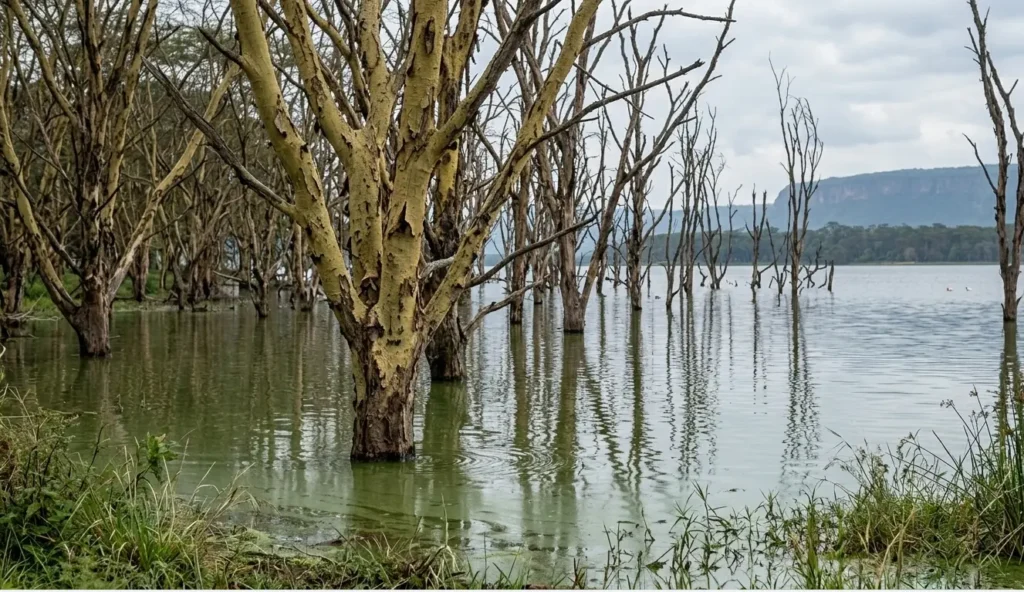
While academic reports treat this as a climate statistic, on the ground, it has created a specialized hunting zone for predators. These submerged acacia trees have become tactical vantage points for leopards and the park’s unique tree-climbing lions, who use the high branches to stay dry while scouting for prey. However, this 2030 expansion projection means that the “Old Nakuru” map you might find in vintage guidebooks is physically underwater.
🛡️ OPERATOR INSIGHT: The flooding has made the northern tracks near the Main Gate a permanent “no-go” zone for low-clearance vehicles. To avoid getting stuck in the black cotton soil that now borders the new shoreline, see our Lake Nakuru self-drive route hacks to find the elevated tracks that remain open year-round.
This landscape shift is permanent, and the KWS has already begun decommissioning old campsites that are now three meters below the surface. Our best safari lodge Lake Nakuru verdict identifies the flood-proof properties that remain operational despite these changing waterlines. Such a “wet” reality actually concentrates the wildlife into smaller, high-ground pockets, making sightings more intense but requiring a precise navigation strategy.
Now that we’ve mapped the expanding shoreline, let’s look at the “Lion Island” effect and why the floods have actually made the big cats easier to find…
The “Lion Island” Effect: Predator Behavior in the Naishi Sector
The rising Lake Nakuru water levels have created a fascinating geographical “squeeze” that most visitors misunderstand as simple wildlife displacement. Instead of fleeing the park, the local prides have retreated to “Islands” of high ground, specifically within the Naishi plains and the southern ridge. This concentration has made the answer to “how many lions in Lake Nakuru” less about raw numbers and more about density; sightings are now more predictable because the habitable territory has physically shrunk.
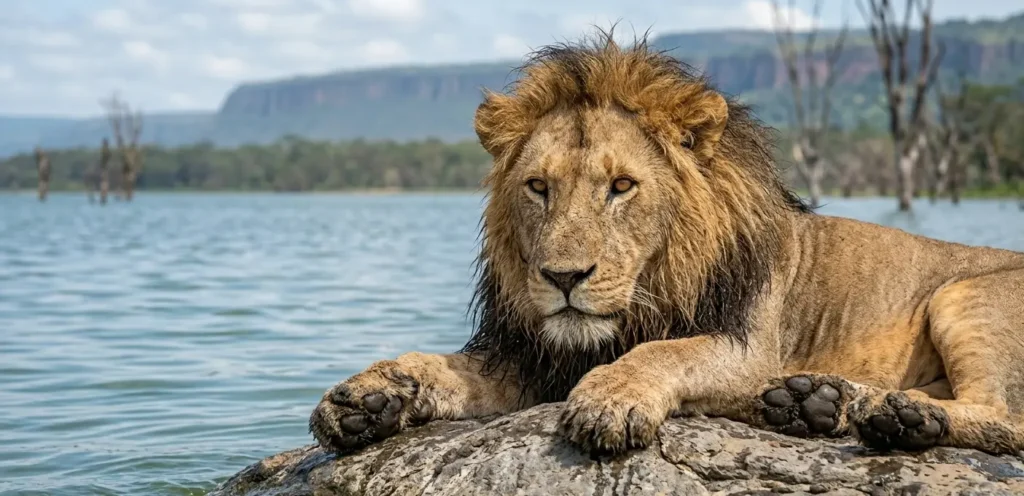
In 2026, we are seeing what we call the “Wet-Paw” behavior, where lions are increasingly found lounging on the massive basalt rocks or even in the lower branches of the remaining dry acacias. The Lake Nakuru flooding 2026 has essentially eliminated the tall grass hunting grounds in the northern basin, forcing predators and prey into a high-visibility coexistence on the southern grasslands. For a photographer, this means fewer hours spent searching and more time focused on active, localized prides that can no longer hide in the now-submerged marshes.
🛡️ OPERATOR INSIGHT: While the lions are easier to spot, the “squeeze” has made them more territorial and prone to crossing the main tracks near the Naishi rangers’ post. To ensure you are looking in the exact drainage lines where they congregate during the heat of the day, see our 2026 guide to the tree-climbing lions for the specific GPS coordinates we use on the ground.
This shift in behavior is a direct result of the Lake Nakuru water levels encroaching on the traditional buffalo grazing corridors. We’ve observed that the lions now wait at the very edge of the new Lake Nakuru shorelines, intercepting zebras that are forced to navigate the narrow dry strips between the water and the cliff faces. It is a high-drama environment that didn’t exist five years ago, offering a raw look at survival in a changing landscape.
Now that we’ve located the predators on their new “islands,” we need to handle the practical side of your 2026 visit, starting with the eCitizen logistics that the floods have made slightly more complicated…
Logistics Survival: Paying Fees Amidst Rising Rift Valley Lakes
The reality of rising Rift Valley lakes isn’t just ecological; it is administrative, especially regarding park entry. The expanding Lake Nakuru water levels have physically reached several fiber optic relay stations and solar arrays at the lower gate offices. In 2026, this has led to frequent signal “blackouts” at the Main Gate, making it nearly impossible to log into eCitizen once you are already in the queue.
KWS enforcement is stricter than ever in 2026, and “no network” is no longer an acceptable excuse for manual payment. Because the Lake Nakuru flooding 2026 has forced some gate operations into temporary containers on higher ground, their local Wi-Fi range is extremely limited. You must complete your payment and generate your QR code while you still have a stable 5G signal in Nakuru City or before leaving Nairobi.
🛡️ OPERATOR INSIGHT: Since the floods have disrupted the local network at the gate, trying to pay on-site can lead to a 2-hour delay while you wait for a signal. To ensure a seamless entry, see our 2026 KWSPay step-by-step guide to secure your QR code before you reach the park boundary.
Managing your park logistics in 2026 also requires a change in how you view your vehicle’s capability. The Lake Nakuru water levels mean that the “Main Circuit” is no longer a loop but a series of out-and-back tracks. If you are on a self-drive mission, don’t just check the Lake Nakuru national park entry fees; check your tire tread and clearance, as the KWS has introduced a specific fine for “negligent blockage of tracks” if you get stuck in a clearly marked flooded zone.
Now that your paperwork is sorted and your vehicle is prepped for the new shoreline, let’s look at the long-term forecast and whether the “Old Nakuru” will ever return…
Navigation Secrets: Gates and Tracks Lost to Lake Nakuru Flooding 2026
The Lake Nakuru water levels have turned the northern sector of the park into a logistical minefield that traps dozens of unsuspecting tourists every month. As of 2026, the Lake Nakuru flooding 2026 has permanently reclaimed the traditional “Lake Circuit” tracks near the Main Gate, leaving behind a thick layer of black cotton soil. If you follow your GPS blindly through the northern entrance, you are likely to encounter “Main Gate swamp traps”—innocent-looking puddles that hide deep, axle-breaking mud.
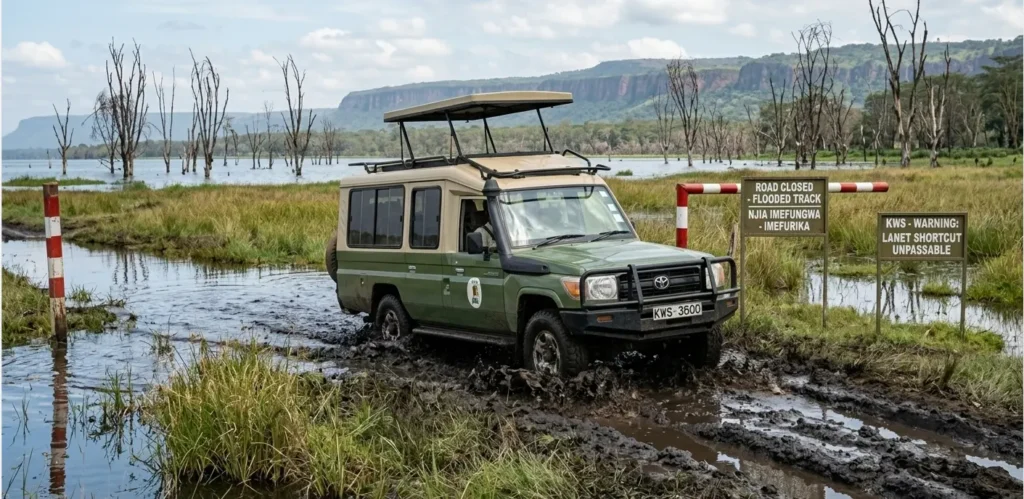
To save your safari, the ultimate operator secret is to prioritize Lanet Gate access over the Main Gate whenever possible. Because the Lake Nakuru shorelines have moved so far inland, the Lanet entrance places you directly on the elevated, hard-packed ridges that remain dry year-round. This tactical shift allows you to bypass the flooded northern bypasses entirely, giving you immediate access to the lion-rich Naishi sector without risking a “mud-stuck” delay.
🛡️ OPERATOR INSIGHT: KWS rangers now strictly enforce a KES 10,000 recovery fee for any vehicle that gets stuck after ignoring “Closed Track” signs near the rising water. To ensure you don’t start your day with an expensive tow, check our 2026 guide on which Lake Nakuru gate to use to see the current dry-track map.
While the Main Gate is more famous, it is currently the most difficult entry point for low-clearance vehicles due to the unpredictable Lake Nakuru water levels. We consider 4×4 essential tracks to be the only safe way to navigate the southern connection between the Hippo Point and the Baboon Cliff. If you are in a 2WD vehicle, your movement will be restricted to less than 30% of the park’s total area, making your choice of gate even more critical for a successful day trip.
The 2026 Forecast: Will Lake Nakuru Double in Size by 2030?
The most common question we receive on the ground is whether the current Lake Nakuru water levels are a temporary anomaly or a permanent takeover. Current hydrological trends for rising Rift Valley lakes suggest that the 82km² expansion isn’t just a possibility; it is already becoming the new baseline for the park. The Lake Nakuru water levels forecast indicates that the basin is effectively “resetting” to its prehistoric boundaries, meaning the acacia forests that defined the park in the 1990s are likely gone for good.
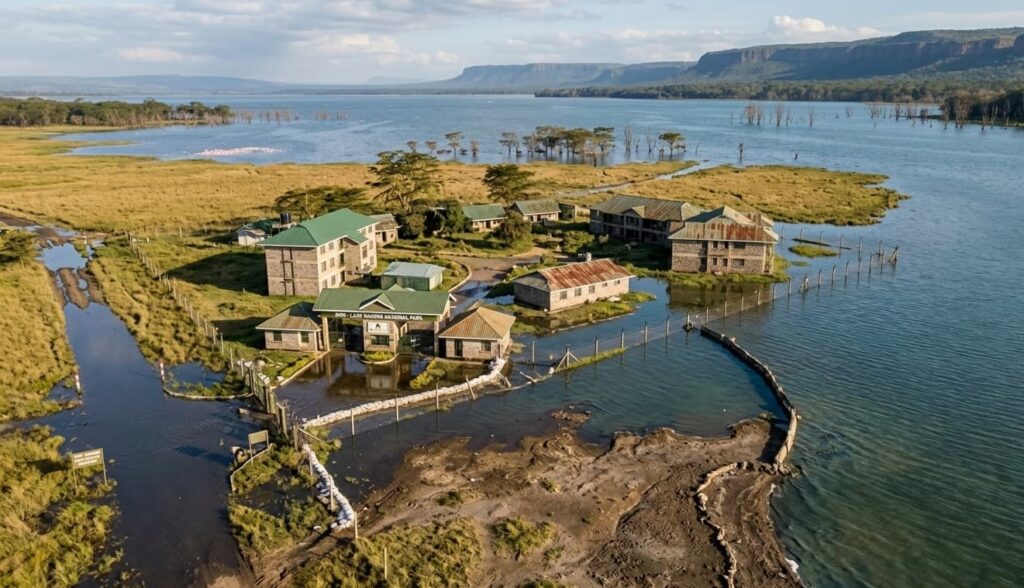
In 2026, the KWS and local conservationists have shifted their strategy from “flood mitigation” to “landscape adaptation.” This means new, elevated infrastructure is being planned for the Naishi and Lanet sectors, which are expected to remain dry even under extreme scenarios. While the Lake Nakuru shorelines continue to creep toward the park’s electric fence, the result is a smaller but more concentrated wildlife sanctuary that offers some of the most intense predator-prey interactions in East Africa.
💡 PRO TIP: Because the park geography is changing so rapidly, your choice of accommodation is now a tactical decision rather than just a luxury one. To stay ahead of the rising waters and ensure you are positioned near the most active wildlife “islands,” see our complete 2026 guide for Lake Nakuru lodges to find the properties that haven’t been cut off by the new shoreline.
Visiting the park in 2026 is a rare chance to witness a massive geological shift in real-time. The Lake Nakuru water levels have created a “New Nakuru”—one that is wetter, greener, and arguably more dramatic than the soda lake of the past. If you plan correctly, respect the new boundaries of the water, and use the right gates, it remains the most rewarding short-haul safari from Nairobi.
Conclusion: Embracing the “New” Lake Nakuru in 2026
The shifting Lake Nakuru water levels are more than just a seasonal flood; they represent a permanent transformation of one of Kenya’s most iconic parks. In 2026, success on a Nakuru safari depends entirely on your ability to adapt to a landscape where the Lake Nakuru shorelines have swallowed old landmarks and created entirely new predator corridors. By trading outdated “Soda Lake” myths for ground-level operator facts, you position yourself to see a version of the park that almost no automated guidebook or generic travel site has caught up with yet.
Whether you are tracking the tree-climbing lions in the “Ghost Forest” or navigating the rising Rift Valley lakes via the Lanet Gate, the message for 2026 is clear: the water has rewritten the rules. Don’t rely on generic blogs that still promise “millions of flamingos” in a basin that has physically changed. Instead, come prepared for the high-drama, freshwater-driven ecosystem that Lake Nakuru has become, where the animals have adapted, and you must too.
If you respect the power of the water, pay your fees in advance to avoid gate signal traps, and choose your routes based on current 2026 reality, Lake Nakuru remains the most rewarding short-haul safari from Nairobi. But navigating the water levels is only half the battle; you still need to know where the rhinos have moved to avoid the mud, how to beat the Rironi traffic on your way down, and which specific lodges haven’t been cut off by the expanding lake.
For the ultimate 2026 advantage, you’ll want to see our insider’s guide to guaranteed rhino sightings to find their new high-ground territories. If you are driving from the city, don’t leave without checking our Nairobi to Nakuru road hacks to avoid the construction delays that can eat into your game drive time.
FAQs: Your 2026 Lake Nakuru Water Level Questions Answered
Is Lake Nakuru still flooded in 2026?
Yes. While the water levels fluctuate seasonally, the Lake Nakuru flooding 2026 remains a reality. The lake is currently nearly double its 2010 size, covering approximately 80km². Key infrastructure, including the old Main Gate and several northern circuit roads, remains submerged. Always check the dry-track map before entering to avoid the newly formed “swamp traps.”
Why are the Rift Valley lakes rising so fast?
The rising Rift Valley lakes are driven by a combination of three factors: increased regional rainfall due to climate change, heavy siltation from upstream farming that makes the lake basins shallower, and deep-seated geological shifts within the African Rift. This is not a temporary flood but a long-term “landscape reset.”
Can you still see flamingos at Lake Nakuru in 2026?
You can, but the “Pink Carpet” effect is rare. Because the Lake Nakuru Water Levels have diluted the lake’s salinity, the specialized algae that flamingos eat has decreased. You will see scattered flocks, but the park has now become more famous for its massive populations of Great White Pelicans and African Fish Eagles that thrive in the newer, fresher water.
Is the road from Nairobi to Lake Nakuru open?
The main A104 highway is open, but travel times are unpredictable in 2026 due to the Rironi construction and seasonal flash floods near the escarpment. We recommend using the Lanet Gate shortcut to bypass Nakuru city traffic and the flooded northern park sections. To plan your trip timing, see our Nairobi to Nakuru transport guide for the latest “Rironi Construction Hacks.”