Email:
 Phone:
 WhatsApp:

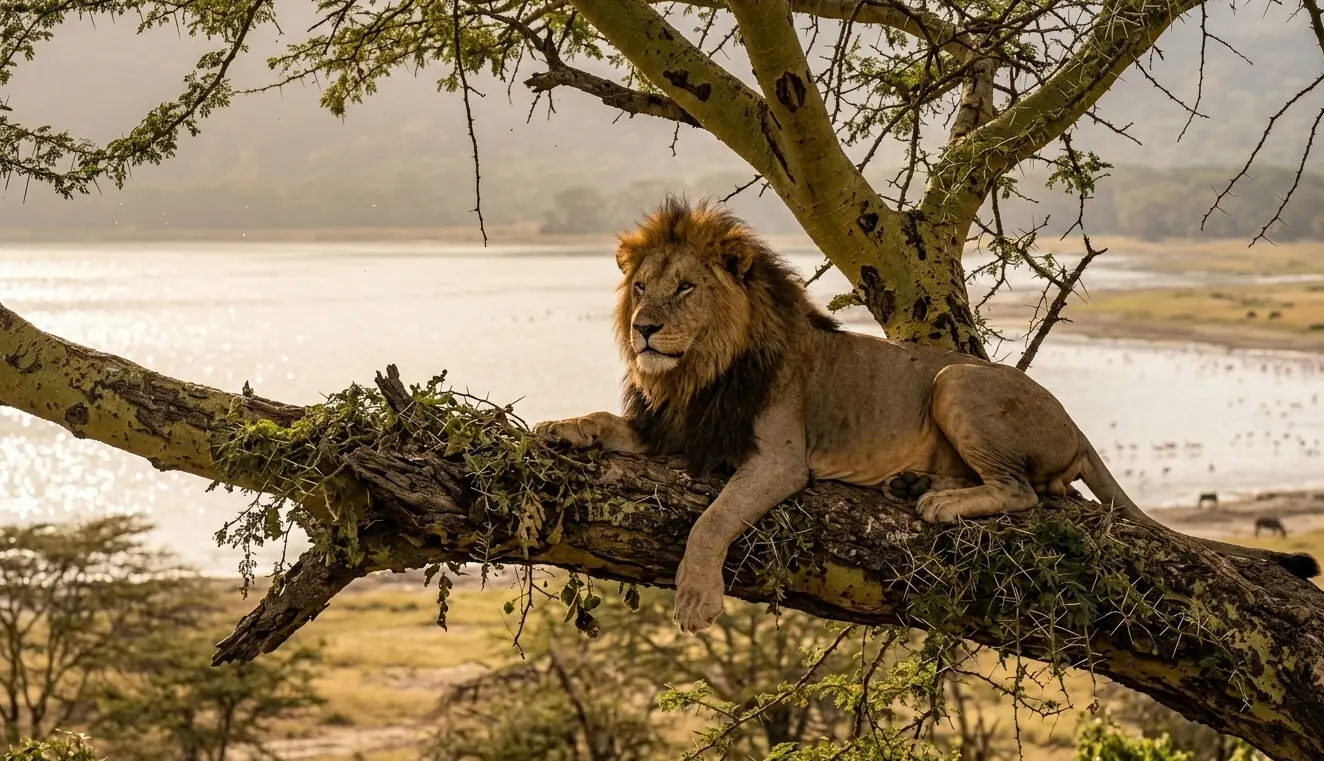
Tree Climbing Lions Lake Nakuru are a specialized population of Panthera leo that habitually climb acacia trees to escape the rising water levels of 2026. Unlike lions elsewhere, Lions in Lake Nakuru use the canopy to regulate body temperature and find dry refuge away from the park’s flooded, alkaline soil.
While often considered one of the 12 best things to do in Lake Nakuru, seeing these predators in the canopy is no longer just a matter of luck. If you are looking for Lions in Lake Nakuru, you’ve likely heard the outdated myth that they only climb to escape tsetse flies.
While that was the standard answer for decades, our current ground reports for 2026 reveal a much more fascinating “Wet-Paw” reality. Due to the habitat squeeze caused by the rising lake, the traditional “living rooms” of the local prides are often damp or submerged. This environmental shift has turned the park into a premier destination for Lake Nakuru wildlife sightings 2026, specifically for photographers hunting for that rare shot of a 400-pound predator lounging on a branch.
Quick Navigation: Jump to your Section
The “Wet-Paw” Reality: Why Lions in Lake Nakuru Climb in 2026
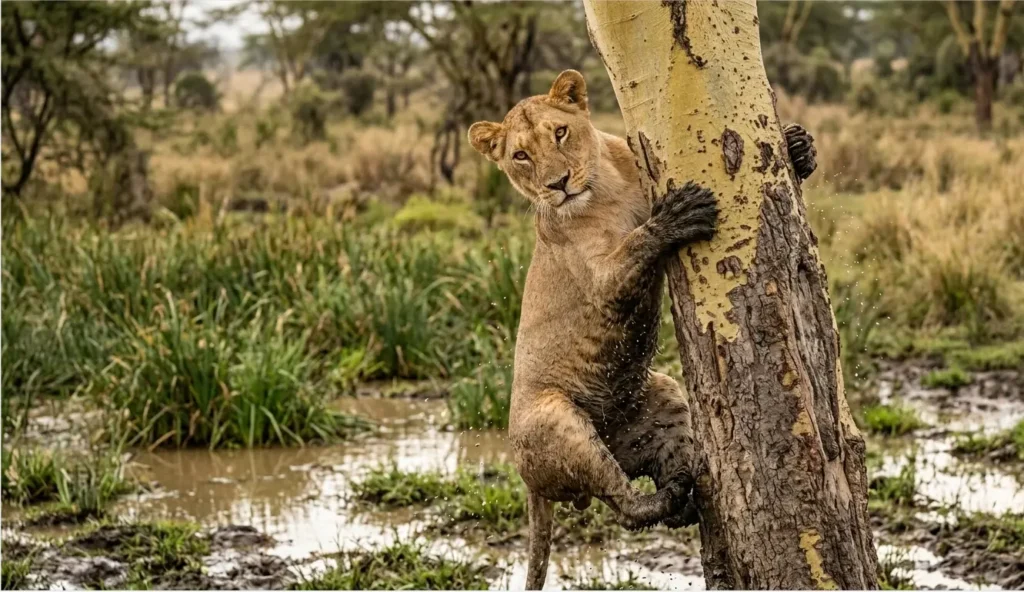
The old safari textbooks claim that the only reason you see Lions in Lake Nakuru in the trees is to escape the bite of tsetse flies. While this tsetse fly myth persists in generic travel blogs, the ground reality in 2026 is far more practical and environmental. The primary driver for Tree Climbing Lions Lake Nakuru is the massive habitat squeeze caused by the park’s expanding water levels.
Since the lake floor has risen, the low-lying grasslands have become a network of flooded acacia forests and marshy saturated soils. For Lions in Lake Nakuru, the ground is no longer a comfortable place for the 20 hours of rest they require daily. Alkaline mud is abrasive to a lion’s paw pads, and the high humidity at grass-level makes the cool, breezy canopy of a Yellow-Fever tree the only dry “living room” left in the park.
🛡️ OPERATOR INSIGHT: Don’t waste time looking for lions in the open plains near the main gate where the ground is currently a swamp. To see the tree climbing lions in Lake Nakuru, head straight for the higher ground tracks; see our Lake Nakuru self-drive route hacks to find the specific “Dry-Paw” corridors we use to guide our visitors.
These lions have become masters of the Nakuru water levels, adapting their hunting and resting patterns to avoid the damp undergrowth. You will notice that tree climbing lions often choose branches that catch the lake breeze, which naturally regulates their body temperature better than the stifling, humid ground. This behavioral shift has made the park a global hotspot for Lake Nakuru wildlife sightings 2026, as the lions are now more visible in the canopy than they ever were in the tall grass.
💡 PRO TIP: Because these lions are often perched 15 feet high in dense foliage, your standard phone camera will fail you. If you want a clear shot of the lions in Lake Nakuru without the “branch-blur” effect, read our 2026 Nakuru photography gear guide to understand why a 600mm lens is now the mandatory operator standard.
Now that you understand the “Wet-Paw” environmental trigger, let’s look at the exact GPS coordinates and tracks where our drivers often spot the prides…
Sightings Map: Where to see tree climbing lions in Kenya (The Nakuru Edition)
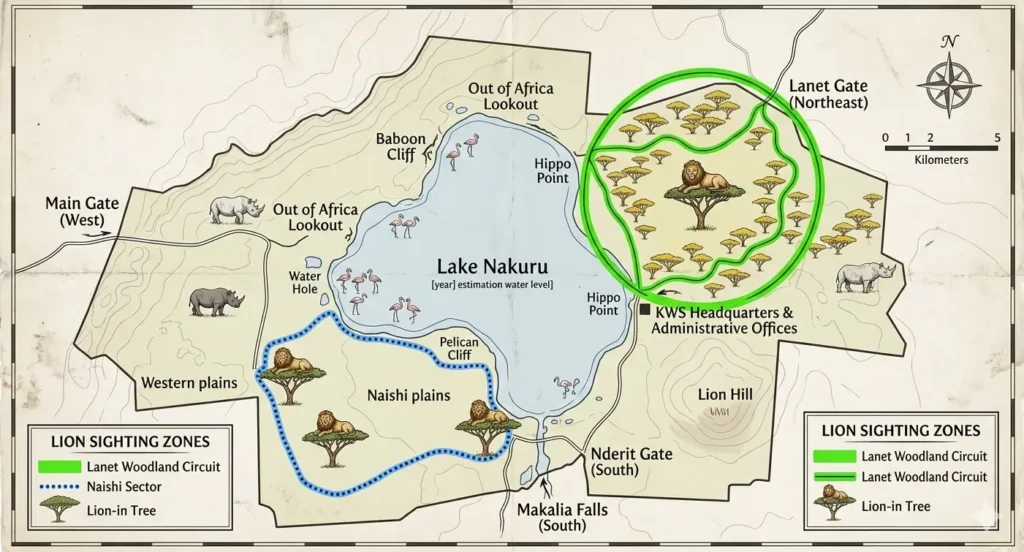
While international guides point travelers toward Uganda, the most accessible place for where to see tree climbing lions in Kenya is actually the northeastern circuit of Lake Nakuru. In 2026, the pride dynamics have shifted away from the submerged western shores toward the denser, drier Yellow-Fever trees near the Lanet sector. We have spent weeks tracking these lions in Lake Nakuru, and the highest strike rate remains within a 5-kilometer radius of the park’s administrative offices and the Pelican cliff area.
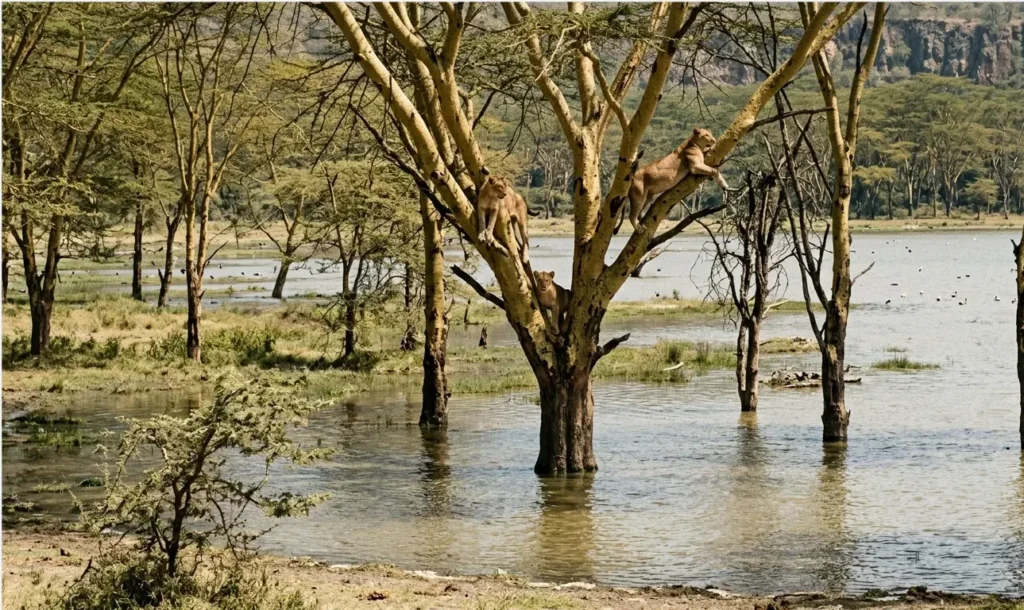
The specific Lanet Gate tracks offer a unique advantage because the acacia canopy is lower here, allowing for eye-level views of tree climbing lions Lake Nakuru. Unlike the deep forests of the south, these groves are interspersed with open glades, providing the backlighting necessary for professional-grade photography. Most self-drive visitors miss these prides because they rush toward the lake’s edge, but the real “canopy action” is currently happening in the woodland corridors that connect the main road to the Naishi sector.
🛡️ OPERATOR INSIGHT: If you enter through the main gate, don’t get stuck in the mud-prone western tracks trying to reach the lake. For a higher probability of seeing tree climbing lions in Lake Nakuru park, use our Lake Nakuru gate selection guide to understand why entering via Lanet Gate puts you directly into the heart of the “lion trees” within 10 minutes of entry.
The Naishi sector remains the “wild card” for spotting lions in Lake Nakuru because it serves as a transitional corridor for the prides moving between the hills and the water. In 2026, the rangers have strictly enforced the “No Off-Roading” rule, with fines reaching up to 10,000 KES if you are caught leaving the marked track to get under a lion tree. To avoid these traps, look for the “Lion Hill” lookout point—it is a little-known landmark that offers a panoramic view of the canopy, allowing you to spot a tail flick from a distance before committing to a specific track.
💡 PRO TIP: The Naishi plains are beautiful but deceptive; the black cotton soil can swallow a 4WD in minutes during the 2026 rains. Before you head deep into the lion territory, ensure your vehicle is equipped for the specific terrain where these lions hunt.
Now that you have the GPS coordinates for the Lanet groves, let’s discuss why your watch—not your binoculars—is the most important tool for a successful sighting…
The 2:00 PM Secret: Peak Lake Nakuru wildlife sightings 2026
While conventional safari wisdom dictates a 6:00 AM start, spotting tree climbing lions in Lake Nakuru requires a tactical shift in your timing. In 2026, the most consistent Lake Nakuru wildlife sightings 2026 for arboreal lions occur between 2:00 PM and 4:00 PM. This is due to a specific heat humidity hack: as the tropical sun hits the saturated ground, the rising vapor makes the tall grass stifling, forcing Lake Nakuru lions to seek the convective breezes found 15 feet up in the acacia canopy.
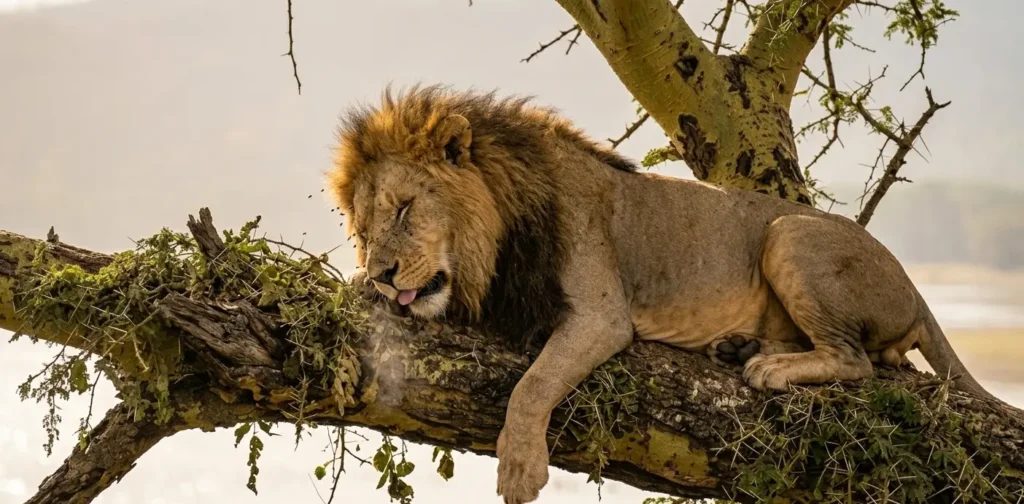
At midday, the ground-level temperature in the park’s flooded sectors becomes a “sauna” for large cats with thick coats. By late afternoon, the tree climbing lions are fully settled into their branches, often draped over limbs to maximize surface area cooling. If you arrive at dawn, you will likely see them moving through the wet grass, but for that iconic “treetop lounge” photo, the mid-afternoon window is scientifically superior.
🛡️ OPERATOR INSIGHT: Do not make the mistake of heading back to your lodge for a nap during this window just because the light is “harsh” for photos. Most tourists leave the tracks at 1:00 PM, which is exactly when the lions in Nakuru begin their ascent; check our Lake Nakuru lodge guide to find stays located near the Lanet gate so you can maximize your time in the “Lion Zone” without long commutes.
Planning your afternoon game drive around this thermal behavior also helps you avoid the “poverty of sightings” common in other parks during the heat of the day. Because the lake Nakuru tree climbing lions are stationary and elevated, they are easier to spot against the pale bark of the Yellow-Fever trees than they are when camouflaged in the golden savanna. This is the secret we use to guarantee results for our clients who only have a few hours to spare in the park.
💡 PRO TIP: The afternoon sun in Nakuru can be brutal, and since you’ll be stationary while observing the canopy, dehydration is a real risk. Ensure you’ve packed electrolyte tabs and a high-spec wide-brim hat; see our ultimate Lake Nakuru packing list to ensure you are geared up for the 2026 thermal conditions.
Now that you’ve mastered the timing for the climb, let’s differentiate between the king of the jungle and the ghost of the trees so you don’t misidentify your prize…
Lions vs. Leopards: Identifying Treetop Predators in the Acacia Groves
Distinguishing between an African leopard and the famous Kenya tree climbing lions from a distance is a common challenge for visitors in 2026. While both predators utilize the acacia tree canopy for rest and tactical advantage, their physical silhouettes and behaviors in the branches are distinct. Lions in Lake Nakuru are heavy, communal climbers, often seen huddled in groups on a single sturdy limb, whereas leopards are solitary, agile, and much more coordinated in the heights.
The most immediate giveaway is the tail behavior. A leopard’s tail is longer, more muscular, and typically hangs straight down like a “fifth limb” used for precision balance. In contrast, the tail of one of the Nakuru tree climbing lions is shorter, features the characteristic black tuft, and is usually curled or tucked awkwardly as they struggle more with the physics of gravity than their leopard counterparts.
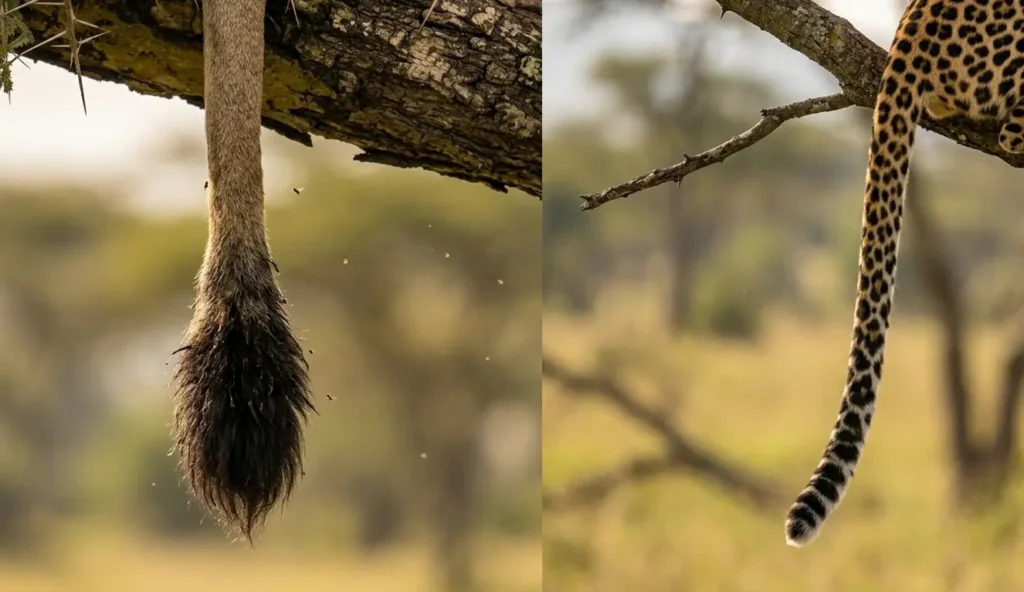
🛡️ OPERATOR INSIGHT: Leopards in the park prefer the dense, high-altitude forest cover near the cliffs, but Lake Nakuru lions favor the wider, lower branches of the Yellow-Fever trees in the transition zones. If you see a kill hauled into the high branches, it is a leopard; tree climbing lions in Lake Nakuru lack the vertical neck strength to hoist a carcass and will only climb to rest or escape the damp ground.
Predator Competition Check:
- Lions: Communal (look for multiple cats), tufted tails, prefer lower thick branches.
- Leopards: Solitary, long balanced tails, often found in higher, thinner branches.
Misidentifying a cat from 200 yards is easy if you don’t have the right optics. If you find yourself squinting at a shape in the acacia tree canopy, see our Lake Nakuru photography gear guide to see why we recommend a minimum 10×42 binocular spec for 2026 predator identification.
Now that you can tell the kings from the ghosts, let’s ensure your camera is set up to capture the high-contrast light of the canopy before the sun dips too low…
The Photographer’s Edge: Framing Lions in Lake Nakuru
Capturing Lake Nakuru tree climbing lions presents a unique technical challenge: shooting upward into a backlit, high-contrast acacia tree canopy. Because Lake Nakuru lions often lounge on thick, horizontal limbs, the camera’s light meter is easily fooled by the bright sky leaking through the leaves, often leaving the predator as a dark, featureless silhouette. To get the “Information Gain” shot that stands out, you must manually overexpose by +1.0 or +2.0 stops to reveal the texture of the lion’s mane against the bright Kenyan sky.
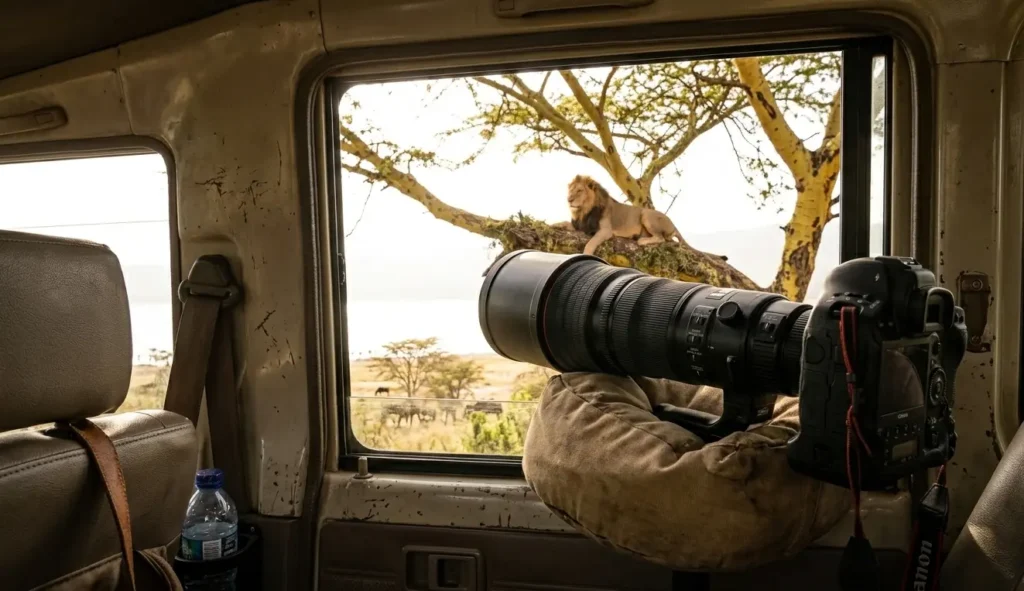
Your choice of safari photography gear will dictate the quality of your portfolio in 2026. While a standard zoom might suffice for rhinos on the plains, you are often shooting from a fixed track looking up at a cat 15-20 feet in the air. This distance makes a 600mm lens the operator’s gold standard, as it allows you to compress the background and capture the “eye-contact” that makes tree-climbing shots so impactful.
🛡️ OPERATOR INSIGHT: Do not settle for high-angle shots from your vehicle’s roof hatch if the lion is perched on a low-hanging branch. For the most dramatic low angle shots, shoot from the mid-level window of your cruiser to create a sense of scale and dominance; check our Lake Nakuru safari photography gear guide to see why we’ve swapped out our old zoom lenses for prime glass in 2026.
Technical Checklist for Canopy Shots:
- Metering: Use Spot Metering on the lion’s face, not the sky.
- Focus: Use Single-Point AF to lock onto the eye through the acacia thorns.
- Support: Use a beanbag on the window sill; engine vibration is your biggest enemy at 600mm.
The “Golden Hour” in Nakuru is often shortened by the shadows of the western cliffs, so your window for perfectly lit tree climbing lions Lake Nakuru shots is narrow. Aim to be in position by 3:30 PM when the sun begins to drop low enough to illuminate the undersides of the branches where the lions rest. See our guide on the best time to visit Lake Nakuru to coordinate your gate entry with the peak season for wildlife sightings.
Now that your memory cards are filling up with treetop predators, let’s look at the legal boundaries and KWS enforcement rules you need to know to avoid a heavy fine…
Logistics: KWS Rules for Viewing Tree Climbing Lions Lake Nakuru
Observing lions on trees in Lake Nakuru requires more than just a good pair of binoculars; it requires strict adherence to the latest KWS enforcement protocols. In 2026, Kenya Wildlife Service rangers have increased patrols specifically around the Lanet and Naishi acacia groves to prevent habitat destruction. While it is tempting to edge off the track for a better angle of lions in Lake Nakuru, the park now enforces a strict off-roading fine of 10,000 KES (approx. $80) per vehicle, which is often levied on the spot.
Ethical wildlife viewing is the core of the Hilmuks operator philosophy, especially when dealing with predators in a “habitat squeeze.” You must maintain a minimum distance of 20 meters from any tree occupied by tree climbing Lions to avoid causing the cats to jump down prematurely due to stress. Furthermore, the use of drones is strictly prohibited without a specialized permit from both KWS and the Kenya Civil Aviation Authority, a rule that carries heavy penalties if violated within the park boundaries.
🛡️ OPERATOR INSIGHT: Rangers at Lake Nakuru are particularly vigilant about “crowding” sightings; if more than five vehicles are present at a single lion tree, you are legally required to limit your viewing time to 10 minutes. To ensure you don’t get stuck in a “safari traffic jam” and miss the action, see our guide on Lake Nakuru park opening hours and seasonal tips to plan an entry that beats the mid-morning tour bus rush.
2026 KWS Code of Conduct:
- Keep to the Tracks: Off-roading to reach lions triggers an immediate 10,000 KES fine.
- Silence is Golden: Loud noises or “clapping” to make a lion wake up is classified as animal harassment.
- Payment Readiness: Ensure your park fees are validated before you reach the lion circuits; see our step-by-step KWSPay eCitizen guide to avoid being turned back at the inner check-points.
Respecting these KWS park rules ensures that these unique prides remain comfortable in their arboreal homes for future generations. By following the “Operator’s Path,” you not only stay legal but also earn the respect of the local rangers who often share “live” sighting coordinates with ethical drivers.
Now that we’ve cleared the legal hurdles, let’s address the most common myths and questions travelers ask us on the ground…
FAQs: Common Myths About Tree Climbing Lions Lake Nakuru
In our years operating on the ground, we have found that travelers arrive with many misconceptions about the behavioral quirks of lions in Lake Nakuru. Below are the direct answers to the most common questions we receive, optimized for the 2026 landscape.
Are there lions in Lake Nakuru?
Yes, there is a healthy and growing population of lions, consisting of several resident prides. While the park is famous for rhinos and flamingos, the lion sightings here are unique because the prides have become specialized in arboreal behavior to navigate the flooded terrain of 2026.
How many lions are in Nakuru?
As of 2026, the park is home to approximately 50 to 70, though the exact number fluctuates as prides move between the forest and the high ridges. This population density is high for a park of its size, which increases the frequency of tree climbing sightings compared to larger, more sparse reserves.
Can all lions climb trees?
Technically, all lions have the physical ability to climb, but very few populations do it habitually. The tree climbing lions in Lake Nakuru are world-renowned because they have turned this rare ability into a daily survival strategy, whereas lions in other parts of Kenya typically only climb to escape immediate danger or a buffalo charge.
Now that we’ve debunked the myths and mapped the prides, you are ready to witness the “Wet-Paw” phenomenon for yourself—just remember to keep your eyes on the canopy, not just the grass.
To ensure you don’t leave the park having seen only half the story, see our insider guide to guaranteed rhino sightings in Lake Nakuru to see how the 2026 flooding has created new “secret” territories for both Black and White rhinos… but that is not all.