Email:
 Phone:
 WhatsApp:

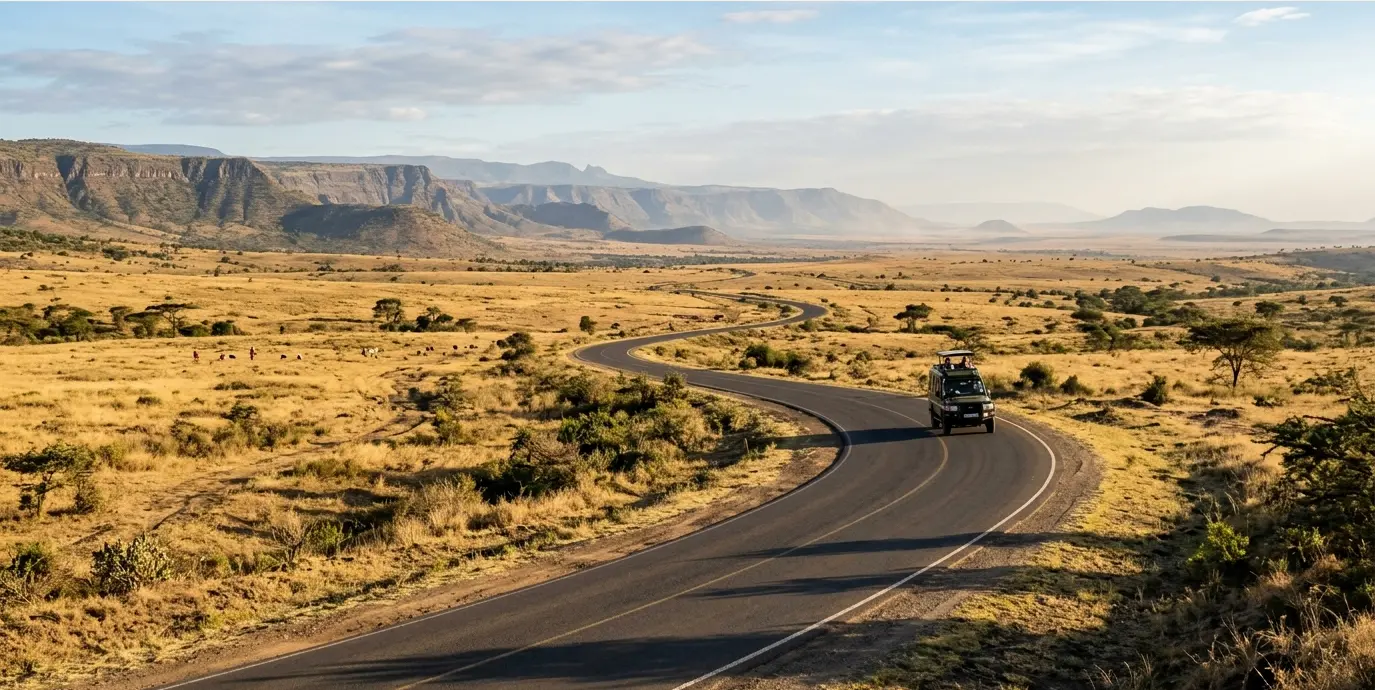
The primary Nairobi to Masai Mara alternative route in 2026 is the Ngong-Suswa bypass, a 245km fully tarmacked road completed in December 2025. This route avoids the Mai Mahiu escarpment entirely, delivering a consistent 5.5-hour drive by bypassing heavy commercial truck traffic and construction-related standstills.
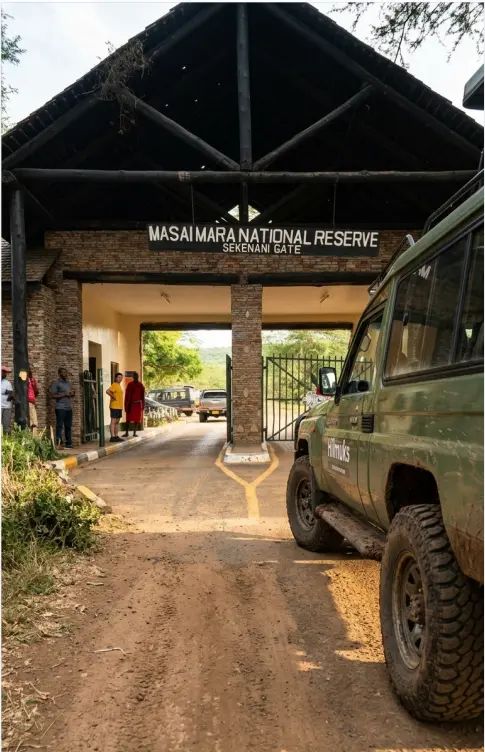
While legacy platforms like TripAdvisor still suggest the B3 highway as a “5-hour drive,” the 2026 reality is that a single stalled trailer on the single-lane escarpment transforms that estimate into a 13-hour gamble. Evans Kimojino, a Mara-based safari guide and Hilmuks Safaris partner, now uses this bypass for all flight-sensitive clients because he can no longer guarantee arrival times via the standard route.
The 2026 Reality: Why the “Standard” Route is a 13-Hour Gamble
Experienced safari operators no longer trust the standard Nairobi to Masai Mara alternative route logic of old maps because the B3 highway has become a logistical bottleneck. While legacy guides still promise a 5-hour transit, the combination of the Rironi-Mau Summit dualling project and the Mai Mahiu escarpment bottleneck creates a high-stakes gamble for travelers. In 2026, the escarpment remains a single-lane descent with zero shoulders, meaning a single stalled 40-ton trailer can paralyze traffic for kilometers with no way to reverse or divert.
🛡️ OPERATOR INSIGHT: Our guides have witnessed clients spend seven stationary hours on the escarpment after a minor accident. This delay often results in arriving at the gates after dark, effectively forfeiting the first day’s non-refundable park fees—a financial hit that underscores why we now prioritize a more reliable Nairobi to Masai Mara drive.
The escarpment truck gridlock is most dangerous once you pass the “Point of No Return” at the Kijabe Viewpoint (approx. Km 52). Once you begin the steep descent past this landmark, you are physically locked into the convoy; there are no bypasses or turn-offs until you reach the valley floor. According to the Kenya National Highways Authority (KeNHA), the ongoing B3 highway construction 2026 alerts and recent siltation advisories near Kedong Ranch suggest this “standard” path is now the highest-risk variable in your safari itinerary.
⚠️ 2026 ROAD ALERT: The B3 is only a viable choice for a 5:00 AM departure on clear weekdays when no rain has fallen the previous night. If you cannot control your departure time or have a fixed arrival deadline, see our 2026 Kenya Car Hire Survival Guide to ensure your vehicle is vetted for the steeper, technical bypasses we use to avoid these standstills.
Now that you understand why the B3 is often a gamble rather than a route, let’s look at the two specific bypasses our partners use on the ground today to guarantee timing.
The Ngong-Suswa Bypass — The “Flight-Saver” Route
For the Nairobi to Masai Mara alternative route that eliminates escarpment risk entirely, our guide consistently chooses Ngong-Suswa. This Rift Valley floor bypass became a game-changer for the industry after the tarmac was completed in December 2025, according to the Kenya Urban Roads Authority (KURA). Unlike the traditional B3 highway, this route provides a predictable arrival window because it completely avoids the commercial truck traffic synonymous with the Mai Mahiu escarpment.
🛡️ OPERATOR INSIGHT: We utilize this specific route for clients with tight Wilson Airport afternoon flight connections. While most guides hope for clear traffic on the B3, we stake our professional reputation on the Ngong-Suswa corridor because it allows us to commit to a 5.5-hour arrival window regardless of the chaos on the standard highway. This reliability is the primary reason why the Nairobi to Masai Mara drive 2026 timings have shifted for professional operators.
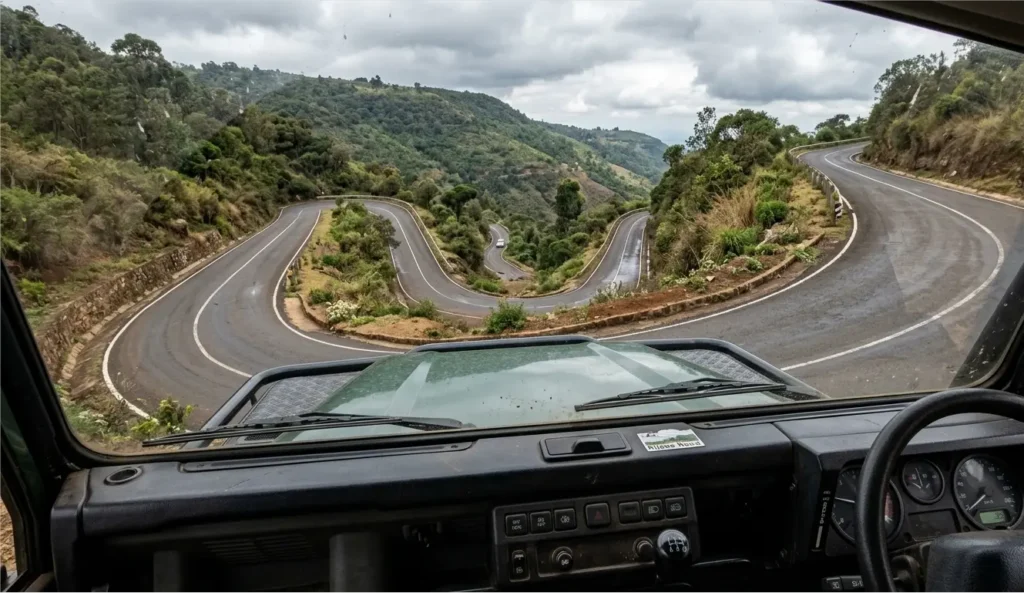
However, this is not a high-speed leisure highway; the route features sharp bends and steep valley sections that demand high-altitude torque and focus. The only significant traffic occurs between the Karen-Ngong corridor and Ngong Town, after which the road clears completely for a smooth run to the valley floor. If you are taking this route, ensure your vehicle is up to the task by following our Kenya Car Hire Survival Guide to vet your brakes and steering before leaving Nairobi.
Exiting Nairobi on the Ngong-Suswa Route
To access this Ngong-Suswa road 2026 bypass, travelers from JKIA or the CBD should use the Southern Bypass exit Nairobi and head toward Dagoretti or Karen. We recommend passing through Ngong Town before 7:00 AM to avoid the local school-run gridlock that can add 30 minutes to your departure. Once you clear the Ngong hills, the descent offers a clear, newly tarmacked path that stays on the valley floor, far away from the escarpment bottleneck.
The Suswa Plains Join — Re-entering the Narok Road
The route eventually merges into the main Narok-bound road at the Suswa plains, well past the most congested sections of the B3 construction. This join point is easily identified by the sudden increase in roadside traders and the visible transition back to the standard highway heading toward the Mara gates. If you are tracking your total trip duration, this bypass typically adds about 20km in distance but saves up to 4 hours in stationary idling time.
💡 PRO TIP: Because this route is technically harder to drive than the B3, it is not recommended for first-time Kenya drivers in an unfamiliar rental. The steep rises require confident gear handling and a vehicle with responsive brakes.
Now that we have mapped out the “flight-saver” bypass, let’s look at a second, even newer route that drops you directly behind the escarpment chaos.
The Kijabe Drop-In — The 2026 Route That Legacy Guides Miss
The second confirmed Nairobi to Masai Mara alternative route bypasses the Rironi-Limuru gridlock by dropping directly into Mai Mahiu town via the Kijabe junction. This route is your highest “information gain” option because it remained a rough track for years; however, the Kijabe road tarmac 2026 completion in January 2026 changed the logistics entirely. It allows you to exit the main Nairobi-Nakuru highway before the worst of the Rironi construction, effectively “dropping in” behind the escarpment bottleneck.
This escarpment drop-in route is specifically suited for travelers starting from Westlands, Parklands, or Northern Nairobi who want to avoid the Southern Bypass and Karen traffic. While the route features steep valleys and rises that demand a focused driver, the lack of heavy commercial trucks makes it a significantly calmer experience than the B3. Our guides typically choose this path for mid-morning departures (after 7:00 AM) when the standard highway has already begun to choke with construction traffic.
Where to Exit for Kijabe from Nairobi
To find this Narok-bound traffic bypass, watch for the clearly marked Kijabe Junction on the Nairobi-Nakuru highway, approximately 10km past Limuru. This is a specific, named location that allows you to peel off the main highway before the descent truly begins. Once you take this exit, the road is fully tarmacked and easy to follow, provided you maintain a steady pace on the winding corners.
From Kijabe to Mai Mahiu Town — The Descent
The descent from Kijabe to the valley floor is breathtaking but technical, with several sharp hairpins described as “steep sections requiring confident braking.” You will see clear road signs directing you toward Mai Mahiu; follow these rather than relying solely on GPS, which often glitches in the deep valley pockets. Once you reach the bottom, you merge into the Narok road at a point where the escarpment chaos is already behind you in the rearview mirror.
💡 PRO TIP: If you are departing before 5:30 AM on a bone-dry weekday, the standard B3 might still be your fastest bet. However, for any departure after the sun is up, see our guide on Nairobi to Masai Mara via Lake Nakuru to see how these alternative “drop-in” points can be used to link multiple parks without getting stuck in the Rironi dust.
The 2026 Flood and Silt Warning — When Both Alternatives Are Affected
Both Nairobi to Masai Mara alternative route options have seasonal vulnerability windows that our partner guide monitors before every departure. The March and April “long rains” create specific flood risks on both alternative routes that do not affect the B3 in the same way. The Ngong-Suswa route crosses the Suswa plains floor; during heavy rainfall, the Kedong Ranch section can flood, while the Kijabe descent carries a specific siltation risk on its steep sections during sustained downpours.
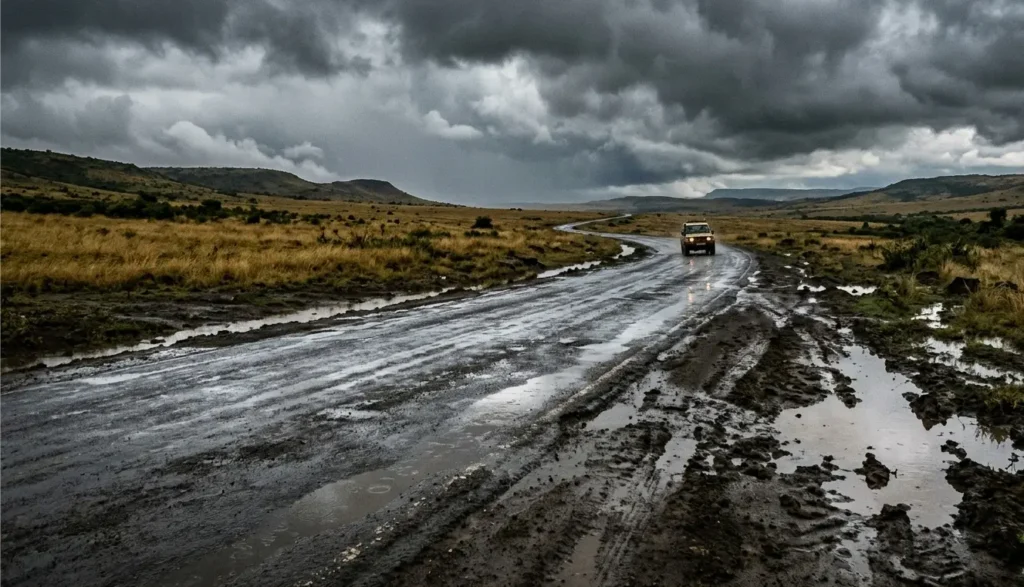
🛡️ OPERATOR INSIGHT: Our lead guide has a strict decision protocol: if it has rained heavily for more than 24 hours in the Rift Valley within a 48-hour window, he defaults back to the B3. He chooses a 4:30 AM departure to beat the truck traffic before the construction crews arrive. This operational knowledge—that the Suswa plains floor may be impassable for standard vehicles after a 24-hour rainfall threshold—is a “human-only” detail that mapping apps cannot calculate.
According to a recent KeNHA road advisory, siltation on the Kijabe descent can significantly reduce traction, making it a “no-go” for light vehicles during peak wet weeks. To ensure your vehicle is equipped for these high-stakes seasonal shifts, see our 2026 Kenya Car Hire Survival Guide to learn how to vet tire tread depth before leaving Nairobi. Always check the Kenya Meteorological Department the evening before your trip to confirm if a “bypass day” is safe or if you should revert to the highway.
⚠️ 2026 ROAD ALERT: March, April, and November are the highest flood-risk months for the Ngong-Suswa and Kijabe routes. If the forecast shows sustained heavy rain, do not gamble on the valley floor; revert to the B3 with a 4:30 AM departure to avoid being trapped in the Kedong Ranch silt.
The Route Comparison — 2026 Real-World Data
Choosing the right Nairobi to Masai Mara alternative route depends on three variables: departure time, weather, and your arrival deadline. While the standard B3 remains the shortest distance on paper, the ongoing Rironi-Limuru construction has turned it into a high-stakes gamble. Your “fastest” route is now defined by consistency rather than speed limits.
2026 Route Comparison: B3 vs. Ngong-Suswa vs. Kijabe
|
Variable |
B3 Mai Mahiu |
Ngong-Suswa |
Kijabe Drop-In |
|
Distance |
225km |
245km |
230km |
|
Best Case Time |
5.5 hrs |
5.5 hrs |
5 hrs |
|
Worst Case Time |
13+ hrs |
6 hrs |
6.5 hrs |
|
Tarmac Status |
Full |
Full — Dec 2025 |
Full — Jan 2026 |
|
Heavy Trucks |
Very high |
None |
Very low |
|
Best Departure |
Before 5:30 AM |
Any time |
After 7:00 AM |
|
Recommended For |
Early birds |
Flight-sensitive |
Mid-morning starts |
🛡️ OPERATOR INSIGHT: Most of our guides do not have a single “favorite” route; they use a decision protocol based on the morning’s ground reality. For instance, if they are departing after 7:00 AM, they completely abandon the B3 to avoid the gridlock that often traps travelers for hours. The mental tax of the B3 is simply too high for professional operators who must guarantee a 3-Day Masai Mara Safari from Nairobi starts on schedule.
A typical guide Decision Tree: Choosing Your Path
To simplify your planning, use the same logic our partner applies before he turns the key in his safari cruiser. This protocol ensures you aren’t just guessing which fastest route to Masai Mara actually works for your specific situation.
- Is it before 5:30 AM and has it been dry for 48 hours? → Take the B3 Mai Mahiu.
- Do you have a fixed afternoon deadline or a Wilson Airport flight? → Take Ngong-Suswa regardless of the time.
- Are you departing between 7:00 AM and 9:00 AM in dry conditions? → Use the Kijabe Drop-In.
💡 PRO TIP: If your journey starts from the airport or Southern Bypass, the Ngong route is almost always superior to the B3. However, if you are coming from the north, see our guide on Nairobi to Nakuru 2026 transport to see how to link the Kijabe route with other Rift Valley destinations efficiently.
Timing the Gate — Why the Alternative Route Changes Your “12-Hour Clock”
The Nairobi to Masai Mara alternative route you choose dictates more than just your arrival time—it determines your entire park fee strategy. Unlike KWS parks that often operate on 24-hour cycles, the Masai Mara park fees 12-hour rule means that arriving even 30 minutes late due to a route choice can cost you an extra day’s fees. Evans notes that the Ngong-Suswa bypass is the only way to ensure a “pre-noon” entry for those departing Nairobi after 6:30 AM.

🛡️ OPERATOR INSIGHT: Many self-drive travelers arrive at the Sekenani Gate at 4:00 PM because of escarpment delays, only to realize their “Day 1” ticket expires at 6:00 PM. By using the Ngong-Suswa road 2026 bypass, We consistently get clients to the gate by 12:30 PM, maximizing the value of the high Narok County entry fees. Before you pay, see our 2026 guide on how to pay Masai Mara park fees to avoid the eCitizen “pending” trap at the gate.
Don’t let the bypass speed fool you into a late start. Even with the tarmac completed in December 2025, the Nakuru to Masai Mara distance and the final stretch into the reserve still require a buffer for wildlife crossings and police checks.
CONCLUSION
The Nairobi to Masai Mara alternative route question in 2026 has two clear answers: Ngong-Suswa for flight-sensitive clients and Kijabe for mid-morning departures when the B3 is already building. Both routes are newly tarmacked, both demand careful driving on steep sections, and both deliver something the B3 cannot—time certainty. At Hilmuks Safaris, we do not gamble with the escarpment when a client’s park fees and itinerary are on the line. Neither should you.
FAQs on Nairobi to Masai Mara alternative route
What is the best alternative route from Nairobi to Masai Mara in 2026?
Ngong-Suswa bypass is the most reliable Nairobi to Masai Mara alternative route in 2026. Fully tarmacked in December 2025, it bypasses the Mai Mahiu escarpment entirely and delivers a guaranteed 5.5-hour drive with zero heavy truck traffic — compared to the B3’s unpredictable 6 to 13-hour window.
How do I avoid Mai Mahiu when driving to Masai Mara?
Two routes bypass Mai Mahiu — the Ngong-Suswa bypass via Karen and Ngong Town, and the Kijabe drop-in via the Kijabe junction on the Nairobi-Nakuru highway. Both were fully tarmacked in late 2025 and early 2026 respectively and carry minimal heavy vehicle traffic.
Is the Ngong-Suswa road to Masai Mara tarmacked in 2026?
Ngong-Suswa road was fully tarmacked in December 2025 making it a viable all-weather alternative to the B3 Mai Mahiu route for the first time.
Can a 2WD car use the Ngong-Suswa or Kijabe routes to Masai Mara?
In dry conditions, a well-maintained 2WD saloon can handle both routes. However both roads have steep descents and ascents that require vetted brakes — We strongly recommend a pre-departure brake check regardless of vehicle type. After sustained rainfall, 4×4 high clearance becomes mandatory for both routes.
How long does the Ngong-Suswa route to Masai Mara take?
The Ngong-Suswa bypass covers approximately 245km and takes 5.5 hours in normal conditions — similar to a best-case B3 time but with guaranteed consistency regardless of truck traffic or construction delays. The Kijabe route covers approximately 230km and takes 5 to 6 hours depending on the mid-morning departure window.
When should I NOT use the Ngong-Suswa alternative route?
Avoid the Ngong-Suswa bypass if it has rained heavily in the Rift Valley for more than 24 hours — the Suswa plains floor near Kedong Ranch can flood during sustained rainfall making the route impassable. Always check Kenya Meteorological Department forecasts the evening before every departure and revert to a 4:30 AM B3 departure when the plains flood risk is high.
Is there a shortcut from Nairobi to Masai Mara that avoids the escarpment?
Yes — the Ngong-Suswa bypass is the only route that avoids the Mai Mahiu escarpment entirely. It is longer in distance — 245km versus 225km — but shorter in guaranteed time because it carries no heavy commercial vehicle traffic and has no single-lane descent sections that can cause standstills lasting hours.
When is the Ngong-Suswa bypass NOT safe to use?
Avoid the Ngong-Suswa bypass during and immediately after heavy sustained rainfall in the Rift Valley — particularly in March, April, and November. Always check the Kenya Meteorological Department forecast the evening before every departure and revert to a 4:30 AM B3 departure when the Suswa plains flood risk is high. The bypass floor near Kedong Ranch can become impassable within 24 hours of heavy upstream rain.