Email:
 Phone:
 WhatsApp:

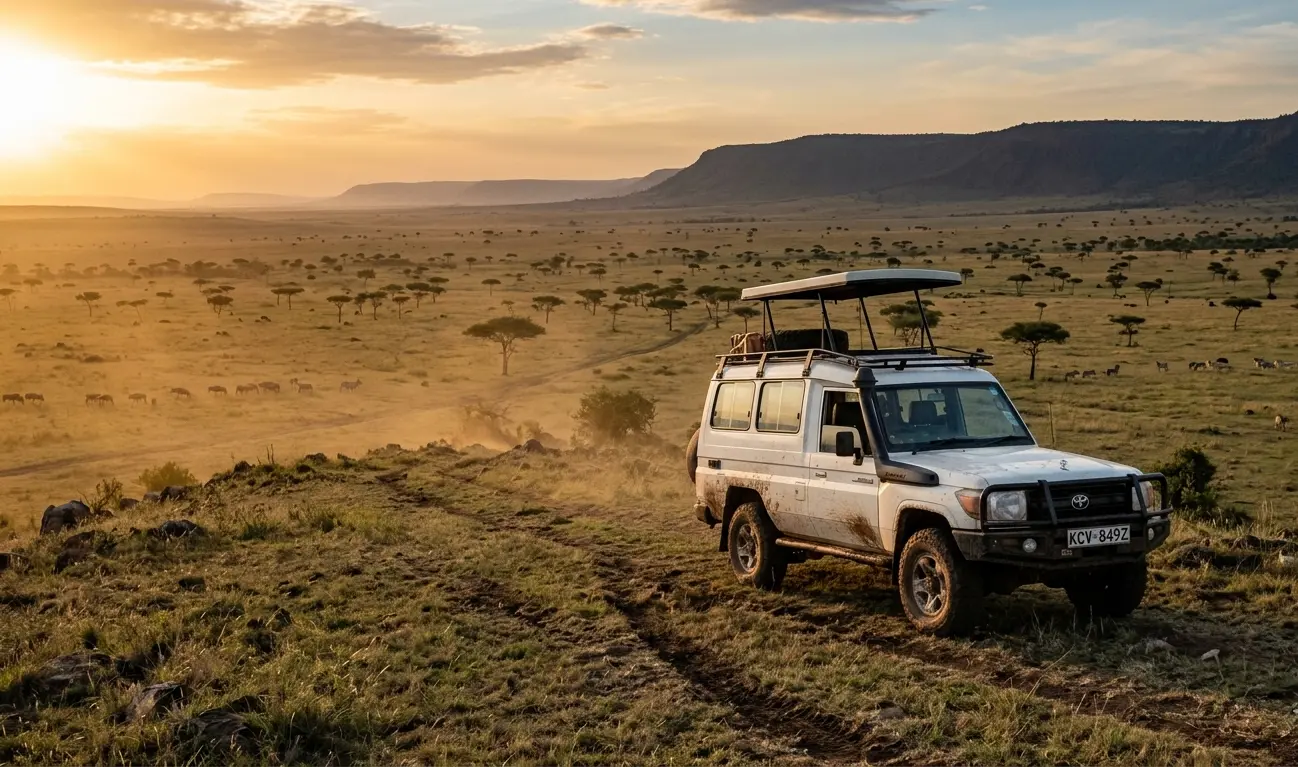
Masai Mara self drive rules in 2026 require a gate-approved 4×4, a Narok County — not KWS — entry payment, and a ranger’s contact number saved before entry. Remote sections near the Tanzanian border have zero mobile signal, making pre-gate preparation your only safety net.
While generic booking platforms claim any 4×4 rental is sufficient, the 2026 reality is that rangers at Sekenani now conduct physical vehicle inspections and can reject rentals with inadequate clearance. Evans, a Mara-based guide with 1,300+ documented sightings, observes that most self-drive failures—wrong payments or dead batteries—happen before the vehicle even crosses the gate. This Field Manual covers the seven operational realities you must know before departure.
|
Rule |
What Most Self-drivers Think |
2026 Ground Reality |
|
Payment |
Pay via KWS eCitizen |
KWS receipts rejected — use Narok County portal only |
|
Vehicle |
Any 4×4 works |
Gate rangers check and can reject unapproved rentals |
|
Navigation |
Download Google Maps offline |
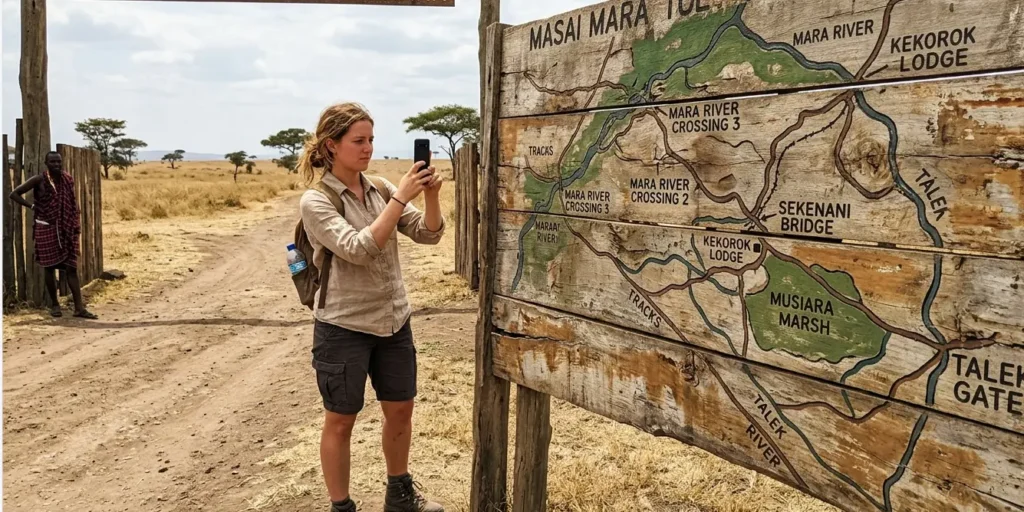
Maps fail in deep reserve — photograph gate’s physical map |
|
Signal |
Patchy in some areas |
Zero signal near Tanzanian border |
|
Time |
Leave by noon on exit day |
Safari Time-Warp phenomenon expires permits before clients realise |
|
Safety |
Stay in Vehicle |
Alighting, rooftop climbing and animal touching trigger forced guide |
|
Guide |
Optional |
Standby guides available at gate — rangers can mandate one |
Quick Navigation: Jump to Your Section
What Changed in 2026 — Why Your Old Self Drive Guide is a Liability
The Masai Mara self drive rules landscape has shifted significantly from what most online guides published before 2026 describe. Following outdated advice in the current ecosystem doesn’t just result in a minor delay; it often leads to non-refundable financial losses at the entry gate.
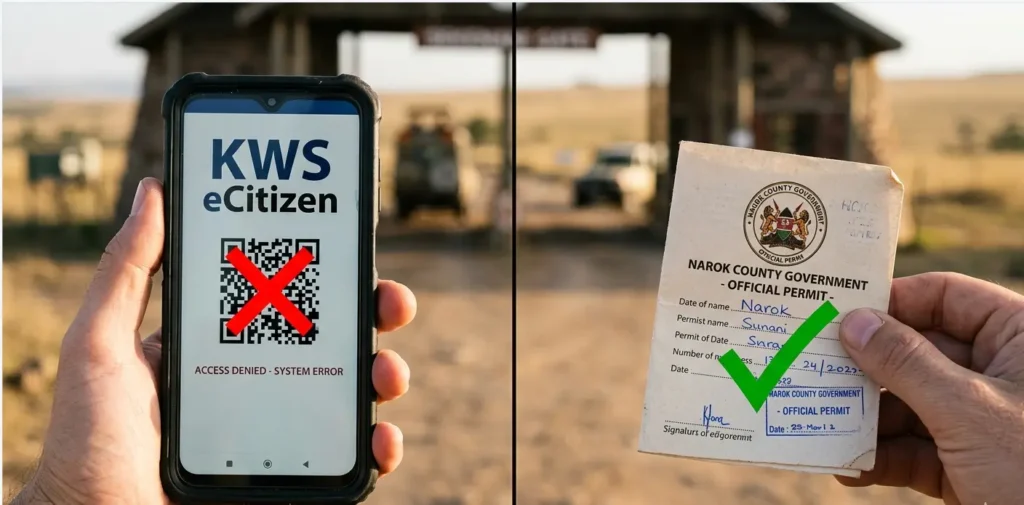
The most critical change involves the complete separation of payment portals. While generic booking platforms still cite a “KWS eCitizen payment” as the standard, our ground team has confirmed that the Masai Mara—a National Reserve under Narok County jurisdiction—does not recognize KWS receipts. This applies to any KWS-managed payment made for national parks such as Lake Nakuru — showing up with the wrong QR code at a Mara gate means paying the full daily rate a second time on the spot.
Ranger enforcement has also tightened regarding vehicle standards and visitor conduct. Due to a rise in off-roading incidents by solo content creators, vehicles are now physically inspected at the gate for ground clearance and “safari-readiness” before entry is granted.
🛡️ OPERATOR INSIGHT: Before you even turn the ignition, check the Mai Mahiu escarpment traffic on Google Maps. If the B3 is “Deep Red” due to truck breakdowns, you risk missing your non-refundable gate entry window. To avoid getting stuck in a 4-hour jam, see our guide on the Nairobi to Masai Mara alternative route to learn how to bypass the escarpment bottleneck.
Our Mara ground team confirm that the “KWS mistake” is now the most expensive error a self-driver can make. Verified data from narok.go.ke confirms that all revenue is managed locally, meaning KWS (national) funds cannot be transferred to the Reserve once paid.
Now that you know what has changed on the legal front, let’s look at the specific payment trap that costs most travelers $200 before they ever see a lion.
The eCitizen Payment Trap — The $200 Mistake That Happens at Your Keyboard
The first Masai Mara self drive rules catch international visitors is the payment jurisdiction split. Most travelers assume that because they paid for Lake Nakuru or Amboseli via the national eCitizen portal, the same receipt works here.
Rangers at Sekenani and Talek gates cannot process KWS receipts because the Mara operates under Narok County revenue management, not the national park system. Our ground team confirms this is the single most common error seen at the gates; arriving with a KWS receipt results in a non-refundable mistake where you must pay the full daily rate again on the spot.
According to jurisdictional data from narok.go.ke, the Reserve requires payment through their specific county portal to generate a valid QR code. Failing to distinguish between KWS vs Narok County Masai Mara portals before you leave Nairobi can turn a budget-friendly trip into a financial headache before the gate even opens.
🛡️ OPERATOR INSIGHT: Many self-drivers arrive at the gate having paid via KWS eCitizen—a system that works correctly for Lake Nakuru but is not recognized at any Masai Mara gate. To avoid a forced re-payment of $100 to $200 per person, complete your Masai Mara park entry payment 2026 through the correct portal before leaving Nairobi. See our step-by-step Masai Mara payment guide for the exact 2026 process and the specific QR code verification steps rangers require at Sekenani and Talek.
With your payment confirmed and your QR code saved offline, the next step is understanding the physical terrain you are about to navigate—because the map on your phone is bound to let you down in the reserve.
Dead Zone Navigation — The Ranger Contact Hack and the Offline Protocol
The most dangerous aspect of Masai Mara self drive rules is not the wildlife—it is the communication blackout that makes a mechanical breakdown a genuine emergency. While most guides suggest simply downloading offline maps, they fail to mention that the Mara contains vast “dead zones” where even GPS-assisted smartphones can struggle with orientation on unmarked tracks.
The Dead Zones: Where Signal Vanishes
Remote sections near the Tanzanian border and the western reaches of the Mara Triangle have zero Kenyan mobile network coverage. This is a complete blackout, meaning if you experience a Masai Mara self drive breakdown here, you cannot call for help or use live tracking. Our ground team confirms that in these remote sectors, you may wait several hours for a passing vehicle, making pre-gate preparation your only safety net.
🛡️ OPERATOR INSIGHT: Since you cannot rely on a 5G signal once you leave the main gate, your vehicle’s mechanical health is your primary survival tool. To ensure your rental is actually up to the task before you lose bars, see our Kenya car hire pre-departure checklist to learn more on how to vet a safari vehicle’s critical components.
The Gate Map Protocol: The Analog Backup
Our field partner recommends a simple, two-minute “analog” hack: photograph the physical ranger map displayed at the gate before driving into the reserve. Digital mapping applications frequently miss seasonal track updates, current lugga (dry riverbed) water levels, or temporary route closures. Having a high-resolution photo of the official gate map ensures you have a reliable reference for Masai Mara dead zones navigation even if your phone’s battery or GPS fails.
The Ranger Number Protocol
What happens if your vehicle breaks down in Masai Mara? If you break down in a signal-dead zone, you must stay in your vehicle and wait for a passing car. However, if you have a signal, your only reliable rescue is contacting the specific on-duty ranger whose personal number you saved at the gate.
Our guide instructs every self-driver to ask for the direct mobile number of the ranger on duty during entry registration. While not an advertised service, our ground team confirms that rangers can coordinate undocumented mechanical rescues by sending a local mechanic directly to your coordinates. Without this personal ranger contact Masai Mara protocol, you are at the mercy of whoever happens to drive past your location.
Knowing where your phone fails is essential—but knowing where your vehicle fails is what keeps you out of a real crisis.
The Marsh Soil Map — Where 4x4s Go to Die and Gate Approval Reality
A critical Masai Mara self drive rule that rental companies never mention is that not every 4×4 passes the game drive vehicle check at the gate. Rangers at Sekenani and Talek conduct a physical inspection before admitting any self-drive vehicle to the interior tracks.
Gate Vehicle Approval: The Check Most Guides Skip
Vehicles that do not meet Masai Mara 4×4 requirements—such as inadequate ground clearance, visible mechanical leaks, or standard AWD SUVs lacking low-range gears—can be turned away. This creates a nightmare scenario where you drive six hours from Nairobi only to be denied entry or forced to hire a gate guide to drive you in. Our Mara ground team confirms that gate rejections happen regularly, especially with budget rentals that look capable but fail the ranger’s safety standards for the deep reserve.
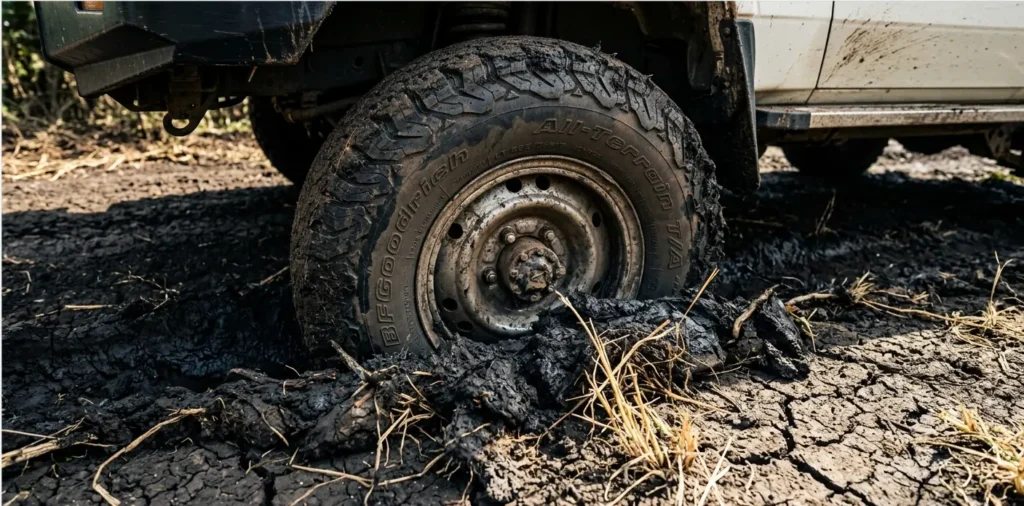
The Black Cotton Soil Reality
The terrain is dominated by Masai Mara marsh soil, specifically a fine-grained “black cotton” earth that is structurally unstable. While the surface often looks bone-dry and cracked, it remains soft underneath and can swallow a vehicle to the axle within seconds if you lose momentum. Our team observes that self-drivers consistently underestimate this black cotton soil safari risk, as professional guides are the only ones who know which specific tracks near the Talek River become impassable within 24 hours of rainfall.
🛡️ OPERATOR INSIGHT: To avoid the risk of vehicle rejection or a mechanical failure in the mud, you must vet your rental source before leaving the city. If you haven’t secured a vehicle yet, see our Kenya car hire pre-departure checklist to learn more on how to identify “Safari-Ready” builds that pass the Masai Mara gate vehicle check 2026 without friction.
The “Leeching” Strategy
A practical technique our field team observes among experienced self-drivers is “leeching”—positioning your vehicle a respectful distance behind a professional safari cruiser when navigating high-risk marsh sections. This allows you to benefit from the professional driver’s route judgment and ensures you have immediate help proximity if you encounter difficulty. Always maintain enough distance to avoid blocking the professional vehicle’s sighting or disrupting the guests’ experience.
Your vehicle is gate-approved and your tires are on firm ground. Now comes the trap that catches even the most prepared self-drivers—the clock inside the reserve that does not feel like a clock.
The Time-Warp Warning — How the Mara Steals Your Hours and Expires Your Permit
The most financially damaging Masai Mara self drive rule is the one the reserve enforces automatically—the 12-hour entry clock. Unlike the 24-hour stay allowed in KWS parks, Narok County regulations dictate that your permit begins the moment your vehicle is scanned and expires exactly at 6PM on that day.
Evans notes that the “Safari Time-Warp” phenomenon is the single most consistent operational failure he observes among self-drivers. A driver who stops at a lion sighting at 9:00 AM often believes they have spent thirty minutes there, when in reality, two hours have passed. This psychological immersion causes many to reach the gate with only minutes left on their permit, having seen less than a quarter of the reserve.
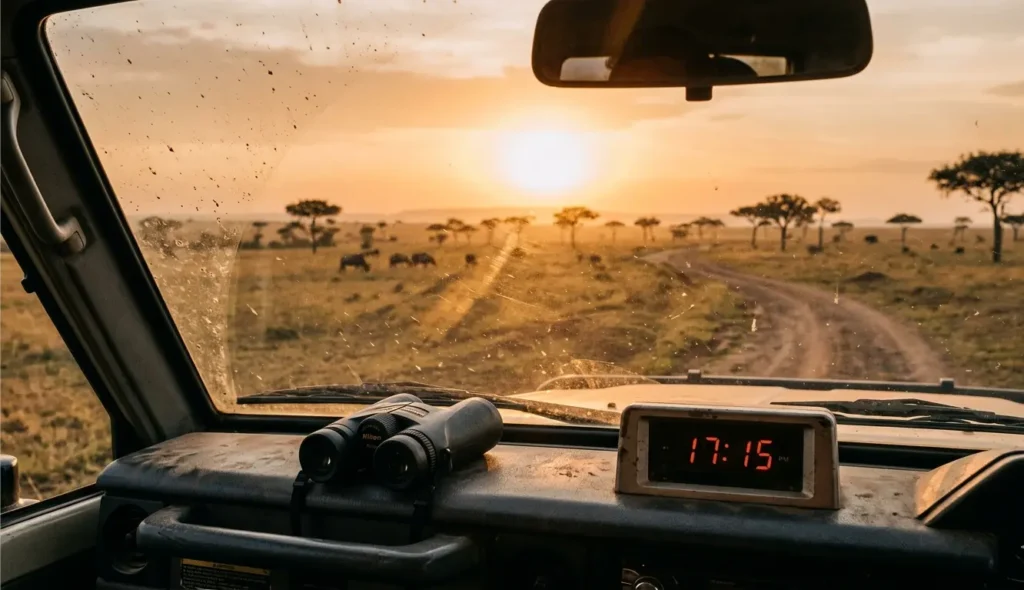
⚠️ TIME ALERT: The “Time-Warp” isn’t just a mental trick; it has a steep price tag. According to the Masai Mara fee structure, exceeding your 12-hour window by even a few minutes triggers a full second-day charge per person and vehicle. To understand the financial math and how to avoid double-paying, see our guide on Masai Mara 12-hour fee mechanics.
The Mara Timing Schedule
To combat Masai Mara permit expiry, our ground team uses a strict time-budget rather than a loose itinerary. Use this breakdown to ensure you aren’t racing the sunset to avoid a fine.
|
Time Block |
Recommended Activity |
Time Budget |
|
Gate Entry to Track |
Initial registration and driving to first loop |
20 Minutes (Fixed) |
|
Morning Game Drive |
Peak predator activity and river crossings |
3 Hours Maximum |
|
Midday Break |
Picnic site or camp (Mandatory “grounding” break) |
45 Minutes |
|
Afternoon Drive |
Grazers and evening light photography |
2 Hours Maximum |
|
Exit Route to Gate |
Commute from deep reserve back to Sekenani/Talek |
45 – 60 Minutes |
To maintain successful Masai Mara self drive time management, set a recurring alarm on your phone every 90 minutes from the moment you enter the gate. This external reminder is the only way to override the mind’s natural immersion response and ensure you reach the exit before the rangers log your overstay.
With your clock managed, the final layer of self-drive preparation is the conduct rules—the ones that trigger immediate ranger intervention and occasionally a forced exit from the reserve.
Rules of the Reserve — Safety, Conduct, and the Content Creator Warning
The Masai Mara self drive rules on conduct are not suggestions—violations trigger immediate ranger intervention and, in serious cases, forced removal from the reserve. While you are the pilot of your own adventure, you are still operating within a highly regulated ecosystem where rangers prioritize habitat protection over your holiday photos.
Core Enforcement Realities
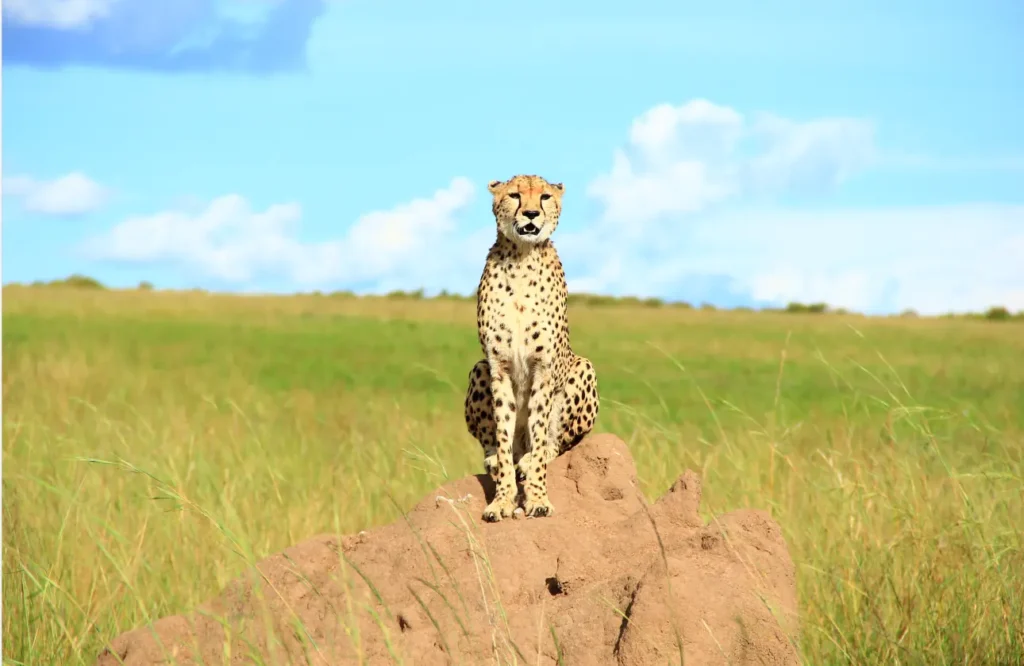
- Rule 1: Stay in your vehicle. Alighting in non-designated areas is a fineable offense under Narok County regulations; unless you are at a marked picnic site or your lodge, your feet must not touch the ground.
- Rule 2: No off-road driving. Off-roading destroys the delicate root systems of the savannah and is a zero-tolerance area for Masai Mara ranger enforcement 2026.
- Rule 3: No wildlife harassment. Approaching too closely or making loud noises to get an animal’s attention will result in an immediate escort to the gate and a significant fine.
The Content Creator Warning
Our Mara ground team has observed a sharp increase in incidents involving live streamers and influencers attempting proximity stunts for their audience. Without a professional guide to provide contextual judgment, content creators on self-drive itineraries frequently find themselves in dangerous positions that the reserve’s rangers are not obliged to bail them out of. Common sense is the only restraint available on a self-drive, and in 2026, we’ve seen that the desire for viral content overrides safety with alarming regularity.
🛡️ OPERATOR INSIGHT: If the logistical weight of managing these Masai Mara conduct rules while navigating and spotting wildlife feels overwhelming, you don’t have to cancel your plans. Standby guides are often available at Sekenani or Talek gates; hiring one allows you to stay in your own vehicle while they handle the rules and animal tracking. To weigh up the stress of solo navigation against professional help, see our Masai Mara Self Drive vs Guided honest verdict to see which path actually fits your travel style.
According to the official Kenya Wildlife Service conduct framework, which serves as the baseline for all Kenyan reserves, these Masai Mara self drive rules are strictly enforced to prevent permanent damage to the wildlife population. Rangers use binoculars to spot off-road tracks from kilometers away, meaning a “quick detour” for a photo is almost always caught and penalized.
You now have everything you need to plan a self-drive that does not end at the gate, in a ditch, or with a ranger escort out of the reserve.
Conclusion
The Masai Mara self drive rules in 2026 reward preparation and punish assumption. The payment trap, the vehicle check, the signal dead zones, and the “time-warp” phenomenon are all solvable—but only by a driver who addresses them before departure, not at the gate.
Hilmuks guides navigate this complex terrain daily. If this manual has made the logistics feel heavier than the adventure, our 3-Day Masai Mara Safari from Nairobi handles every variable as standard—so you can focus on the lions, not the clock.
FAQ — Expert Answers on Masai Mara Self Drive Rules 2026
Is self-drive allowed in Masai Mara National Reserve in 2026?
Yes—self-drive is legally permitted in the Masai Mara National Reserve in 2026 provided you enter in a gate-approved 4×4 vehicle, pay through the correct Narok County portal, and follow all reserve conduct rules. Rangers at Sekenani and Talek conduct vehicle checks and can mandate a gate guide if your vehicle or behavior does not meet reserve standards.
What vehicle do I need for a Masai Mara self drive in 2026?
A high-clearance 4×4 with vetted brakes and adequate ground clearance is the minimum requirement. Saloon cars and standard SUVs without true 4×4 capability are typically rejected at the gate. Before you commit to a rental, consult The Kenya Car Hire Survival Guide to ensure your vehicle won’t be turned away by rangers.
How do I pay Masai Mara entry fees as a self-driver in 2026?
Payment must be made through the Narok County Government portal—not the KWS eCitizen system used for Lake Nakuru and Amboseli. KWS receipts are non-refundable and are rejected at all Mara gates. For a detailed walkthrough of the portal, see How to Pay Masai Mara Park Fees 2026
What is the Masai Mara 12-hour rule and how does it affect a self-drive?
The 12-hour rule means your entry permit begins the moment your vehicle is scanned at the gate and expires exactly at 6PM regardless of how much of the reserve you have seen. Unlike KWS parks, there is no 24-hour flexibility. For a deeper look at the logistical impact of this policy, read Masai Mara Park Fees 2026: Why the 12-Hour Rule is Different from KWS Parks.
What happens if my vehicle breaks down inside the Masai Mara?
Save the on-duty ranger’s personal contact number at the gate before entering. Rangers coordinate mechanical rescue for stranded self-drivers and can organize a mechanic to reach your location—but only if you can contact them. If the risk of a breakdown in a remote area sounds daunting, consider our Masai Mara Safari from Nairobi where we handle all mechanical logistics.
Are there areas in the Masai Mara with no mobile signal?
Yes—remote sections near the Tanzanian border and parts of the Mara Triangle have zero Kenyan mobile network coverage. This is a complete blackout, not intermittent signal. Always ensure at least one other vehicle is in visual proximity and that you have packed essential survival items as outlined in the Masai Mara Packing List 2026
Can I hire a guide at the Masai Mara gate if I arrive without a booking?
Yes—standby guides are sometimes available for hire at the main gates including Sekenani and Talek. Hiring a gate guide does not require you to switch vehicles—you drive your own vehicle while the guide provides wildlife intelligence. To help you decide if this is necessary for your trip, check out our Masai Mara Self Drive vs Guided 2026: The Honest Verdict From the Driver’s Seat.