Email:
 Phone:
 WhatsApp:

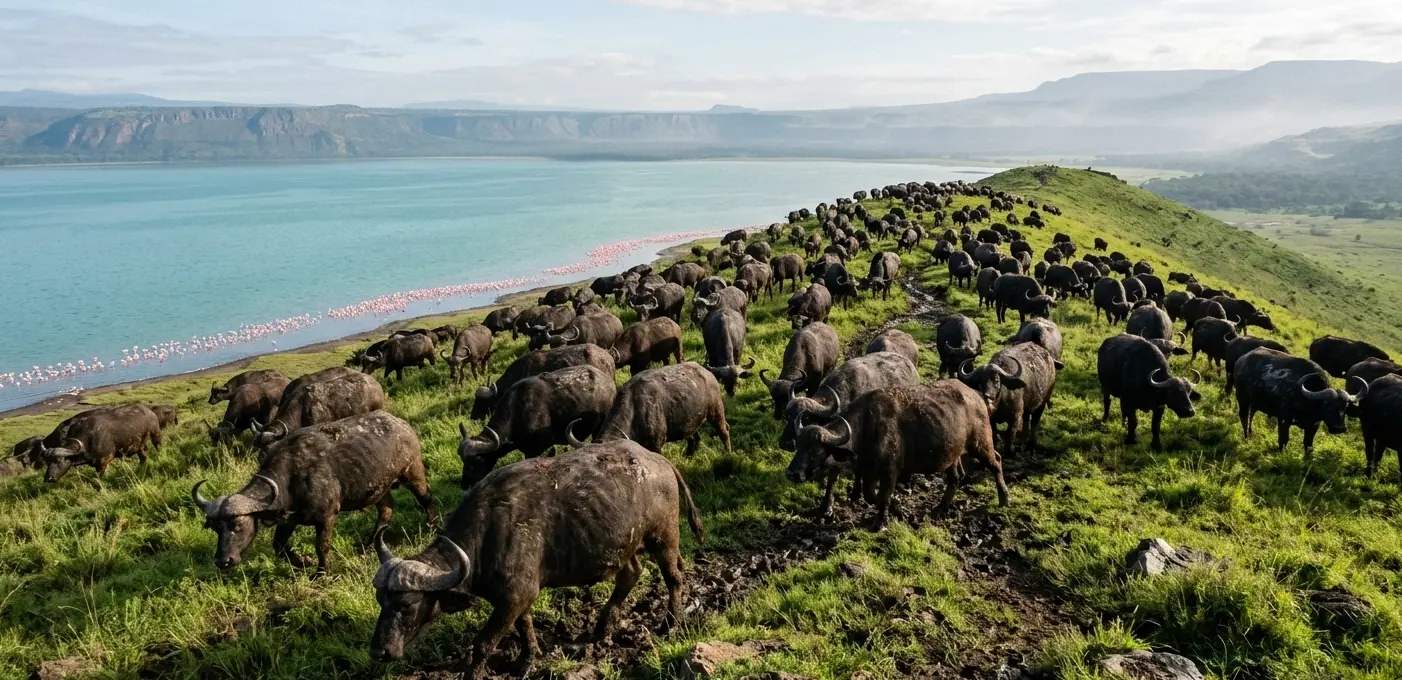
Buffaloes in Lake Nakuru National Park are 2026’s most high-density wildlife encounter, now concentrated in the southern Nderit sector due to rising lake levels. While common, these Cape Buffaloes represent a significant safety risk for self-drive travelers navigating flooded tracks and hidden mud wallows.
The Cape Buffalo is often dismissed as a “static” sighting in Kenya, but in 2026, the Buffaloes in Lake Nakuru National Park have become the park’s most unpredictable logistical hurdle. Unlike the Leopards, which have retreated to the higher cliffs, the 4,000-strong buffalo population is now squeezed into the narrow corridors between the southern ridges and the expanding shoreline.
If you are planning a Lake Nakuru self-drive safari, you need more than just a camera lens; you need a strategy to navigate the “Nderit Bottleneck” and the aggressive “Dagga Boys” that now frequent the park’s primary transit routes. This operator’s report breaks down the 2026 “Mud Trap” reality and the tactical maneuvers needed to enjoy these massive herds without becoming another recovery statistic on the Nderit tracks.
Quick Navigation: Jump to your Section
The 2026 Reality: Why Buffalo Sightings in Lake Nakuru are Changing
The 2026 expansion of the lake to over 82km² has fundamentally redrawn the map for Buffaloes in Lake Nakuru National Park. High water levels have effectively “erased” the northern plains, forcing the massive Southern Sector Buffalo Herds into a narrow topographical bottleneck. This compression means you are now 70% more likely to encounter a herd on the main transit tracks than in previous years.
Unlike the Tree-Climbing Lions that have moved to the higher Acacia woodlands, the Cape Buffalo Lake Nakuru population remains tethered to the shoreline’s lush, water-logged grasses. Because the available grazing land has shrunk, the density of Buffaloes in Lake Nakuru National Park in the Nderit sector is currently at an all-time high. You will find that the animals are less likely to move off the road for vehicles, as there is literally nowhere else for them to stand without sinking into the marsh.
🛡️ OPERATOR INSIGHT: The “Nderit Bottleneck” is a genuine logistical hazard near the Ndarugu River crossing. If you encounter a large herd blocking the path, do not rev your engine or honk; these buffaloes are increasingly agitated by the limited space and rising water. See our Lake Nakuru self-drive guide to learn more about navigating these high-density animal corridors without damaging your vehicle.
Now that we’ve looked at the geographical shift of the herds, let’s discuss the literal “traps” these animals are leaving behind for unsuspecting drivers…
The 2026 “Mud Trap” Warning: Navigating the Southern Sector Tracks
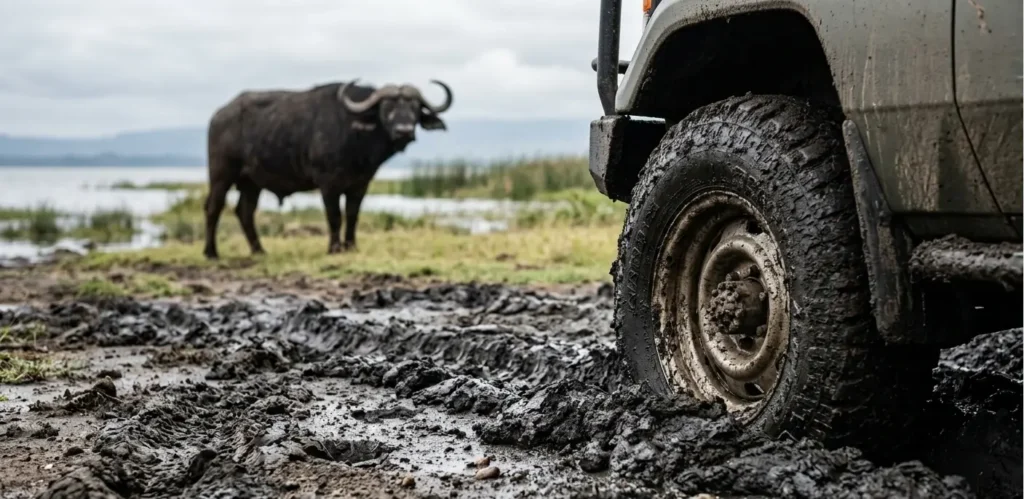
In the 2026 landscape, the greatest threat to a self-drive vehicle isn’t just the rising lake, but the literal Buffalo Mud Traps 2026 hidden along the southern tracks. As Buffaloes in Lake Nakuru National Park wallow to cool their body temperatures, they create deep, clay-heavy pits that are often camouflaged by shallow surface water. These wallows can swallow the tires of even a sturdy 4×4, turning a photography session into a multi-hour recovery ordeal.
Standard safari maps won’t show you these dynamic hazards, which are most prevalent near the Nderit gate and the low-lying plains of the southern sector. Many travelers mistakenly believe that if they see Buffaloes in Lake Nakuru National Park standing in water, the ground underneath is solid enough for a car. In reality, the weight of a three-ton buffalo compacts the mud into a “suction trap” that is the primary reason for vehicle stalls this season.
⚠️ 2026 ROAD ALERT: If you find yourself stuck in a buffalo wallow, KWS recovery fees in the southern sector can exceed KES 10,000, and commercial tow trucks from Nakuru town often charge double for park entry.
Maintaining Safari Safety Kenya protocols means staying on the established ridges where the ground is baked hard by the sun. Avoid any track that shows fresh “churned” mud, as this indicates Buffaloes in Lake Nakuru National Park have recently vacated the area, leaving the soil unstable. For a safer experience, consider sticking to the high-ground viewpoints .
With the logistical risks of the terrain cleared up, we must turn our attention to the specific behavior of the residents—starting with the most temperamental bulls in the park…
Dangerous Wildlife in Nakuru: The “Old Dagga Boy” & Naishi Airstrip Warning
While the large herds offer safety in numbers, the real threat from Buffaloes in Lake Nakuru National Park comes from the “Dagga Boys.” These are older, solitary bulls that have been pushed out of the herd and have become notoriously territorial and unpredictable. In 2026, these lone residents are frequently spotted lurking in the thickets near the Naishi Airstrip and the Ndarugu River crossing.
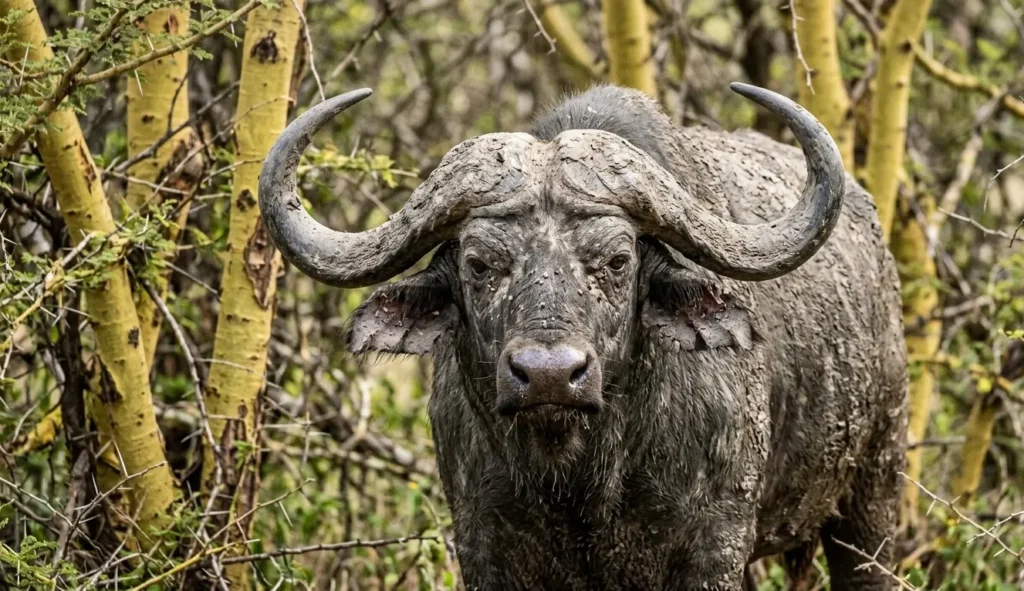
Spotting a solitary Cape Buffalo Lake Nakuru near these transit points is a signal to keep your windows up and your engine running. These bulls lack the flight instinct of the larger groups and often perceive a stationary vehicle as a challenger for the limited dry ground remaining in the southern sector. They are widely considered the most Dangerous Wildlife Nakuru has to offer because they will charge without the typical “head-lowering” warning signs used by younger bulls.
🛡️ OPERATOR INSIGHT: The Naishi Sector is currently a high-activity zone for these aggressive loners. If you are planning to exit your vehicle at designated points, check our Is Lake Nakuru National Park Safe? guide to understand the specific ranger-monitored “Green Zones” where you can safely stretch your legs without encountering a Dagga Boy.
It is a common mistake to assume these old bulls are “lazy” because they are often caked in dried mud and moving slowly. On the ground last week, we observed a single bull at the Naishi junction force a self-driving tourist reverse nearly 100 meters simply by standing its ground on the narrow track. For those doing a Lake Nakuru self-drive, the golden rule is simple: if the buffalo is alone and staring directly at you, it owns the road.
Understanding the temperament of these solitary bulls is just the first step; next, we need to master the professional distance protocols used by park rangers…
Safari Safety Kenya: The 20-Meter Buffer Rule
Standard park regulations often give vague advice on distance, but professional Safari Safety Kenya protocols require a strict 20-meter buffer when approaching Buffaloes in Lake Nakuru National Park. While rhinos and giraffes generally tolerate closer proximity if you remain quiet, a buffalo’s “comfort zone” is significantly larger and more volatile. If you cross this invisible line, you trigger a defensive posture that can escalate from a stare to a charge in seconds.
Reading the body language of the Cape Buffalo Lake Nakuru residents is a vital skill for any self-drive visitor. Look for the “Head-Up” stare; if a bull raises its chin and looks down its nose at your vehicle, it is measuring the distance for a potential strike. This behavior is a clear signal of dangerous wildlife Nakuru intent and should be met with a slow, quiet reversal of your vehicle until the animal resumes grazing.
🛡️ OPERATOR INSIGHT: While the 20-meter rule is standard for buffalo, remember that different species require different gaps to avoid fines or distress. See our Rothschild’s Giraffe identification guide to learn why these giants require a 50-meter buffer compared to the tighter limits used for buffalo.
Never park your car in a way that blocks a buffalo’s path to the water or the thickets, as they feel most threatened when their exit route is cut off. In the 2026 high-water environment, the limited dry land makes these animals more protective of their immediate space. Keeping your engine idling in neutral during close encounters allows for a quicker exit if the Buffaloes in Lake Nakuru National Park show signs of agitation.
Now that you know how to maintain a safe distance from the herd, let’s address the 2026 fence crisis and why you might spot buffaloes in unexpected places…
The 2026 Fence Crisis: Stray Buffaloes and the Barut Sector
As of 2026, the rising water levels have created a unique security challenge: the “Fence Crisis” near the Ndarugu River. Persistent flooding has compromised sections of the electric perimeter fence, allowing members of the Southern Sector Buffalo Herds to occasionally stray into the neighboring Barut and Nakuru West estates. This environmental shift has turned the park boundaries into active zones for Dangerous Wildlife Nakuru encounters that weren’t present five years ago.
If you are driving along the park’s western fringes, you may notice KWS rangers more frequently patrolling the fence lines to herd these animals back into the protected area. For travelers, this means that Buffaloes in Lake Nakuru National Park are no longer confined to the deep interior; they are increasingly common right at the edge of the transit roads. These “fringe” buffaloes are often more stressed by human activity and noise than those deep in the southern sector.
🛡️ OPERATOR INSIGHT: Vandalism of fence wires and water-logged posts has made the Barut sector a hotspot for stray wildlife. To ensure you aren’t caught in a logistical delay due to fence repairs or animal crossings, check our Is Lake Nakuru National Park Safe? guide for the most recent 2026 solo and family security updates.
You should strictly avoid the temptation to stop your vehicle near a fence gap for photos, as straying too close to a compromised boundary can lead to a heavy fine from patrolling units. Always maintain a clear path for KWS patrol vehicles, which have right-of-way during herd containment operations. To learn more about how the changing landscape is impacting your route, see our report on Lake Nakuru Water Levels to see why your old safari map is now technically “underwater.”
Now that we have covered the security risks at the park boundaries, let’s identify the specific ridges where you can get the best views of the herds without the mud…
Best Viewpoints for the Southern Sector Herds
After navigating the logistical challenges of the marshes, the reward is witnessing the 2026 mega-herds from the safety of the park’s elevated ridges. The Southern Sector Buffalo Herds are currently most impressive when viewed from the raised contours of the Naishi and Soimet ridges, where the animals congregate to avoid the high-water humidity. From these vantage points, you can often spot over 100 members of the Buffaloes in Lake Nakuru National Park moving in a single, dark wave across the surviving grasslands.
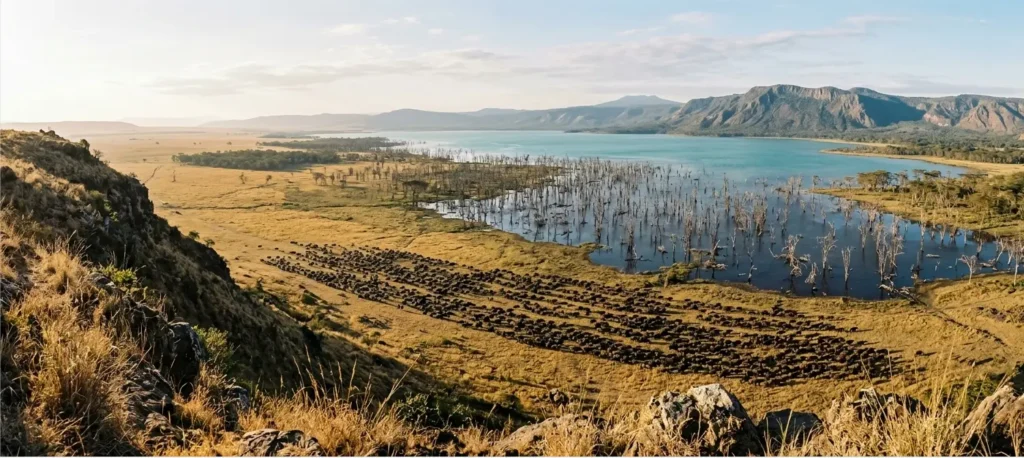
For the best panoramic photography, prioritize the southern “High-Ground” tracks that overlook the Nderit plains rather than driving right to the water’s edge. These elevated spots allow you to capture the sheer scale of the Cape Buffalo Lake Nakuru population without the risk of high-centering your vehicle in a hidden wallow. On a clear 2026 morning, the contrast between the black buffalo capes and the pink flamingo-lined shore creates the park’s most iconic visual.
💡 PRO TIP: To capture the most dramatic herd movements without the haze, we recommend timing your visit to the southern ridges between 06:30 AM and 08:30 AM. See our guide to the best viewpoints in Lake Nakuru to find the specific GPS coordinates for the Soimet “Buffalo Ridge” and other hidden photography spots.
If you are looking for the absolute “insider” spot, there is a small, unnamed rise just past the Naishi Airstrip that offers a 360-degree view of the Nderit bottleneck. This is where we frequently observe the older bulls interacting with the younger buffaloes in Lake Nakuru National Park before the heat of the day forces them back into the thickets. It is a far more productive use of your time than circling the flooded northern circuit where sightings have become increasingly rare.
With your memory card full of high-ground photography, the final step is ensuring you have a clean exit strategy and the right logistical wrap-up for your trip…
Logistical Essentials: Getting to the Buffaloes in Lake Nakuru National Park
Reaching the high-density Southern Sector Buffalo Herds requires a specific entry strategy in 2026 because of the flooded northern tracks. If you are arriving from Nairobi, the most efficient route is to bypass the main gate and use the Lanet Gate, which drops you closer to the dry ridges where buffaloes in Lake Nakuru National Park congregate. Most travelers lose two hours navigating the submerged northern circuit, a mistake you can avoid by following a “South-First” itinerary.
For those using public transport or a Nairobi to Nakuru transport guide, ensure your driver drops you at a point where a 4×4 can pick you up, as 2WD vehicles are currently prohibited from the Nderit sector. The transit time from the Lanet Gate to the primary buffalo viewing ridges is roughly 35 minutes, provided the tracks are dry. If you are coming from the west, the Nderit Gate remains the best entry point for immediate proximity to the 2026 “Mud Trap” zones.
🛡️ OPERATOR INSIGHT: Since all park payments are now digital, ensure you have loaded your eCitizen account before reaching the gate to avoid signal delays in the forest sections. See our step-by-step guide on how to pay Lake Nakuru park fees on eCitizen to ensure your entry is seamless and you don’t miss the early morning herd movements.
Comparison Table: Gate Proximity to Buffalo Sectors
| Gate Name | Best for… | Distance to Southern Ridges | 2026 Road Status |
| Lanet Gate | Faster access from Nairobi | 12km | Recommended (Hard Ground) |
| Nderit Gate | Immediate Buffalo sightings | 4km | High Risk (Mud Wallows) |
| Main Gate | Flamingo/Rhino sightings | 22km | Flooded (Use Bypass Only) |
Before you head out, make sure your vehicle is up to the task; a standard car rental may not have the clearance needed for the deep buffalo wallows. Check our Kenya car hire survival guide for the 7 critical checks you must perform before leaving the yard.
Now that your transport and gate entry are sorted, let’s ensure you have the right gear to document these massive herds without losing your equipment to the humidity…
Photography & Gear: Capturing Buffaloes in the 2026 Humidity
Photographing Buffaloes in Lake Nakuru National Park in 2026 presents a unique technical challenge: extreme shoreline humidity combined with the deep, light-absorbing black of the buffalo’s coat. Because the Southern Sector Buffalo Herds are now compressed against the water’s edge, you are often shooting through a layer of heat haze and evaporated lake moisture. Standard autofocus settings often struggle to lock onto the dark texture of a buffalo’s hide against the high-contrast glare of the alkaline water.
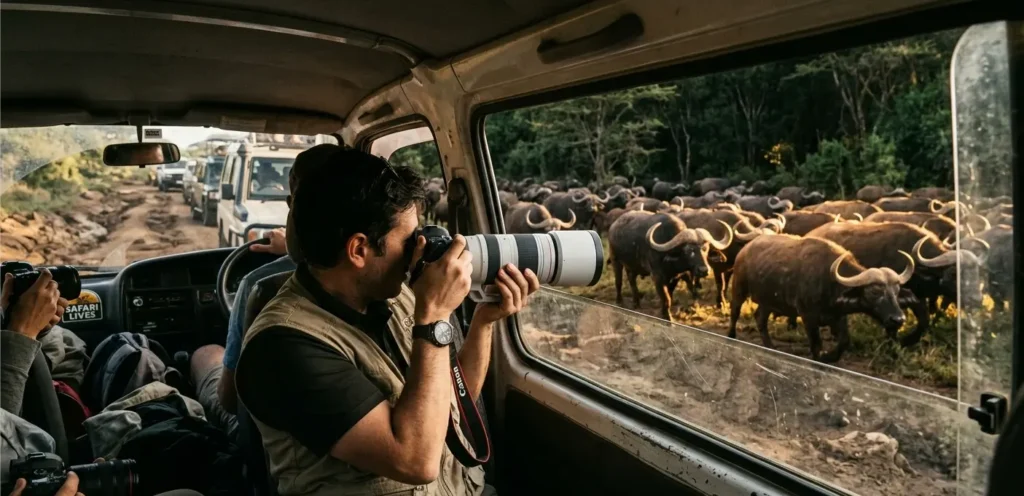
To get professional results, you must move away from the “all-purpose” settings used on the northern plains. The dark capes of the Cape Buffalo Lake Nakuru require an exposure compensation of -0.3 to -0.7 to prevent the surrounding bright water from blowing out the highlights. Additionally, the 2026 water levels mean you are likely shooting from a distance of 20 to 50 meters, making a stabilized lens essential for those sharp, “eye-contact” shots that define top-tier safari portfolios.
🛡️ OPERATOR INSIGHT: While our general photography gear guide explains why a 600mm lens is essential for distant rhinos & Flamingoes, the “Nderit Bottleneck” is the one place where that big glass becomes a liability. Because buffaloes in Lake Nakuru National Park are often standing directly on the narrow tracks, a versatile 100-400mm zoom is the superior choice here. It allows you to quickly pull back for a full-body portrait when a herd surrounds your vehicle—something impossible to do with a fixed long-prime lens in a cramped safari van.
💡 PRO TIP: Dust is less of a concern this year due to the mud, but moisture is the new equipment killer. Always carry a few silica gel packets in your camera bag and a high-quality lens cloth to wipe away the salt-heavy mist that clings to glass near the Nderit shoreline. For a full breakdown of what to carry, check the ultimate Lake Nakuru safari packing list to ensure you are logistically prepared for the humid southern micro-climate.
Now that your gear is dialed in for the southern moisture, let’s wrap up with the final “Operator’s Checklist” to ensure you leave the park without a fine or a tow truck…
2026 Buffalo Spotting Checklist: The Operator’s Final Walkthrough
Before you leave your lodge or enter through the Lanet Gate, use this checklist to ensure you are prepared for the specific environmental challenges of the southern sector. In 2026, “winging it” in the Nderit bottleneck often results in a KES 10,000 recovery fee or damaged camera gear.
1. Vehicle & Navigation Prep
- [ ] High-Clearance 4×4 Engaged: Confirm your vehicle has at least 8 inches of ground clearance; do not attempt the Nderit tracks in a standard crossover.
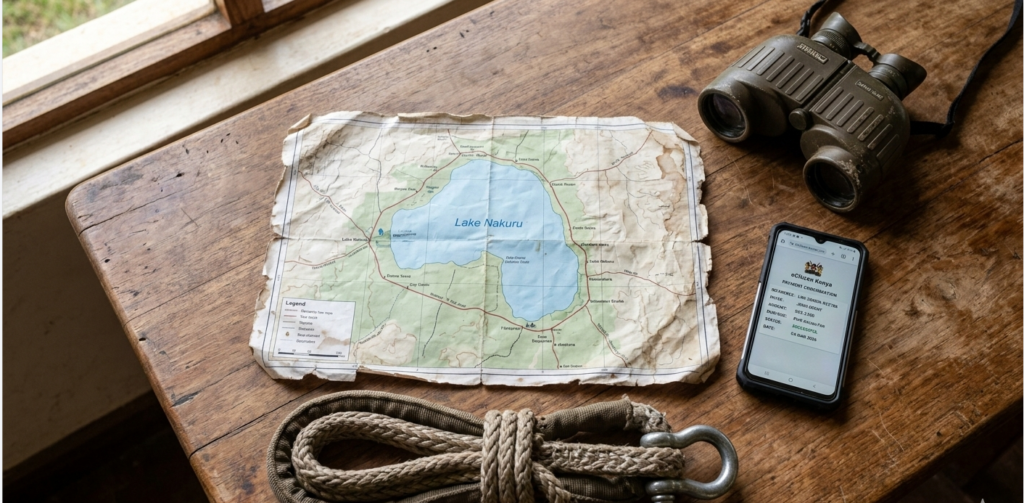
- [ ] Recovery Gear Check: Ensure your spare tire is inflated and you have a heavy-duty tow rope accessible (not buried under luggage).
- [ ] Offline Map Downloaded: Data signals are non-existent in the southern thickets. Use our Lake Nakuru self-drive guide to mark the “Mud Trap” zones on your GPS.
- [ ] Fuel Level: Ensure you have at least half a tank. Reversing out of long herds and navigating detours consumes 30% more fuel than a standard circuit.
2. Safety & Distance Protocols
- [ ] The 20-Meter Rule: Mentally mark a buffer zone. If a Cape Buffalo Lake Nakuru bull raises its head and stares, you are already too close.
- [ ] Exit Strategy: Always park with your nose pointing toward an escape route. Never let Southern Sector Buffalo Herds “sandwich” your vehicle between the water and the ridge.
- [ ] Windows & Doors: Keep all doors locked and windows no more than halfway down when within 30 meters of a solitary “Dagga Boy.”
3. Photography & Logistics
- [ ] The “Zoom” Audit: Ensure you have a 100-400mm lens mounted for the bottleneck. Save the 600mm primes for the rhinos as per our safari photography gear guide.
- [ ] eCitizen Verification: Confirm your QR code is saved as a screenshot. See our KWSPay payment guide if you haven’t received your confirmation SMS yet.
- [ ] Moisture Protection: Place silica packets in your gear bag to combat the intense 2026 shoreline humidity.
If you are traveling with family, verify that everyone knows the “Silent Cabin” rule before approaching a herd. Buffaloes in Lake Nakuru National Park are highly sensitive to high-pitched noises (like children’s shouting), which can trigger a mock charge. For more on keeping your group protected, check our Lake Nakuru safety guide.
[Downloadable PDF Checklist for 2026 Safaris ]
Now that your checklist is complete and your gear is protected, you are ready to experience the raw power of the Nakuru herds. Safe driving, and we’ll see you at the ridges!