Email:
 Phone:
 WhatsApp:

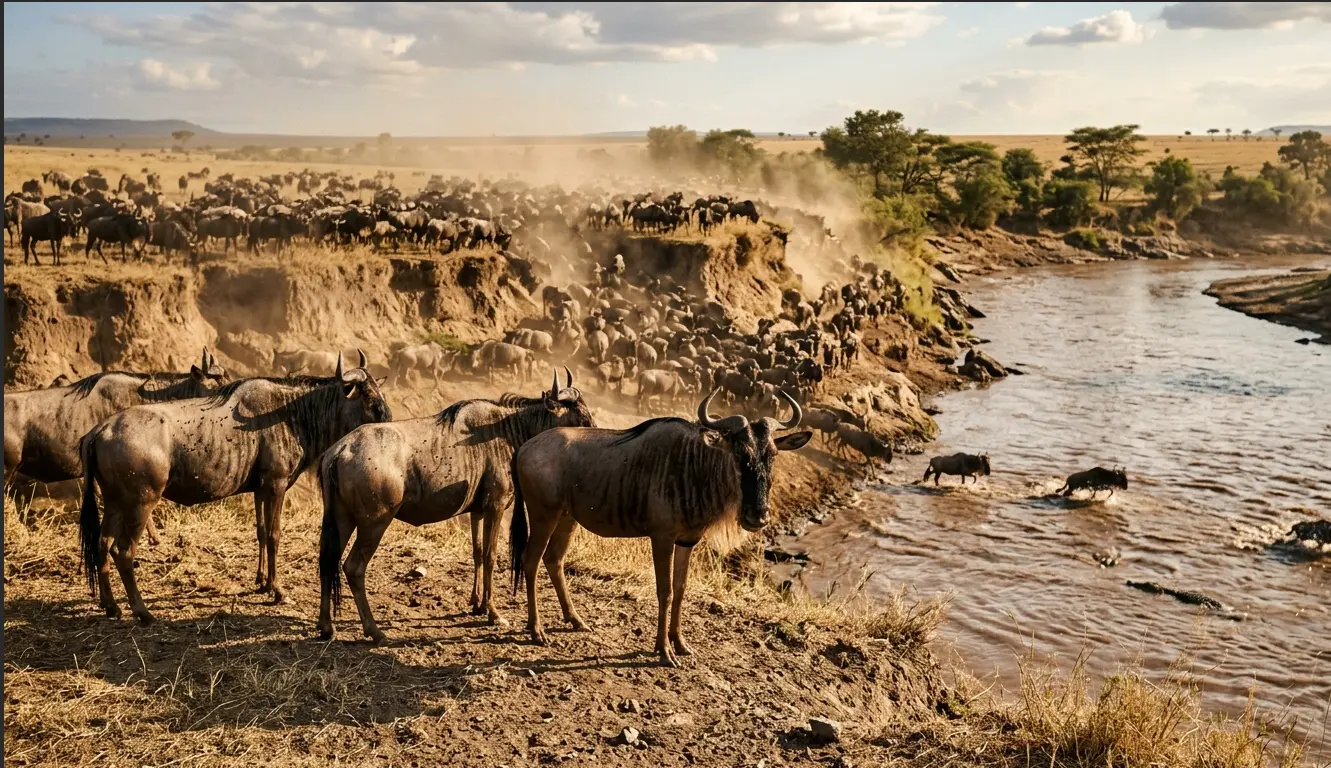
The wildebeest migration river crossing is the most photographed wildlife event on Earth — and the most misunderstood, because the question every visitor at the riverbank actually needs answered is not when the crossing happens but how to read the herd before it does.
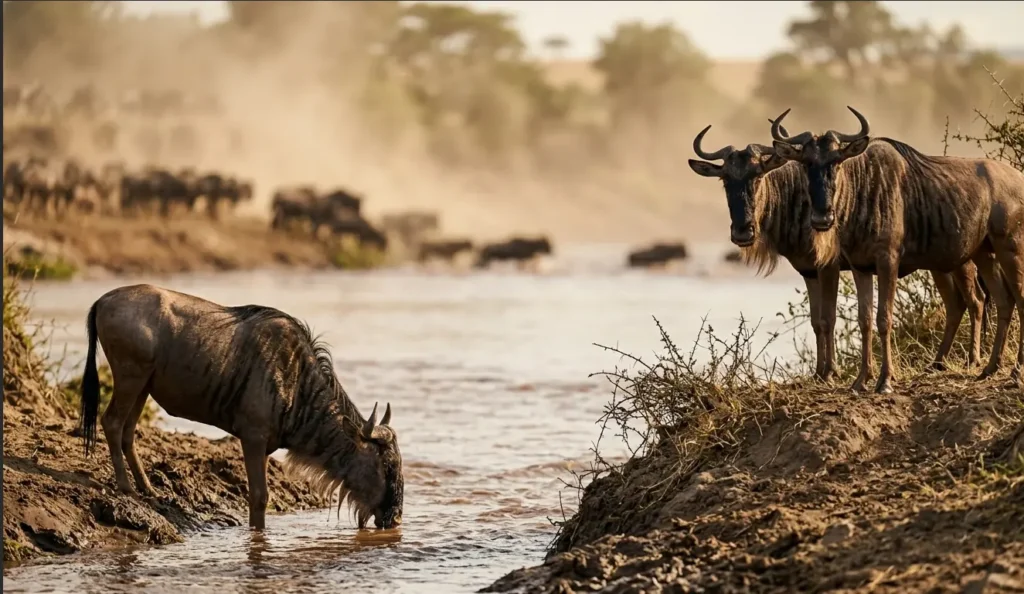
A wildebeest river crossing is imminent when 5 to 10 scout animals walk to the water’s edge and stare at the opposite bank without drinking. If scouts drink, they are thirsty—no crossing is coming. If they stare without drinking, they are measuring the current.
While generic booking platforms claim these events are “random and chaotic,” the 2026 reality is that they follow specific wildebeest river crossing behavior patterns. Evans Kimojino, a Mara-based safari guide and Hilmuks partner with 1,300+ documented sightings, observed that if the herd is agitated, crossing is imminent, whereas a calm herd can take five hours or a full day before jumping. For complete logistics, see our Great Migration Masai Mara complete operator’s guide.
QUICK DECISION TABLE
|
What You Observe |
What It Means |
What To Do |
|
Herd agitated, moving actively toward bank |
Crossing imminent |
Stay at your position — do not move |
|
Herd calm, grazing near bank |
Herd is calculating — could be minutes or hours |
Stay patient, watch the scouts |
|
Scouts at water’s edge drinking |
They are thirsty — no crossing |
You have time — go for coffee |
|
Scouts at water’s edge staring without drinking |
Measuring current — crossing imminent |
Check camera settings now |
|
Dust rising from rear of herd |
Point of no return — the jump is happening |
Camera on, do not move vehicle |
|
Zebra takes 3 steps into shallows |
Wildebeest will follow |
Anticipate the surge |
|
Crocodiles floating on surface (logged) |
Full and dormant — lead cow won’t sense threat |
Long, sustained crossing likely |
|
Water surface empty — no visible crocodiles |
Hunting beneath surface — lead cow senses danger |
Herd may hesitate for hours |
Quick Navigation-Jump to Your Section
Reading the Herd — Why Agitation and Calm Mean Completely Different Things
The starting point for every wildebeest migration river crossing assessment is the macro energy of the herd. If the animals near the river are visibly agitated—moving actively, crowding toward the bank with heads raised and ears forward—a plunge is likely imminent. Conversely, if the herd is calm and scattered laterally while grazing, they are in a low-probability assessment phase that can last for hours without a single jump.
Most generic safari guides describe pre-crossing movements as “anxious milling,” implying the animals are simply nervous or confused. Our field observations confirm that wildebeest river crossing behavior is actually a sophisticated form of collective calculation. Each animal processes sensory data—the scent of rain, the sound of the current, and the musk of crocodiles—contributing to a group energy level that reflects their real-time safety assessment.
🛡️ OPERATOR INSIGHT: Do not be fooled by a large herd simply standing near the water; if they are not “oriented” toward the opposite bank, they are likely just resting. To avoid wasting your day, check our best time for Great Migration Masai Mara 2026 guide to understand how seasonal weather shifts affect these daily movement patterns.
Understanding that wildebeest river crossing behavior is a collective process rather than a moment of individual bravery allows you to filter out false starts. If the macro energy is low and grazing is the priority, no other signal matters yet. However, once that collective agitation fires and the herd begins to “funnel,” your attention must shift immediately to the scouts at the water’s edge.
Now that you can read the herd’s overall energy, let’s look at the specific animals that actually make the “yes or no” decision at the bank…
The Stare vs. Drink Protocol — Field Rule for Timing the Jump
The most precise indicator of an imminent wildebeest migration river crossing involves a subset of five to ten “scout” animals. These individuals separate from the main herd to walk the water’s edge, but their intent is often misread by tourists. According to Evans, if these scouts lower their heads to drink, the crossing is effectively canceled for the moment.
Evans’s rule is based on a fundamental distinction in wildebeest river crossing behavior: drinking signals thirst, not calculation. When scouts drink, they have reached the bank for hydration and will typically retreat or loiter once finished. However, if they stand at the bank and stare intensely at the opposite shore without drinking—sometimes for up to twenty minutes—they are assessing crocodile movement and current strength.
🛡️ OPERATOR INSIGHT: When scouts stop drinking and begin the “staring phase,” check your camera settings immediately. To ensure your gear is ready for the high-speed action that follows, see our Masai Mara migration photography guide for specific lens and shutter speed recommendations.
The “Lead Cow” is rarely the strongest or most dominant member of the herd. Instead, the first animal to jump is simply the one whose individual calculation completes first, registering the river as “crossable.” Once this scout finishes its assessment and steps into the flow, it triggers a psychological cascade that pulls the rest of the 10,000-strong herd behind it.
If the herd appears agitated but no scouts have reached the waterline, the event is still building and not yet at the decision point. In this phase, you should monitor the pressure from the back of the herd; as more animals crowd the bank, the scouts will eventually be pushed into their staring positions. This transition from “milling” to “staring” is the final green light for a wildebeest migration river crossing.
The scouts at the bank are currently reading the river conditions. Meanwhile, a different physical force is building behind them that will eventually force the decision, regardless of the scouts’ calculations…
The Dust Wall Phenomenon — Why the Back of the Herd Forces the Front to Jump
While scientific research often focuses on water depth or current strength, professional operators focus on the dust. A wildebeest migration river crossing is frequently triggered by the animals at the back of the herd who have no visual contact with the river. As thousands of animals begin jogging forward to close the gaps, they generate a massive “Dust Wall” that rises from the rear and moves toward the bank.
This dust creates a critical visibility block for the lead scouts already stationed at the waterline. As the dust obscures their retreat path, the physical pressure from the surging animals behind them compresses the front row toward the drop-off. In many cases, the “Lead Cow” does not choose to jump; it is physically pushed to the point where the only remaining direction is down into the Mara River.
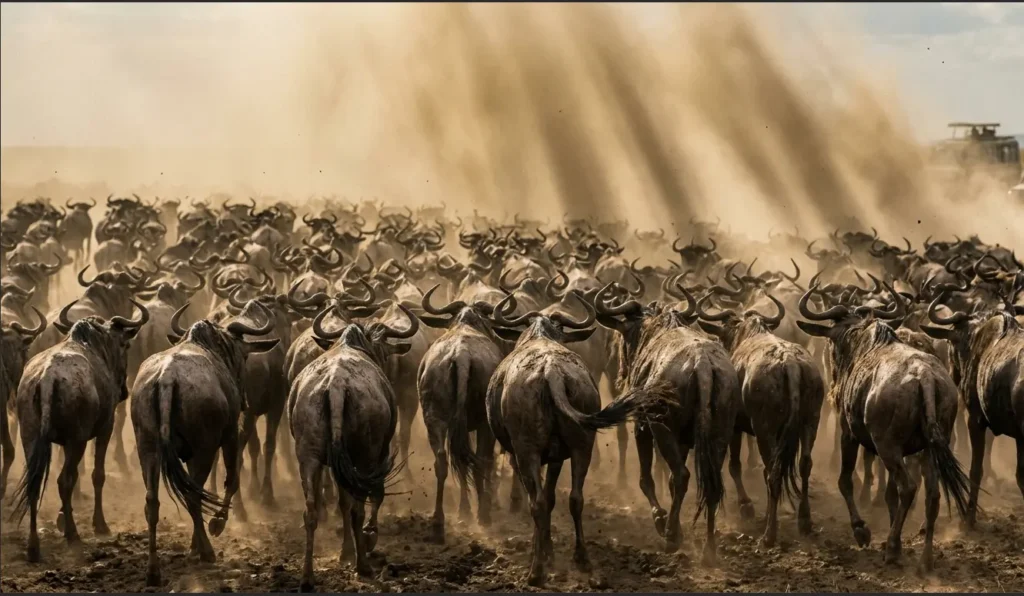
🛡️ OPERATOR INSIGHT: If you see a thick cloud of dust rising from the back of the herd while scouts are in their “staring” phase, do not move your vehicle. This is the second-tier confirmation that a crossing will begin within minutes, and any engine noise or movement now could spook the leaders and cause a dangerous stampede. For more on maneuvering rules, see our guide on Masai Mara self-drive vs guided 2026 safaris.
Most visitors miss this signal because they focus their binoculars entirely on the waterline. By the time the dust is visible to an untrained eye, the wildebeest river crossing behavior has already reached the point of no return. Experienced guides scan the horizon behind the herd specifically to catch this build-up before the first animal even touches the water.
With the internal herd dynamics understood, the wider ecosystem provides two final prediction signals that most visitors overlook—the behavior of the zebras and the secret language of the crocodiles…
The Zebra Catalyst and the Logged Crocodile Rule — Reading the Ecosystem
Beyond the herd itself, two environmental factors dictate the timing of a wildebeest migration river crossing: the presence of zebras and the visibility of crocodiles. Zebras possess superior eyesight and a calmer temperament at the water’s edge compared to wildebeest. When a mixed herd gathers, our ground team watches the zebras; if a single zebra takes three deliberate steps into the shallows, it acts as a “safety signal” that triggers the wildebeest scouts to follow.
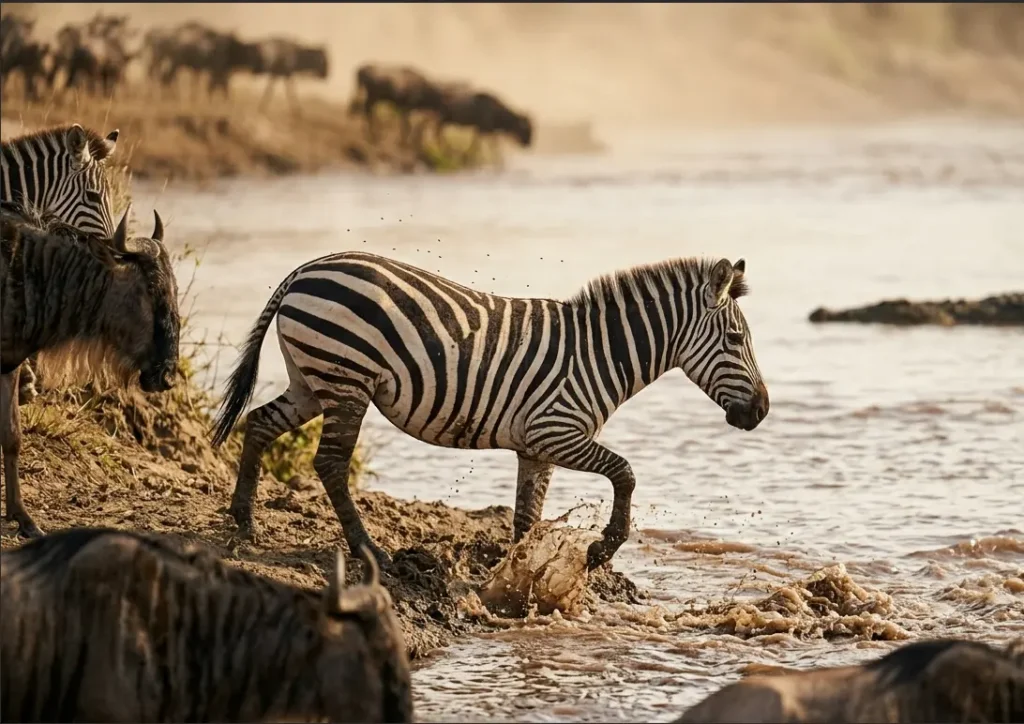
If the zebras in a mixed group remain back from the bank, the wildebeest will likely hesitate indefinitely, regardless of how much pressure builds from the rear. This wildebeest river crossing behavior makes the zebra the “reluctant leader” of the Mara. When you are positioned at the riverbank, ignore the thousands of milling wildebeest for a moment and focus your binoculars on the few zebras at the front—their confidence is the most reliable precursor to a plunge.
🛡️ OPERATOR INSIGHT: Watching the ecosystem requires patience, often lasting from sunrise until the midday heat. To stay comfortable during these long vigils, check our Masai Mara packing list 2026 for essentials like high-SPF sunblock and bean bags for steady long-lens photography.
The “Logged Crocodile” rule is another vital operator secret that contradicts tourist logic. Nile crocodiles are ambush predators that, after a successful kill, will float dormant on the surface like logs to regulate their body temperature. If you see multiple crocodiles floating visibly on the water, it means they are full and dormant, which reduces the “silent threat” sensed by the wildebeest and often leads to a longer, more sustained crossing.
Conversely, an empty river surface is far more dangerous. If no crocodiles are visible, they are likely submerged and actively hunting, a presence the lead scouts can sense even if you cannot. Most visitors feel relieved when the water looks clear, but seasoned operators know that an “empty” river usually causes the herd to hesitate for hours.
With these four behavioral protocols mastered, the final challenge is ensuring your vehicle is in the right place at the right time to catch the action…
Vehicle Positioning and the Radio Network — How Guides Beat the Crowd in 2026
Securing a front-row seat for a wildebeest migration river crossing is a matter of logistical timing, as there is no reserved parking at the Mara River. During the peak August window, over 200 vehicles can converge on a single active crossing point, creating a bottleneck that can ruin your visibility. To beat the volume, our ground team maintains an “early arrival imperative,” often positioning vehicles at the riverbank by 7:00 AM to secure the best angles before the midday rush.
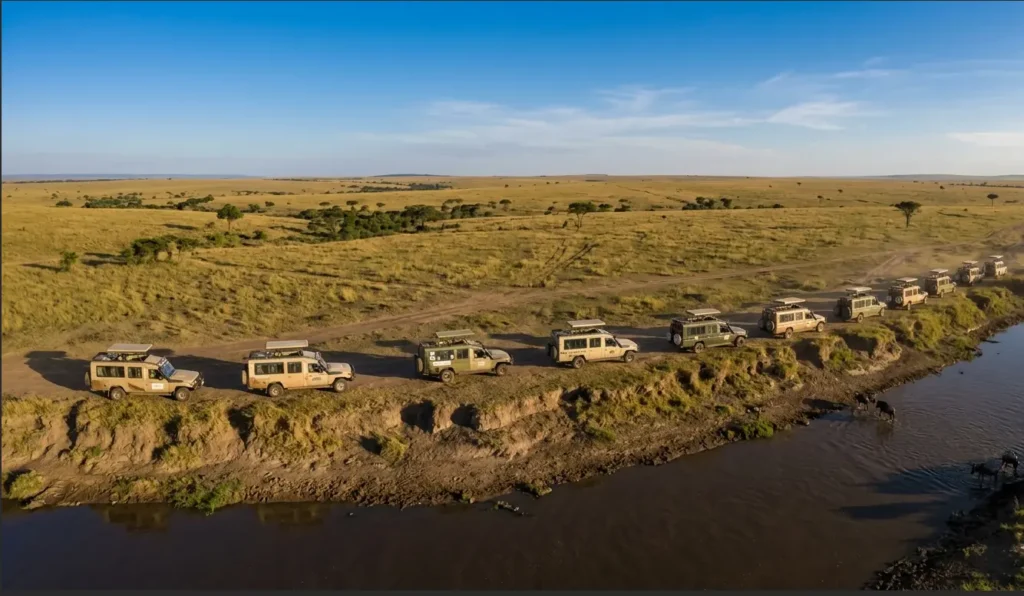
Professional guides navigate this chaos using a real-time radio network to track wildebeest river crossing behavior across various points. When a guide confirms that scouts are in a “staring” position at a specific site, that intelligence travels through the network in seconds. We monitor these frequencies continuously, allowing us to move our clients preemptively to a high-probability site rather than reacting after the jump has already started.
🛡️ OPERATOR INSIGHT: The most visceral viewing position is at the riverbank level, beside the crossing point, rather than looking down from an elevated ridge. If you are a photographer, arriving early is non-negotiable to secure these lower-angle spots. For more on coordinating your timing, see our 3-Day Masai Mara Safari from Nairobi: A Practical, Operator-Led Guide which details how we structure our morning departures to beat the crowd.
The Kenya Wildlife Service (KWS) enforces strict vehicle distance and behavior requirements near crossing events to protect the animals from being spooked. Our guides balance these regulations with your viewing priorities, ensuring you are close enough for the “eye-level drama” without violating park rules. For official guidelines on park conduct, you can visit the Kenya Wildlife Service website.
It is a common mistake to assume a herd crosses once and stays on the other side; our ground observations confirm a constant “to-and-fro” pattern. If rain falls on the Serengeti side, the same herd you watched cross North yesterday may cross back South today. This dynamic makes returning to the same crossing point on consecutive mornings a highly productive strategy.
Now that we have covered the prediction protocols and positioning, let’s discuss the radical honesty of the riverbank—what happens when every signal fires, yet the herd still refuses to jump…
The 90/10 Rule — Radical Honesty About What Crossing Vigils Actually Look Like
The most important truth about a wildebeest migration river crossing is the 90/10 ratio: your experience will be 90% waiting and 10% adrenaline. While the four protocols in this guide drastically improve your odds, the herd ultimately makes its own decision based on variables we cannot always see. Even professional guides who have studied wildebeest river crossing behavior for decades occasionally spend a full day at the bank without a single animal touching the water.
This wait comes with sensory realities that glossy safari brochures often omit, most notably the intense smell of decomposing carcasses. Hundreds of wildebeest perish during the July–October season due to crocodile attacks, drowning, or being trampled in the chaotic surge. As the season progresses, these carcasses accumulate along the riverbanks, creating a heavy scent and attracting a fly density significantly higher than anywhere else in the reserve.
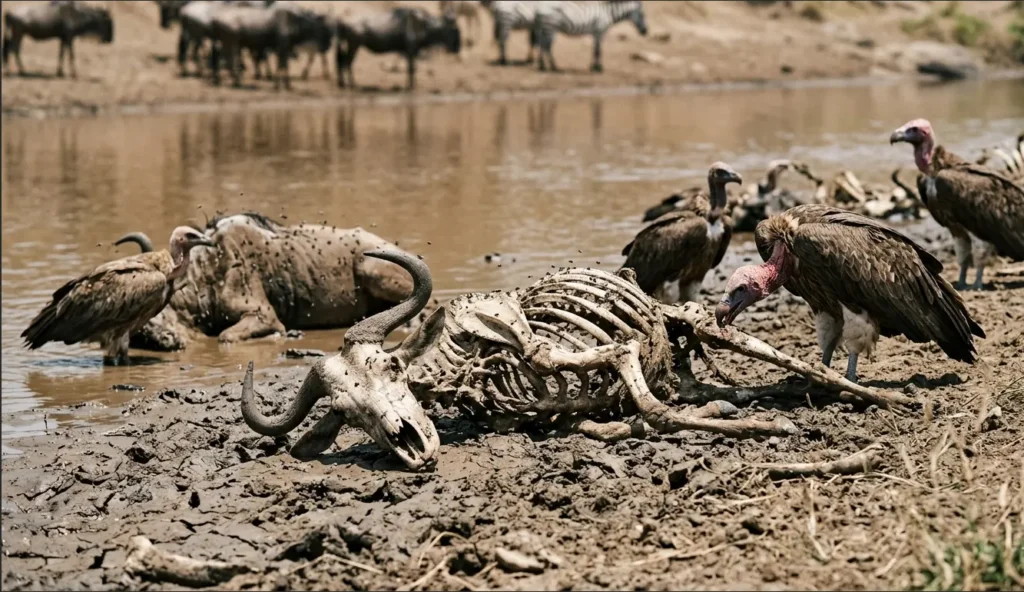
🛡️ OPERATOR INSIGHT: To manage the wait comfortably, we always position our vehicles upwind for meal breaks and strongly advise using heavy-duty insect repellent to handle the riverbank flies. Since you will likely spend hours at a single spot, ensure you have maximized your park time by reviewing our Masai Mara 12-hour permit and park fee guide to avoid costly timing errors at the exit gates.
Even when every signal fires—the scouts stare, the dust wall rises, and the lead animal reaches the mud—the herd may suddenly turn back. This “herd reversal” happens when a lead cow detects a submerged crocodile or a shift in the current that isn’t visible from the bank. We read these moments as deferrals rather than cancellations, as the herd will typically regroup and attempt the jump again within the same afternoon.
Successful sightings are built on the “Patient Principle”: the wild operates on its own schedule, not a tourist itinerary. To ensure you are in the park during the window with the highest frequency of these events, consult our best time for Great Migration Masai Mara timing guide before booking your flights.
Conclusion on Wildebeest Migration River Crossing
The wildebeest migration river crossing in 2026 is not chaos — it is a cascade of readable signals that any visitor can learn to interpret with the right preparation. The four protocols in this guide — agitation reading, the Stare vs Drink rule, the Dust Wall signal, and the Zebra and crocodile indicators — represent the accumulated field observations of a guide who has stood at the Mara River through hundreds of crossing sequences. Evans puts it simply: the herd will tell you what it is going to do. Your job is to learn how to listen.
FAQ — Expert Answers on Wildebeest Migration River Crossing 2026
Why do wildebeest cross the Mara River during the Great Migration?
Wildebeest cross the Mara River during the Great Migration to follow fresh grass on the opposite bank. Their movement is driven entirely by rainfall — when the grass on the Kenya side is grazed down and rain produces fresh growth in Tanzania’s Serengeti, the herd moves back south. The crossing is not a single annual event but a series of to-and-fro movements throughout the July to October window based on where it has rained most recently.
How long do wildebeest wait before crossing the river?
Wildebeest can wait at the Mara River bank for minutes or for up to five hours before a crossing occurs — and sometimes they do not cross at all that day. The waiting period reflects the herd’s collective assessment of river conditions, crocodile threat, and current strength. Scout animals at the water’s edge reading the bank conditions are the most reliable indicator of when the waiting phase will end.
What triggers a wildebeest river crossing?
A wildebeest river crossing is triggered by a combination of signals: scout animals at the bank completing their current and threat assessment, rear herd pressure building and creating a dust wall that removes the lead animal’s ability to retreat, and the presence of a zebra or confident individual completing the bank-entry step. No single trigger exists — it is the convergence of multiple signals reaching a threshold simultaneously.
Do wildebeest cross the Mara River more than once?
Yes — wildebeest cross the Mara River multiple times during migration season, not just once. When it rains on the Tanzania side the herds move back south across the river. When the Mara grass recovers they return north. This to-and-fro pattern means the same crossing point can see multiple crossings in both directions within the same week.
What role do zebras play in wildebeest river crossings?
Zebras have superior eyesight and a calmer individual temperament at the water’s edge. When zebras are present in a mixed herd, if a zebra takes three deliberate steps into the shallows at the crossing point, the wildebeest behind it will interpret this as a safety signal and follow. If the zebras in the group stay back from the water, the wildebeest will typically hesitate regardless of their own assessment signals.
How can you tell if a wildebeest crossing is about to happen?
A wildebeest river crossing is imminent when 5 to 10 scout animals walk to the water’s edge and stare at the opposite bank without drinking. If scouts drink, they are thirsty and no crossing is coming. If they stare without drinking, they are measuring the current. Additional confirmation signals include dust rising from the rear of the herd — the physical pressure building behind the lead animals — and zebras stepping into the shallows.
What is the best time of day to see a wildebeest river crossing?
River crossings can happen at any time of day during migration season, but morning hours — from 6:00 AM to 11:00 AM — produce the highest frequency of crossing attempts in most guide observations. Animals are more active in cooler morning temperatures, predators are still alert from overnight hunting, and the herd movement and agitation signals that precede crossings are easiest to read in clear morning light before the midday heat creates dust haze.