Email:
 Phone:
 WhatsApp:

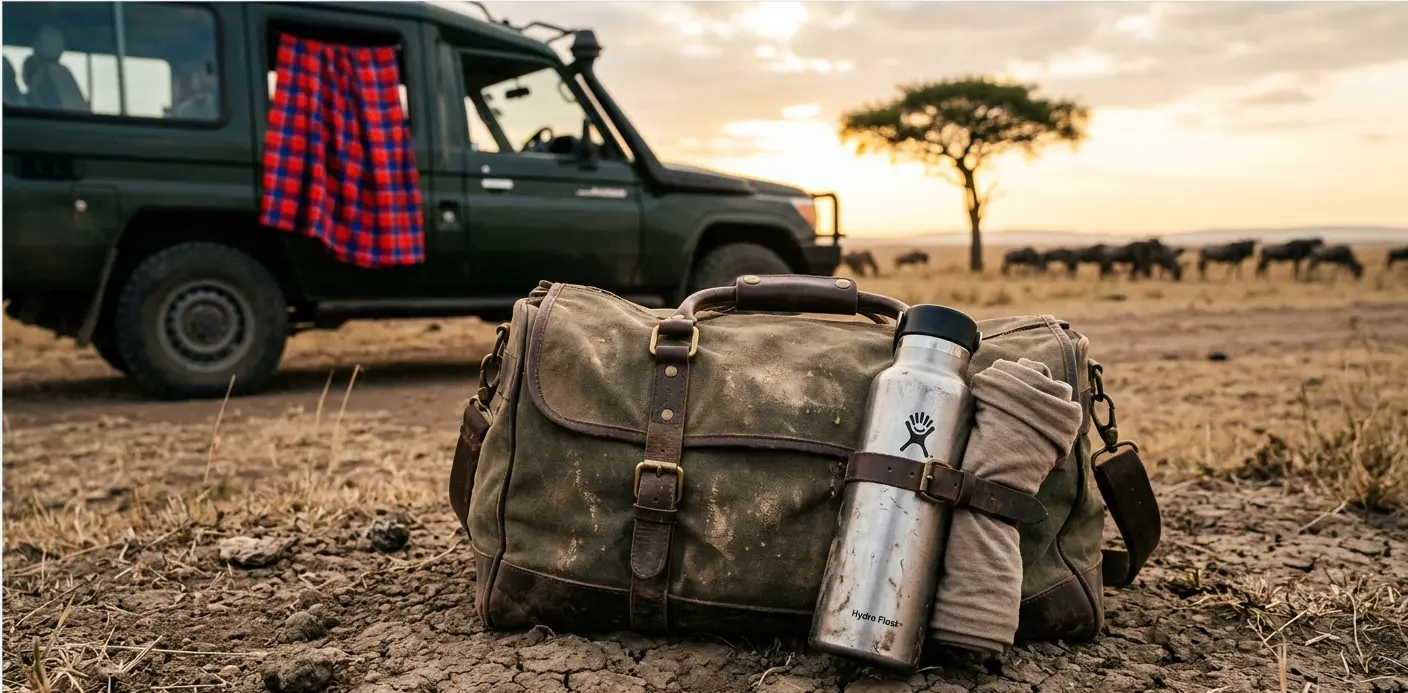
The definitive Masai Mara packing list 2026 is a strategic selection of neutral-toned layers, technical “dust-proof” gear, and a 2026-compliant zero-plastic kit. Essential items are high-SPF protection, a 400mm+ zoom lens, and offline digital entry permits to navigate the new 12-hour national reserve fee rules set by the Narok County Government.
Planning a safari to the world’s most famous reserve in 2026 requires more than just khaki trousers; it requires an understanding of the current “Ground Reality.” Whether you are flying into a luxury camp or embarking on the rugged journey from Nairobi to the park gates, the gear you carry determines your comfort. Most travelers to the Mara arrive via the capital, making the transition from urban asphalt to the dusty savannah a critical factor in your gear selection.
This Masai Mara packing list 2026 is built on current ground data, focusing on the specific logistical shifts that impact travelers right now. We cover the strict zero-plastic safari Kenya audits currently active at the Sekenani and Talek gates and the high-altitude temperature swings of the Mau Escarpment—details that are often overlooked in standard travel checklists but are essential for a smooth 2026 safari experience.
If you are combining your trip with other regions, ensure you’ve also reviewed the ultimate Lake Nakuru safari packing list to synchronize your gear for Kenya’s diverse micro-climates. Below are the 5 critical items 90% of travelers forget, and the technical breakdown of what to wear in Masai Mara to stay ahead of the 2026 regulations.
Quick Navigation: Jump to your Section
The 2026 Reality Check: Why Your Old “Kenya Safari Packing List” is Obsolete
If you are clutching a Kenya safari packing list 2026 that still recommends Ziploc bags for dust protection, you are walking into a logistical trap. While these thin-film plastics were once the “gold standard” for organizing suitcases, they have become a primary target for enforcement at the main entry points. In 2026, the zero-plastic safari Kenya initiative has moved beyond a simple ban on carrier bags to a full forensic audit of traveler luggage at the Sekenani and Talek gates.
Rangers are now actively confiscating non-branded, single-use plastic pouches, even those used for toiletries or electronics, if they lack a permanent, heavy-duty closure. To avoid a frustrating delay or a potential fine at the gate, we recommend replacing all thin-film plastics with TPU (Thermoplastic Polyurethane) clear pouches or silicone compression cubes. These durable, multi-use alternatives are officially recognized as “compliant gear” and offer superior protection against the fine volcanic dust of the Mara Triangle.
🛡️ OPERATOR INSIGHT: The gate audit is not just about bags; it includes the thin plastic sleeves often found on new clothing or high-end electronics packaging. Before you leave your hotel in Nairobi, strip all “disposable” plastic from your gear to ensure a five-minute entry process rather than a thirty-minute luggage search.
Now that we’ve cleared the plastic hurdles at the gate, let’s look at the specific layers you’ll need to survive the dramatic temperature shifts on the road…
The Dawn Departure: Layering for the “Mau Escarpment” Temperature Swing
If you are starting your journey from the capital, your Kenya safari packing list 2026 must account for a 15°C temperature drop as you summit the Mau Escarpment. While the savannah eventually bakes under the equatorial sun, the 6:00 AM departure from Nairobi or Nakuru is deceptively freezing, often requiring a heavy fleece or “softshell” jacket. Understanding what to wear in Masai Mara begins with mastering this high-altitude transition before you ever reach the park gates.
To manage this shift without overpacking, we utilize a “Timeline UX” layering system that mirrors the sun’s trajectory. Start with a moisture-wicking base layer, add a mid-weight insulating fleece for the misty highlands, and top it with a windproof shell to combat the draft in open-sided safari vehicles. By 10:00 AM, as you descend into the Great Rift Valley, you can shed these outer layers to reveal breathable, neutral-toned safari shirts.
⚠️ 2026 ROAD ALERT: The stretch between Limuru and the Mau Summit is notorious for sudden fog and bone-chilling dampness that can seep into poorly sealed luggage.
This technical approach to your Masai Mara packing list 2026 ensures you aren’t shivering during the best photography hours or overheating by noon. With your layers sorted for the transit, let’s look at the specific digital gear needed to navigate the strict new timing rules at the reserve…
The “12-Hour Ticket” Kit: Digital Gear for the New Mara Entry Rules
In 2026, the most critical item on your Masai Mara packing list isn’t physical—it is digital. Unlike the flexible entry systems of the past, the Narok County Government has strictly enforced a 12-hour and 24-hour ticket cycle that begins the exact moment your QR code is scanned at the gate. If your smartphone battery dies or you lose data connectivity while trying to pull up your permit, you risk losing valuable game-viewing time while sitting at the entrance.
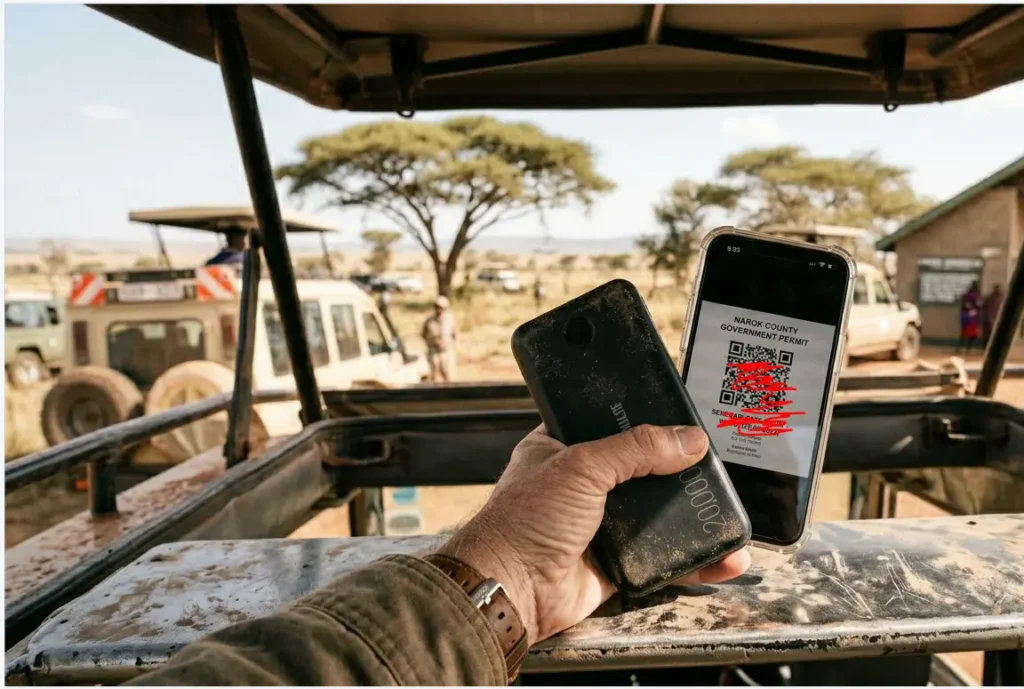
To navigate this, your Kenya safari packing list 2026 must include a high-capacity power bank (minimum 20,000mAh) and a dedicated offline storage strategy for your Narok County Government permits. We recommend taking a high-resolution screenshot of your specific Mara QR codes—distinct from the KWS eCitizen system used elsewhere—or better yet, carrying a physical laminated print-out to overcome screen glare during gate scans. Because network signals at Sekenani and Talek frequently fail under the load of peak morning traffic, rangers cannot verify “proof of payment” via SMS or bank notifications; without a scannable, county-validated QR code, your 12-hour window will vanish while you troubleshoot connectivity.
🛡️ OPERATOR INSIGHT: The 12-hour rule is unforgiving; if you enter at 6:30 AM, your permit expires at 6:30 PM sharp, regardless of whether you spent two hours fixing a puncture. To maximize your investment and avoid “overstay” fines, see our specialized guide on the Masai Mara park fees 12-hour rule to learn how to sync your entry time with your lodge checkout.
With your digital permits secured and your “clock” protected, we can now focus on the physical fabrics required to handle the legendary Mara dust…
Savannah Essentials: Technical Fabrics and the “Dust-Proof” Protocol
While most guides suggest “neutral colors” for the aesthetic, your Masai Mara packing list 2026 needs to prioritize the technical management of the C12 road dust. Mr. Evans Kimojino, a Mara-based wildlife photographer and Hilmuks ground partner with 1,300+ documented wildlife sightings, notes that between Narok and the Sekenani gate, the “black cotton” soil transforms into a fine, alkaline powder that penetrates standard cotton fabrics and can irritate the respiratory system. We recommend packing a high-filament cooling “Buff” or neck gaiter to protect your face during transit, as this is the only effective way to stay comfortable during the two-hour “dust bath” before you reach the conservancy.
When deciding what to wear in Masai Mara, move away from heavy denim or thick flannels in favor of ripstop nylon or technical linen with an SPF rating of 50+. These fabrics allow for maximum airflow during the midday heat while providing a barrier against the abrasive dust that settles on every surface of an open-sided vehicle. For your lower layers, convertible trousers remain the operator’s choice, allowing you to transition from the chilly morning start to the sweltering afternoon savannah without a wardrobe change.
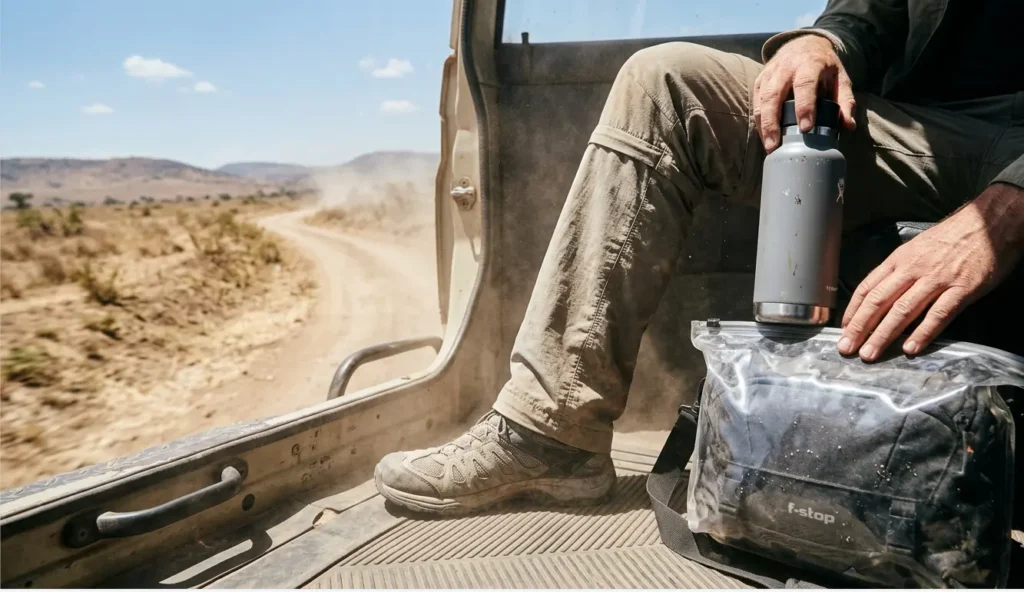
🛡️ OPERATOR INSIGHT: Hydration is governed by the zero-plastic safari Kenya regulations, meaning the old habit of buying a crate of disposable plastic bottles in Nairobi will lead to a gate delay. Pack a high-quality, double-walled vacuum flask like a Yeti or Hydro Flask; not only do these pass the 2026 “Single-Use Audit,” but they also keep your water chilled even when the vehicle’s interior reaches 30°C.
While securing your hydration is a matter of regulation, protecting your electronics is a matter of survival. The same fine dust that necessitates a face buff can be terminal for high-end camera sensors. If you are combining this trip with the alkaline environments of the Rift Valley, see our guide on Lake Nakuru safari photography for the specific dust-proof lens pouches we recommend for high-exposure lakeside settings.
Now that we’ve armored you against the elements of the road, let’s discuss the health and hygiene requirements for the Mara escape…
Health & Hygiene: The High-Altitude Defense
Your Masai Mara packing list 2026 must account for the brutal UV intensity of the equatorial sun, which is amplified at the reserve’s 1,500m elevation. While the breeze feels cooling, the atmosphere is thin, meaning you can sustain a severe burn in under 20 minutes without realizing it. We recommend a high-altitude SPF 50+ mineral sunscreen containing zinc oxide, as it provides a physical barrier that doesn’t break down under intense heat or mix with the heavy dust.
Insect defense in 2026 has moved beyond standard DEET, which many operators find largely ineffective against the aggressive tsetse flies found in the thicker bush. These flies are attracted to dark blue and black movement, and they can bite through thin leggings or tight cotton shirts. The current industry secret is to use a Picaridin-based repellent or the Australian-made RID Tropical Strength, which creates a chemical mask that tsetse flies find much harder to track than traditional mosquito sprays.
Now that we’ve armored your skin against the savannah’s biological challenges, let’s look at the “Heavy Glass” and power strategies needed to capture those high-stakes predator moments…
The Photographer’s Ground Report: Optics & Power in Tented Camps
For the 2026 season, the “Mirrorless Revolution” has officially changed the Masai Mara packing list 2026 requirements. While the new Sony, Canon, and Nikon systems offer incredible animal eye-tracking autofocus, their electronic viewfinders (EVFs) are power-hungry. If you are staying in eco-conscious tented camps that rely on limited solar windows, your power strategy is as critical as your lens choice.
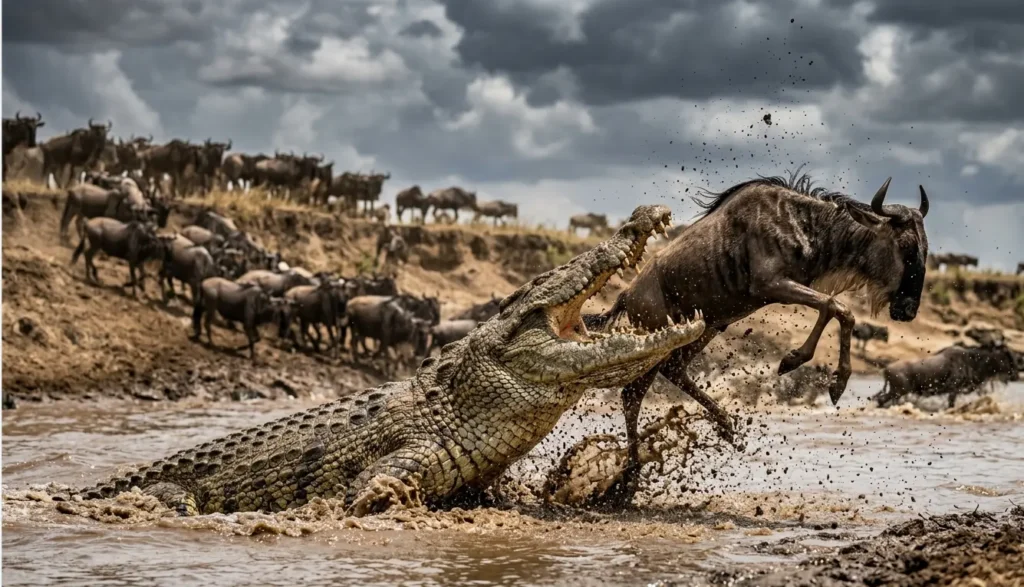
We recommend a minimum of three high-capacity batteries per body. The Mara’s morning chill can cause a 15% drop in lithium-ion efficiency, and a single “Great Migration” river crossing can result in 1,000+ frames in ten minutes, quickly draining a single charge. To stay operational, pack a multi-port USB-C PD charger; this allows you to fast-charge both your camera and power bank simultaneously during the camp’s 6:00 PM – 10:00 PM generator or solar window.
🛡️ OPERATOR INSIGHT: Forget the tripod. Inside a 4×4 safari vehicle, there is no room to spread the legs, and they often annoy other guests if doing a group joining Masai Mara safari. The 2026 operator standard is a pre-filled safari beanbag or a window-mount clamp. These provide the stability needed for 600mm telephoto shots while allowing you to react instantly to a predator’s movement. If you are transitioning from the Rift Valley, remember that the “Mara Dust” is less corrosive than the Lake Nakuru alkaline powder, but it is more “sticky”—keep a rocket blower in your pocket for hourly sensor clearing.
The 2026 “Pro” Glass Kit:
- The Main Workhorse: 100-400mm or 200-600mm Zoom (For the action).
- The Landscape Lens: 24-70mm (For the “Big Sky” Mara horizons).
- The “Silent” Hack: Enable your Electronic Shutter. In 2026, rangers are increasingly strict about vehicle noise; a silent shutter allows you to shoot a hunt from 10 meters away without the “clatter” of a DSLR startling the cats.
Logistical “Logic-Led” Extras: The 2026 Operator Hacks
Your Masai Mara packing list 2026 is incomplete without addressing the behavioral realities of the savannah’s resident primates and shifting weather. Beyond your main luggage, we recommend a “Stealth Snack” protocol using silent silicone bags or reusable beeswax wraps instead of crinkly plastic. The baboons at viewpoints like the Mara River or the main gates are highly habituated to the sound of rustling bags and will aggressively target any visitor they associate with easy calories.
A non-negotiable multi-tool for the 2026 season is the traditional Maasai Shuka. While it serves as a culturally respectful accessory, its true utility lies in its thick, acrylic weave which acts as a windbreaker during 6:00 AM drives and a lap-shield against the dust clouds kicked up by passing vehicles.
Because mobile data signals vanish entirely in the “deep” Mara Triangle and near the Tanzanian border, you must also download the entire region for offline use on Google Maps to serve as a critical safety backup.
⚠️ 2026 ROAD ALERT: While the drive from Nairobi to Mara is relatively straightforward, the 235km transit for those connecting from Lake Nakuru National Park is a notorious “Time Trap” where seasonal washouts can transform a 5-hour journey into an 8-hour gamble. To ensure your vehicle and schedule remain intact if you are linking these two iconic ecosystems, see our report on the Nakuru to Masai Mara distance to understand the current bypasses and the 2026 road conditions.
Now that your logistical extras are sorted for a seamless journey, let’s consolidate everything into a final checklist to ensure you are gate-ready for your departure…
Summary Checklist: Your 2026 “No-Surprise” Masai Mara Packing Kit
Before you zip your bags, use this final 2026 verification to ensure you aren’t caught off-guard by the Mara’s unique jurisdictional rules. This checklist separates the “Survival Must-Haves” required for entry and basic health from the “Comfort Enhancers” that make a 12-hour game drive enjoyable. Use this rapid-fire table for a final 60-second check before leaving for your departure point.
|
Category |
The “Must-Haves” (Gate Ready) |
The “Nice-to-Haves” (Comfort) |
|
Digital |
Offline QR Code (Narok County), Power Bank |
Offline Google Maps, Kenya eTA Copy |
|
Clothing |
Technical Layers, SPF 50+ Buff/Gaiter |
Maasai Shuka, Wide-brimmed Hat |
|
Health |
Malarone Prophylaxis, Mineral Sunscreen |
Picaridin Repellent, Rehydration Salts |
|
Optics |
400mm+ Lens, 3x Spare Batteries |
Silicone Lens Sleeve, Beanbag |
|
Utility |
Reusable Insulated Flask (Non-Plastic) |
“Stealth” (No-Crinkle) Snack Bags |
🛡️ OPERATOR INSIGHT: Do not forget that in 2026, the Narok County rangers strictly enforce the 12-hour ticket exit policy. If you find yourself cutting it close, see our guide for a 3-Day Masai Mara Safari from Nairobi to see how we structure our itineraries to avoid late-exit fines and “manual verification” delays at the gate.
If your journey doesn’t end in the Mara and you are continuing your circuit into the Great Rift Valley, you’ll need a few more specialized tools to combat the “Alkaline Mirror” effect. To learn more about how to protect your eyes and gear from the corrosive soda dust unique to the Rift Valley lakes, see our Lake Nakuru Safari Packing List to ensure you are ready for the shifting micro-climates of the lakeshore.
Now that your gear is locked and your permits are saved offline, you are ready to experience the raw beauty of the Mara with the confidence of a seasoned operator.
FAQs: Masai Mara Packing List 2026
Does my Masai Mara packing list 2026 need specialized gear for the Nairobi transit?
Yes, you must pack a high-filament neck gaiter and a 20,000mAh power bank for this 6-hour journey. The final stretch to the Sekenani gate is an alkaline “dust bath” that penetrates standard cotton, while the new 2026 digital permit system requires a fully charged, offline-ready phone to avoid losing your 12-hour park entry window at the gate.